FMIS Software
  • Home
  • Solutions
    • Fixed Asset Management Systems
      • Capital Projects
      • Enterprise Asset Management
      • Fixed Asset Management Software
    • Asset Tracking
      • Barcode Tracking
      • FMIS Mobile Asset Manager
    • Purchase to Pay
      • Purchase Order Processing
      • Sales Order Processing
    • Stock and Inventory
      • Kitting and Assembly
      • Material Requirements Planning (MRP)
      • Production Control
    • Equipment Maintenance
      • Field Service Management
    • Lease Accounting
      • Order Management
  • Market Sectors
    • Commercial and Retail
    • Education
    • Government
    • Health
    • Manufacturing
    • Non-Profit
    • Oil, Gas and Energy
  • Partners
    • Deltek
    • Find a partner
    • Become a Partner
  • Resources
    • Trust Centre
    • News and articles
    • Case studies
    • Fixed asset management guide
  • About us
  • Contact
    • Request a demo
    • Pricing
    • Product information
    • Customer Support
    • Careers
    • Training Feedback
  • Click to open the search input field Click to open the search input field Search
  • Menu Menu
You are here: Home1 / Solutions2 / Asset Tracking3 / Barcodes vs RFID in Asset Tracking

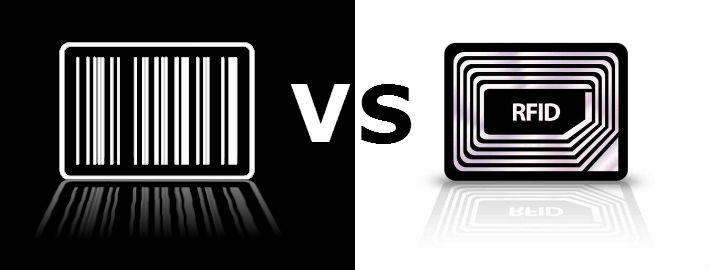
Barcodes or RFID: Choosing the best option for asset tagging?

Written by: John de Robeck • Published: December 9, 2015 • Updated: March 10, 2026

For a long time barcodes have been the default technology for asset tracking and management software. In recent times, the rise of Radio Frequency Identification technology (RFID) has challenged this dominance. Both have benefits and drawbacks, so which option offers the best option for your project?

Predictably, the answer depends on a number of factors. Here we have a quick look at some of the most common questions we get asked and summarise the strengths and weaknesses of both barcode and RFID systems.

Asset Tracking and Telematics 2022, the UK’s leading event in this rapidly growing field, offers valuable insights into the latest innovations.

Barcodes vs RFID at a glance

BarcodesRFID Tags
CostBarcode scanners and labels are usually the cheaper option.✓✗
Getting startedThe compexity of hardware selection and encoding can make RFID harder to implement.✓✗
AccuracyBoth technologies have strengths and weaknesses here depending on the environment and application.✓✓
RangeRFID often has a superior scanning range and does not require a direct line of sight.✗✓
Data storageRFID tags can hold a lot of data although this often isn’t necessary when the data is stored centrally via your software.✗✓
SpeedRFID allows a higher read rate than barcodes.✗✓
UniversalityBarcodes are largely universal, but RFID frequencies and types vary across applications and regions.✓ ✗
  • Barcodes
     
  • Barcoding is simpler and easier to set-up than RFID. Unless you actually need the additional functionality offered by RFID then stick to barcodes. Barcoding can be applied to most environments and heavy duty labels provide a viable option for the harshest of environments.
  • RFID
     
  • RFID does offer something extra, but many companies simply use it to do the same job as a barcode but at a higher price. RFID asset tags can be very helpful when assets are not easily accessible e.g. components within a sealed unit or where the location of the asset is only approximately known.

Barcodes: The Good

  • Barcodes are cheaper. Barcode labels require no encoding and are printed directly onto the label making the labels cheaper to print. The scanners are normally cheaper than the equivalent RFID readers.
  • Barcodes are universally scannable anywhere in the world.
  • Barcode tags are flatter and lighter than RFID tags and therefore easier to use.
  • Labels can be placed on any material without interfering with scanning accuracy.
  • Overall scanning accuracy for barcodes is often higher than RFID.
  • Barcodes do not store data about the asset directly on the label so asset records cannot be corrupted or lost.

Barcodes: The Bad

  • Barcode scanners need a direct line of sight to the label to be able to read the code.
  • In addition to a direct line of sight, most barcode scanners have a limited scanning range.
  • Most barcodes only carry the unique asset id and cannot hold additional data. They are read only labels.
  • Assets or inventory will need to be scanned individually.
  • Paper or vinyl barcode labels are more easily damaged than RFID tags.

RFID: The Good

  • RFID tags don’t require a direct line of sight.
  • Some asset management applications can read multiple tags at the same time.
  • RFID tags can hold a lot more data such as maintenance records, warranty information or product specifications.
  • RFID tags are read/write devices allowing you to alter the data held on the tag with the right hardware.
  • RFID tags have more security for the data they hold. It can be encrypted or password protected.
  • RFID tags are more rugged than standard vinyl labels although hard-wearing plastic or metal barcode labels are available.
  • RFID tags can have barcodes printed onto their surface as a back-up in case of damage or corruption.

RFID: The Bad

  • RFID tags use microchips and encoding data onto them can make them more expensive.
  • The wide range of different readers and tags can make hardware selection complicated especially as many will only work with certain frequencies or types of RFID system.
  • Separate RFID readers are required to scan read only and read/write tags.
  • RFID readers struggle to read data when passing through metal or liquid.
  • Reader and tag collision may occur where multiple signals from different readers overlap or when numerous tags respond at the same time.
Share this post
  • Share on Facebook
  • Share on X
  • Share on WhatsApp
  • Share on Pinterest
  • Share on LinkedIn
  • Share on Tumblr
  • Share on Reddit
  • Share by Mail

G-Cloud 15 - Government Commercial Agency Supplier logo

FMIS awarded G-Cloud 15 supplier status

August 12, 2026
FMIS Asset Management Software awarded G-Cloud 15 Supplier Status for Fixed Asset Management, Lease Accounting, Asset Tracking & Equipment Maintenance software.
https://www.fmis.co.uk/wp-content/uploads/2026/08/GCA-Supplier-logo-G-cloud-15-500px.webp 500 500 John de Robeck https://www.fmis.co.uk/wp-content/uploads/2026/04/FMISNavyTeal-1-150x80-1.webp John de Robeck2026-08-12 16:28:312026-08-17 14:18:48FMIS awarded G-Cloud 15 supplier status
UK public-sector indexation

Indexation in UK Public Sector Fixed Asset Accounting

April 15, 2026
Understanding how indexation fits alongside revaluation is now essential for finance teams managing non-current assets in the public sector.
https://www.fmis.co.uk/wp-content/uploads/2026/03/UK-public-sector-indexation.webp 1024 1536 John de Robeck https://www.fmis.co.uk/wp-content/uploads/2026/04/FMISNavyTeal-1-150x80-1.webp John de Robeck2026-04-15 11:59:412026-04-15 11:59:44Indexation in UK Public Sector Fixed Asset Accounting
Non-Current Assets vs Fixed Assets In the UK public-sector

Why the UK Public Sector Is Moving from Fixed Assets to Non Current Assets

March 20, 2026
Why is the UK public sector shifting to non-current assets, and how does FMIS software enhance control and compliance?
https://www.fmis.co.uk/wp-content/uploads/2026/03/Non-Current-Assets-vs-Fixed-Assets.webp 500 500 Vicky Stanley https://www.fmis.co.uk/wp-content/uploads/2026/04/FMISNavyTeal-1-150x80-1.webp Vicky Stanley2026-03-20 15:49:272026-03-20 15:54:11Why the UK Public Sector Is Moving from Fixed Assets to Non Current Assets
FRS 102 Fixed Assets

FRS 102 Fixed Asset Accounting: A Practical Guide for UK Businesses

June 20, 2025
https://www.fmis.co.uk/wp-content/uploads/2025/06/Feature-image-495x400-copy.webp 400 495 John de Robeck https://www.fmis.co.uk/wp-content/uploads/2026/04/FMISNavyTeal-1-150x80-1.webp John de Robeck2025-06-20 15:08:202026-03-10 10:56:00FRS 102 Fixed Asset Accounting: A Practical Guide for UK Businesses
Capital Expenditure Tariffs and Fixed Assets

How Tariffs Are Transforming Capital Expenditure Strategy

May 14, 2025
https://www.fmis.co.uk/wp-content/uploads/2025/04/Capital-Expenditure-Tariffs-495x400-1.webp 400 495 John de Robeck https://www.fmis.co.uk/wp-content/uploads/2026/04/FMISNavyTeal-1-150x80-1.webp John de Robeck2025-05-14 16:20:132026-03-31 11:34:07How Tariffs Are Transforming Capital Expenditure Strategy
Asset Management vs Asset Tracking

Asset Management vs Asset Tracking – What is the Difference?

September 29, 2022
Barcode Asset Tracking

What is Barcode Asset Tracking

October 3, 2022
Web Based Asset Tracking

Why Use Web-Based Asset Tracking?

September 29, 2022
Asset Tracking and Telematics event 2022

Asset Tracking and Telematics 2022

June 7, 2022
Support Icon
Can we help?
Book a demo View products Contact support
Or call: +44 (0) 1227 773003
Mon–Fri, 9:00–17:00 (BST/GMT)

Explore More

  • FMIS awarded G-Cloud 15 supplier status
  • Indexation in UK Public Sector Fixed Asset Accounting
  • Why the UK Public Sector Is Moving from Fixed Assets to Non Current Assets
  • Preparing for Charities SORP Lease Accounting Changes 2026
  • FRS 102 lease accounting changes 2026: what UK organisations need to know

SOLUTIONS

  • Fixed Asset Management Systems
  • Asset Tracking
  • Purchase to Pay
  • Order Management
  • Equipment Maintenance
  • Lease Accounting
  • Stock and Inventory
  • View all solutions

Home › Barcodes vs RFID in Asset Tracking

Market Sectors

  • Commercial and Retail
  • Education
  • Local and Central Government
  • NHS and Health
  • Manufacturing
  • Non-profit
  • Oil, Gas and Energy

FOLLOW US

FMIS Twitter FMIS Linkedin

CONTACT US

FMIS Ltd
167b John Wilson Business Park
Whitstable
Kent
CT5 3RA
United Kingdom

Phone:+44 (0) 1227 773003
Fax:+44 (0) 1227 773005
Sales:sales@fmis.co.uk
Support:support@fmis.co.uk

Copyright © 2024 - All rights reserved www.fmis.co.uk
  • Privacy Policy
  • Cookie Policy
Link to: Lean asset management in manufacturing Link to: Lean asset management in manufacturing Lean asset management in manufacturingLean Asset Management Link to: FMIS Turns 30 Link to: FMIS Turns 30 FMIS Turns 30FMIS Turns 30
Scroll to top
We use cookies on our website to give you the most relevant experience by remembering your preferences and repeat visits. By clicking “Accept All”, you consent to the use of ALL the cookies. However, you may visit "Cookie Settings" to provide a controlled consent.
Cookie SettingsAccept All
Manage consent

Privacy Overview

This website uses cookies to improve your experience while you navigate through the website. Out of these, the cookies that are categorized as necessary are stored on your browser as they are essential for the working of basic functionalities of the website. We also use third-party cookies that help us analyze and understand how you use this website. These cookies will be stored in your browser only with your consent. You also have the option to opt-out of these cookies. But opting out of some of these cookies may affect your browsing experience.
Necessary
Always Enabled
Necessary cookies are absolutely essential for the website to function properly. These cookies ensure basic functionalities and security features of the website, anonymously.
CookieDurationDescription
cookielawinfo-checkbox-advertisement1 yearSet by the GDPR Cookie Consent plugin, this cookie is used to record the user consent for the cookies in the "Advertisement" category .
cookielawinfo-checkbox-analytics11 monthsThis cookie is set by GDPR Cookie Consent plugin. The cookie is used to store the user consent for the cookies in the category "Analytics".
cookielawinfo-checkbox-functional11 monthsThe cookie is set by GDPR cookie consent to record the user consent for the cookies in the category "Functional".
cookielawinfo-checkbox-necessary11 monthsThis cookie is set by GDPR Cookie Consent plugin. The cookies is used to store the user consent for the cookies in the category "Necessary".
cookielawinfo-checkbox-others11 monthsThis cookie is set by GDPR Cookie Consent plugin. The cookie is used to store the user consent for the cookies in the category "Other.
cookielawinfo-checkbox-performance11 monthsThis cookie is set by GDPR Cookie Consent plugin. The cookie is used to store the user consent for the cookies in the category "Performance".
CookieLawInfoConsent1 yearRecords the default button state of the corresponding category & the status of CCPA. It works only in coordination with the primary cookie.
PHPSESSIDsessionThis cookie is native to PHP applications. The cookie is used to store and identify a users' unique session ID for the purpose of managing user session on the website. The cookie is a session cookies and is deleted when all the browser windows are closed.
viewed_cookie_policy11 monthsThe cookie is set by the GDPR Cookie Consent plugin and is used to store whether or not user has consented to the use of cookies. It does not store any personal data.
Functional
Functional cookies help to perform certain functionalities like sharing the content of the website on social media platforms, collect feedbacks, and other third-party features.
Performance
Performance cookies are used to understand and analyze the key performance indexes of the website which helps in delivering a better user experience for the visitors.
Analytics
Analytical cookies are used to understand how visitors interact with the website. These cookies help provide information on metrics the number of visitors, bounce rate, traffic source, etc.
CookieDurationDescription
CONSENT2 yearsYouTube sets this cookie via embedded youtube-videos and registers anonymous statistical data.
_ga2 yearsThe _ga cookie, installed by Google Analytics, calculates visitor, session and campaign data and also keeps track of site usage for the site's analytics report. The cookie stores information anonymously and assigns a randomly generated number to recognize unique visitors.
_gat_UA-48954022-11 minuteA variation of the _gat cookie set by Google Analytics and Google Tag Manager to allow website owners to track visitor behaviour and measure site performance. The pattern element in the name contains the unique identity number of the account or website it relates to.
_gid1 dayInstalled by Google Analytics, _gid cookie stores information on how visitors use a website, while also creating an analytics report of the website's performance. Some of the data that are collected include the number of visitors, their source, and the pages they visit anonymously.
Advertisement
Advertisement cookies are used to provide visitors with relevant ads and marketing campaigns. These cookies track visitors across websites and collect information to provide customized ads.
CookieDurationDescription
VISITOR_INFO1_LIVE5 months 27 daysA cookie set by YouTube to measure bandwidth that determines whether the user gets the new or old player interface.
YSCsessionYSC cookie is set by Youtube and is used to track the views of embedded videos on Youtube pages.
yt-remote-connected-devicesneverYouTube sets this cookie to store the video preferences of the user using embedded YouTube video.
yt-remote-device-idneverYouTube sets this cookie to store the video preferences of the user using embedded YouTube video.
Others
Other uncategorized cookies are those that are being analyzed and have not been classified into a category as yet.
SAVE & ACCEPT
Powered by CookieYes Logo