FRS 102 guidance for finance teams

FRS 102 Lease Accounting Guide: Section 20

Apply revised FRS 102 Section 20 with clear decisions on exemptions, lease terms, discount rates, transition and reporting.

For accountants and financial controllers applying the revised lessee requirements. This FRS 102 Lease Accounting Guide focuses on Section 20 judgements and transition, with links to the main lease accounting guide for the wider accounting process.

Content owner: Alex Clements · Sources checked 10 October 2026 · About 15 minutes to read

Covers revised Section 20 and the associated Section 1 transition provisions. It assumes a working knowledge of financial accounting and focuses on property and equipment leased by your organisation.

FRS 102 Lease Accounting Guide covering Section 20 — FMIS Guides illustration

What revised Section 20 changes, and when it applies

Revised FRS 102 Section 20 brings most lessee arrangements onto the balance sheet. The former operating and finance lease distinction no longer determines lessee recognition: a non-exempt lease gives rise to a right-of-use asset and lease liability. Lessors continue to classify leases as operating or finance. [1]

The requirements apply to accounting periods beginning on or after 1 January 2026, unless adopted early. A year ending during 2026 does not by itself establish that the revised rules apply. Early adoption of the Periodic Review 2024 changes requires the relevant amendments to be applied together. [2]

Start with your reporting period

For a 31 December year-end, the first mandatory period is normally 1 January to 31 December 2026. For a 30 June year-end, it is normally 1 July 2026 to 30 June 2027. Record the applicable basis against each entity before preparing opening balances.

Small entities applying Section 1A use the same recognition and measurement requirements, with a different disclosure framework. Entities applying FRS 105 use that standard instead. Confirm the reporting framework rather than assuming that company size establishes an exemption. [3]

For the wider process, including lease records, calculations and journals, use our main lease accounting guide. This guide concentrates on Section 20 decisions and the associated Section 1 transition provisions.

Which arrangements and exemptions need assessment?

Look beyond agreements labelled as leases. A contract may contain a lease where the customer controls the use of an identified asset, obtaining substantially all its economic benefits and directing its use. Review equipment and service agreements as well as property contracts. [4]

Where a supplier can substitute equipment, examine whether that right is substantive rather than assuming that a named asset establishes a lease. Capture the relevant contractual rights in the assessment file.

Lease and service components

Normally, separate lease components from services and allocate consideration using relative stand-alone prices. Section 20.33 permits an election, by class of underlying asset, to combine a lease component and its associated non-lease components. This can simplify administration while increasing the amount measured as a lease. [4]

Keep the contract analysis separate from the calculation file. For an equipment agreement with maintenance, record what is being leased, what service is supplied, the allocation evidence and any election. The reviewer should be able to follow the decision without rebuilding the schedule.

Short-term and low-value recognition exemptions

Recognition exemptions under revised Section 20
Exemption Assessment and application
Short-term lease Lease term of 12 months or less at commencement, with no purchase option. Apply the election by class of underlying asset.
Low-value underlying asset Assess the underlying asset’s value on an absolute basis. Apply the exemption lease by lease. Section 20 specifies no monetary threshold; vehicles, land, buildings and production line equipment are among the examples that are not low value.

Where an exemption is taken, recognise payments as an expense over the lease term on a straight-line or other representative systematic basis. The exemption concerns balance-sheet recognition, rather than removing all reporting requirements. [5]

Document how your assessment treats borderline assets. A low annual rental or a small portfolio is not a substitute for assessing the underlying asset. Keep exempt agreements in a register so that expenses, commitments and subsequent changes remain visible to finance.

The low-value exemption also has restrictions: the lessee must be able to benefit from the asset independently or with readily available resources, and a head lease does not qualify where the asset is subleased or expected to be subleased. [6]

Determining the lease term and payments

Break clauses, extensions and rolling arrangements

The term includes the non-cancellable period and option periods that meet the reasonably-certain assessment. Consider enforceability, economic penalties, operational dependence and leasehold improvements. A rolling agreement is not automatically a short-term lease: analyse the enforceable period and cancellation rights. [6]

Scenario: a property lease with a break clause

A company leases a fitted-out warehouse for ten years, with a break at year five. Finance should obtain the break terms and management’s documented assessment of continued occupation. Significant fit-out costs and operational reliance may influence that assessment. Choosing five years simply because a break exists leaves the accounting judgement unexplained.

Capture the approved term, assessment date and evidence owner alongside the contract. Review the judgement when relevant circumstances change, rather than extending the schedule automatically whenever the operational team updates an expected departure date.

Which payments belong in the liability?

Include unpaid fixed and in-substance fixed payments, net of incentives receivable; index- or rate-dependent payments at the commencement-date index or rate; expected residual guarantee payments; and relevant purchase-option or termination payments. Do not forecast future CPI increases into the initial liability. Turnover-based payments that do not depend on an index or rate are generally excluded from that measurement. [7]

Fixed contractual increases differ from future index movements. Tag each payment type in the register and preserve the original contract wording. A generic annual-increase field can conceal differences that matter to initial measurement and later remeasurement.

Use the master guide’s key terms and judgements section for the broader terminology.

Choosing and evidencing the discount rate

Use the interest rate implicit in the lease if readily determinable. Otherwise, FRS 102 permits a lease-by-lease choice between the incremental borrowing rate and obtainable borrowing rate. The obtainable borrowing rate reflects borrowing an amount comparable to total undiscounted lease payments over a comparable term; it is not simply the interest rate on any existing loan. [8]

A public benefit entity unable readily to determine the implicit, incremental or obtainable borrowing rate uses the rate otherwise obtainable on deposits with financial institutions. This conditional provision is not a general election for all organisations. [9]

Evidence to retain

Record the rate type, valuation date, relevant term and borrowing amount, source evidence, adjustments and approval. A bank quotation can be useful evidence for an obtainable borrowing rate, but finance should establish that the quoted terms match the accounting assessment.

Give the reviewer both the rate and the reasoning. If a portfolio approach is used, document why its leases have sufficiently similar characteristics. Avoid using a single convenient rate across entities, currencies and terms without an assessment.

The distinction matters when consolidating information from different reporting bases. A rate approved for an IFRS 16 schedule should not be labelled as a FRS 102 obtainable borrowing rate without checking the basis of its calculation.

Initial and subsequent measurement

At commencement, measure the liability as the present value of unpaid lease payments. The right-of-use asset starts with that liability, adjusted for payments made at or before commencement, incentives received, qualifying initial direct costs and restoration obligations. Section 20 also addresses incoming resources from grants or non-exchange transactions. [7] [9]

Subsequently, interest increases the liability and payments reduce it. Account separately for depreciation, impairment and any remeasurement. The depreciation period depends on the lease terms, including ownership transfer and purchase-option assessments. [10]

Keep three dates distinct in the register: contract inception, commencement and initial application. A signed agreement, an asset becoming available for use and an opening transition balance can represent different events. Put the relevant date on every schedule and journal export.

The master guide provides a general calculation and journal example. Its worked example uses IFRS 16; the FRS 102 transition example below has a different purpose and starting point.

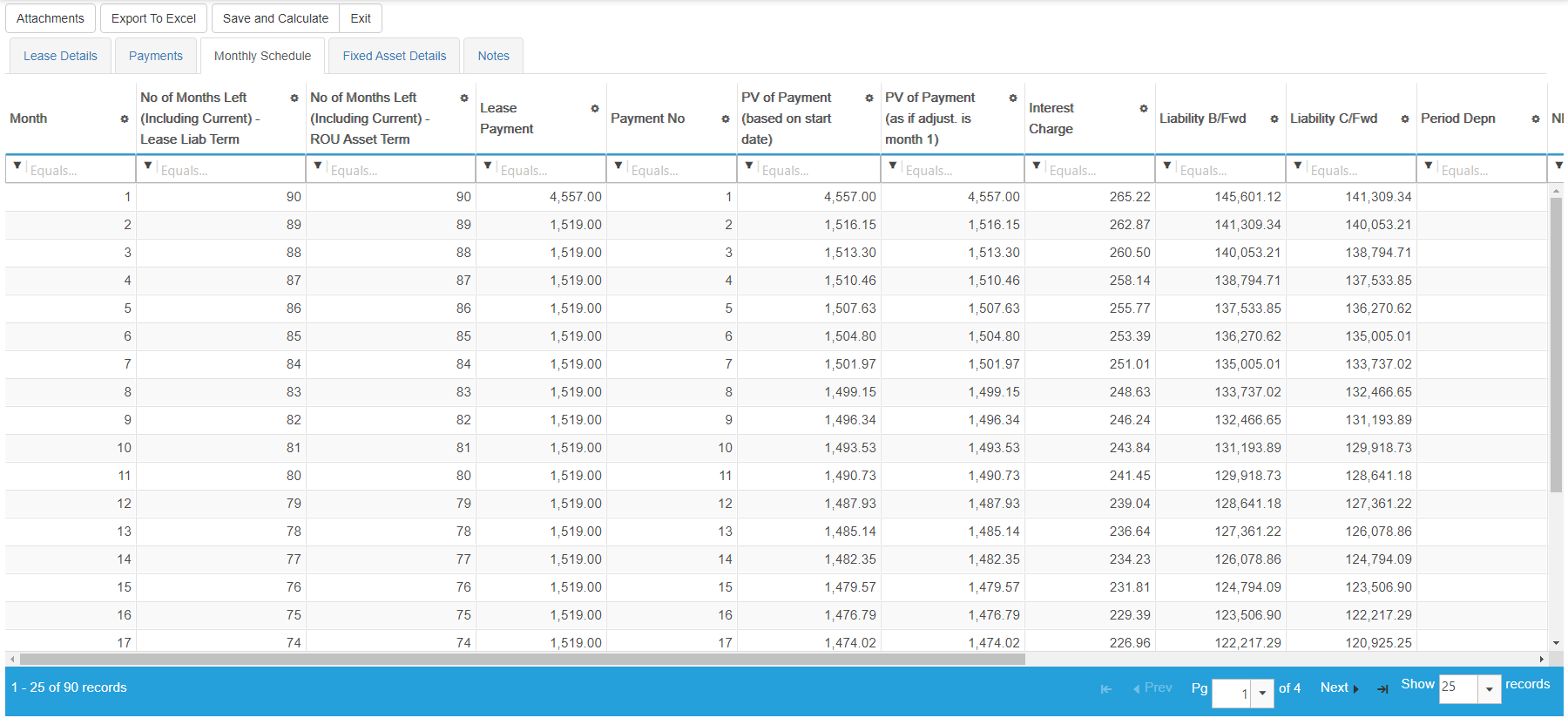
FMIS monthly lease schedule showing payments, interest and opening and closing lease liability balances
Review the monthly liability movement when applying FRS 102 Section 20: interest increases the balance and lease payments reduce it. This existing FMIS screen illustrates the output, rather than the figures in the transition example below. Select the screenshot to enlarge it.

Transition to revised Section 20

Apply the modified retrospective approach: recognise the cumulative effect at the date of initial application in opening equity and do not restate comparatives. For previous operating leases, normally measure the liability using remaining payments and a transition-date incremental or obtainable borrowing rate. Measure the right-of-use asset from that liability, adjusting for prepaid or accrued rent and other applicable transition items. Previous finance leases normally carry forward their existing asset and liability amounts. [2]

Section 1.48 permits qualifying IFRS 16 group-reporting carrying amounts to be used instead of the normal transition calculations. That route applies to all leases and requires disclosure. It is not permission to substitute any available IFRS 16 spreadsheet. [11]

Practical expedients need recorded decisions

The available expedients include retaining previous lease-identification assessments, a rate for similar leases, certain onerous-lease assessments, hindsight for lease terms and treating leases ending within 12 months of initial application like short-term leases. Some operate lease by lease; the identification expedient applies to all contracts. Record each election and its scope. [2]

Create a transition decision log before importing balances. Give each election an owner, approval date and affected population. Reconcile the previous commitments register to agreements recognised, exempted, expired or otherwise excluded, explaining each category.

Worked example: a previous operating lease with prepaid rent

A company first applies the revised requirements on 1 January 2026. A property lease has three years remaining, with £12,000 payable at each year-end. Finance has approved a 6% transition-date obtainable borrowing rate. The previous balance sheet includes £2,000 of prepaid rent relating to this lease, separate from the remaining payments.

Assume no impairment, onerous provision, non-exchange element or other transition adjustment. This is a simplified illustration, not a market-rate recommendation. Amounts are calculated using unrounded balances and displayed to the nearest pound.

Transition calculation at 1 January 2026
Item Amount
Present value: £12,000 ÷ 1.06 + £12,000 ÷ 1.06² + £12,000 ÷ 1.06³ £32,076
Prepaid rent added to right-of-use asset £2,000
Opening right-of-use asset £34,076

On smaller screens, scroll within the table to see all columns.

Opening transition journal
Account Debit Credit
Right-of-use asset £34,076 —
Lease liability — £32,076
Prepaid rent — £2,000

There is no opening-equity adjustment in this fact pattern. The £2,000 difference between the asset and liability clears an existing prepayment; it is not a new charge to reserves. Other transition circumstances can affect equity.

For 2026, interest is £1,925 and the £12,000 payment leaves a liability of £22,001. Assuming straight-line depreciation over the remaining three years, depreciation is £11,359 and the closing asset is £22,717. Check that the prepaid-rent balance is removed so that it is not also released separately to expense.

Rent reviews, reassessments and modifications

A payment change under the original contract, such as a CPI review, differs from a negotiated modification. First classify the event; then determine whether to remeasure, recognise a separate lease or adjust the existing asset and liability. This avoids applying one generic recalculation rule to every change. [12]

For remeasurement arising from an index or rate change, normally retain the original discount rate. A change in floating interest rates requires a revised rate reflecting that change. Lease-term and purchase-option reassessments follow the revised-rate requirements in Sections 20.66–20.67. [12]

Start by identifying the type of change
Event Main question
Contractual rent review Has the index or rate change altered contractual cash flows? Consider remeasurement under the reassessment rules.
Change to extension assessment Has a qualifying change altered the approved lease term or purchase-option assessment?
Negotiated additional premises Does the extra right of use and pricing meet the separate-lease criteria?
Negotiated reduction or termination What scope is removed, and how should the asset reduction and any gain or loss be recorded?

FRS 102 allows an unchanged discount rate for certain modifications: insignificant additional consideration; a scope reduction with a commensurate price reduction; or reduced consideration with no removal of underlying assets. These are specific concessions, not a general rule. Check Sections 20.71–20.73 and the associated disclosure. [13]

Scenario: a negotiated rent reduction

The landlord agrees to lower rent for the remaining term without removing the right to use any premises. Finance should assess the unchanged-rate concession and record the chosen treatment. Preserve both the approved original schedule and the revised version, with the agreement and effective date.

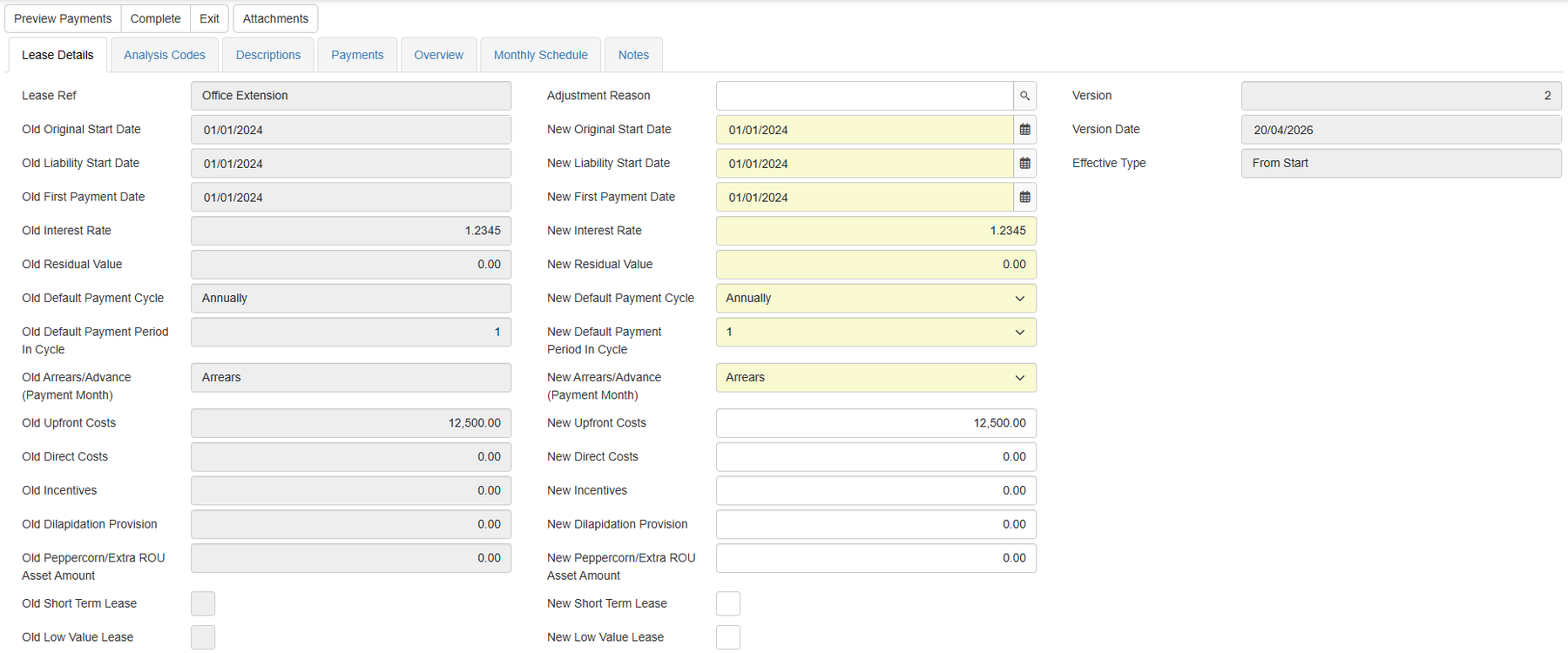
FMIS lease adjustment screen comparing existing and revised lease terms
Compare existing and revised lease terms after approving the accounting treatment of a change. The screen supports review of the adjustment; finance determines whether it is a reassessment, modification or separate lease under Section 20. Select the screenshot to enlarge it.

Presentation, disclosures and first-year reporting

For entities applying the full Section 20 disclosures, prepare the information below. Check the complete requirements against your arrangements; the list is a planning aid. [3]

  • Significant leasing arrangements, unrecognised exposures and relevant restrictions or covenants.
  • Discount-rate types and the share of the liability measured using each type.
  • Relevant expedients, including unchanged-rate modification disclosures.
  • Interest, exempt-lease expenses, other variable payments, sublease income and total cash outflows.
  • Right-of-use asset movements and gross carrying amounts and depreciation by class.
  • Commitments for exempt short-term and low-value leases in the specified time bands.

Section 1A requires its own disclosure assessment; its recognition and measurement requirements remain those of Section 20. Do not assume that every full-standard note is mandatory for a small entity, or that no leasing disclosure is needed. [3]

Build the disclosure data into the register from the start. Identifying the rate type, exemption status and asset class at year-end can be much harder if those fields were omitted during transition. Review the source of each note figure with the person preparing the financial statements.

First-year reporting also needs a clear explanation of transition and the relevant policy-change disclosures. Comparatives remain on the previous lease basis. Explain the effect on reported performance before interpreting changes in EBITDA, gearing or covenant measures. [11] [14]

Use our general period-end checklist for reconciliation and review controls. The source references here identify the FRS 102 requirements to assess alongside it.

Less common arrangements

Intra-group occupation: establish which entity has enforceable rights and obligations, rather than turning every internal recharge into a lease. Keep legal-entity accounting distinct from consolidation eliminations. [8]

Peppercorn and below-market arrangements: nominal consideration may mean an arrangement does not meet the lease definition. Where a lease exists, examine any grant or non-exchange element under the relevant sections. Avoid treating all such arrangements as either exempt leases or conventional commercial leases. [9]

Subleases: assess the head lease and sublease separately. Intermediate lessor classification can differ from the lessee treatment of the head lease. [15]

Investment property and sale-and-leaseback: these have additional measurement or transition requirements. Route them for specific technical review before including them in the standard import population. The general property-lease example above does not address these arrangements. [11]

Charities should also consider the applicable SORP. Our Charities SORP 2026 lease accounting article provides additional context.

Practical review checklist

  • Confirm the framework, reporting period and initial application date for each entity.
  • Reconcile the agreement population and assign a reason to every exclusion.
  • Approve lease terms, payment types, exemptions and component elections.
  • Retain rate evidence and record whether it is implicit, incremental, obtainable or an applicable PBE deposit rate.
  • Document transition elections and reconcile opening journals to the previous ledger.
  • Remove prepaid/accrued balances dealt with in transition to avoid duplicate accounting.
  • Review changes before updating calculations and preserve the previous approved version.
  • Reconcile the register, schedules, ledger and disclosure outputs.
  • Explain first-year comparability and review contracts linked to reported measures.

Assign responsibility for contract updates as well as accounting review. A complete opening register can still become unreliable if rent reviews, breaks or new agreements reach finance too late. Use a regular handover with property and operational owners.

Common FRS 102 questions

Portfolio size does not establish a recognition exemption. Assess the relevant agreement and underlying asset. A small number of property or vehicle leases can still require on-balance-sheet accounting.

Only use a shared rate where the applicable portfolio approach is justified. Record the population, its characteristics and the evidence supporting the rate. A single rate chosen for convenience leaves the judgement unsupported.

No. In the prepaid-rent example, the difference between the opening asset and liability clears an existing balance. Examine the complete transition journal rather than treating every asset/liability difference as a charge to equity.

It is a starting point for identifying agreements, rather than a complete calculation dataset. Obtain payment dates, remaining terms, options, incentives, services and rate evidence. Reconcile the commitments population to the approved register.

Use it to understand the general mechanics. Transition has its own measurement date, elections and treatment of existing balances. Use the transition section of this guide and the relevant Section 1 provisions when preparing opening journals.

Managing the accounting process with FMIS

FMIS Lease Accounting supports lease records, calculated schedules, adjustments and reporting outputs. Finance retains responsibility for approving the accounting basis and judgements. If you are reviewing how to manage your FRS 102 lease portfolio, see our software page for the relevant functionality.

Sources and further reading

Sources checked 10 October 2026. Use the applicable FRC standard and amendments for detailed application; supporting summaries do not replace them. This guide focuses on lease accounting rather than tax treatment.

  1. HMRC: introduction to the on-balance-sheet model · Model and effective date; supporting explanation.
  2. FRC Factsheet 9: Initial application of Periodic Review 2024 amendments · May 2026. See Section 1.37 and 1.44–1.55.
  3. FRC: FRS 102 and subsequent amendments · Authoritative standard. See Section 20.74–20.85, Section 1A and Appendix C, plus applicable amendments.
  4. HMRC: identifying a lease · Lease identification and components; Section 20.15–20.35.
  5. HMRC: scope and exemptions · Supporting summary; Section 20.5–20.12 and the glossary.
  6. ICAEW: FRS 102 lease accounting resources · January 2026 factsheet reviewed for lease-term guidance; some resources require membership. See Section 20.38–20.42.
  7. HMRC: initial measurement · Supporting measurement summary. Use FRS 102.20.49 and source 8 for the obtainable borrowing rate option.
  8. FRC Factsheet 11: Lease accounting for lessees · Borrowing rates and intra-group arrangements; Section 20.49 and enforceability. The FRC supplies an original PDF from this page; its HTML conversion is not authoritative.
  9. FRC: Periodic Review 2024 considerations for charities · January 2025 context for PBE20.50 and non-exchange arrangements. Not a source for the current SORP; use the original PDF linked by the FRC.
  10. HMRC: subsequent measurement · Supporting measurement explanation; Section 20.55–20.69. This guide uses FRS 102 itself for disclosure requirements.
  11. HMRC: transition · Supporting transition explanation; Section 1.45–1.60.
  12. HMRC: lease modifications · Reassessment and modification distinction; Section 20.65–20.73.
  13. FRC: Periodic Review 2024 amendments · Section 20.71–20.73: unchanged-rate modification concessions. Read alongside the current consolidated standard.
  14. RSM: Preparing for change: Leases · Historical implementation commentary on KPIs and covenants. Preparation timing in this older article is historical.
  15. HMRC: subleases · Supporting explanation; Section 20.92 and Section 1.57.

Back to the top