ASC 842 guidance for finance teams

ASC 842 lease accounting guide: classification, measurement and reporting

Apply ASC 842 with clear decisions on operating and finance leases, measurement, policy elections and reporting.

For accountants and financial controllers preparing US GAAP lease reporting. This guide explains ASC 842-specific judgements, with worked operating and finance lease examples and links to the main lease accounting guide.

Content owner: , Head of Finance, FMIS · Sources checked 10 October 2026 · About 16 minutes to read

Covers ongoing lessee accounting for property and equipment under ASC 842. It assumes a working knowledge of financial accounting; lessor accounting and specialist arrangements are signposted separately.

ASC 842 lease accounting illustration of leased property, a van and equipment linked to operating and finance lease schedules

What ASC 842 covers

ASC 842 is the US GAAP standard for leases. This guide focuses on lessees using property, vehicles and equipment. It is relevant both to US organisations and to finance teams preparing US GAAP reporting for an overseas parent.

For recognised leases, the balance sheet records a lease liability and a right-of-use (ROU) asset. Classification as operating or finance determines how subsequent costs and asset movements are accounted for. An operating lease is not automatically an off-balance-sheet arrangement.

The practical sequence is to identify leases, establish the accounting inputs, determine classification, calculate balances, and prepare reporting. Each conclusion should be supported by the agreement and the approved accounting policy. ASC 842-20; overview

Use the main lease accounting guide for the wider process and general terminology. This child guide concentrates on US GAAP decisions. It does not cover tax treatment or provide a full lessor accounting manual.

Identifying leases and separating components

Assess the substance of each arrangement. A contract contains a lease when it conveys control over the use of an identified asset for a period in exchange for consideration. Consider both the economic benefits from use and who directs how and for what purpose the asset is used.

A named asset alone is insufficient if the supplier has a substantive substitution right. Equally, an asset can be identified implicitly. Review supply, logistics and outsourcing contracts as well as agreements labelled as leases. ASC 842-10-15; lease identification

Services bundled with an asset

Maintenance may be a separate non-lease component. Allocate consideration using relative stand-alone prices, estimating those prices where necessary. Contract invoice labels do not determine the accounting allocation. ASC 842-10-15-33

A lessee can elect, by class of underlying asset, to combine each lease component with associated non-lease components. Record the election and apply it consistently. Combining components simplifies administration but can increase recognised lease balances.

Reimbursements of the lessor’s property taxes or insurance do not themselves transfer a separate good or service. Do not treat every separately invoiced charge as a separate component. ASC 842-10-15-30 to 15-37

A completeness check

Ask contract owners whether any supplier arrangement reserves equipment, premises or other capacity for your organisation. Finance can then assess the lease definition and retain its conclusion, including contracts excluded from the lease register.

Operating or finance lease: the classification decision

Assess classification at commencement. A lessee classifies a lease as finance if any of the following criteria is met:

  1. Ownership transfers to the lessee by the end of the lease.
  2. The lessee is reasonably certain to exercise a purchase option.
  3. The term covers a major part of the asset’s remaining economic life, except where commencement is at or near the end of that life.
  4. The present value of payments and relevant lessee residual value guarantees amounts to substantially all the asset’s fair value.
  5. The asset is sufficiently specialised that it is expected to have no alternative use to the lessor at the end of the term.

If none applies, the lease is operating. Support the conclusion with asset life, fair value, option assessments and contract terms, rather than choosing the preferred expense pattern. ASC 842-10-25-2 to 25-3

Using 75% and 90%

ASC 842 does not require universal bright-line thresholds. Its implementation guidance identifies 75% of remaining economic life and 90% of fair value as one reasonable approach. If used, document the approach and apply it consistently. ASC 842-10-55-2

Keep the classification assessment distinct from liability measurement. For example, the residual value guarantee amount relevant to classification can differ from the probable amount included in the liability.

Determining the lease term and payments

Start with the non-cancellable period. Include extension periods when exercise is reasonably certain, termination-option periods when termination is reasonably certain not to occur, and periods covered by options controlled by the lessor.

Consider economic incentives such as significant improvements, relocation costs, asset importance and option pricing. A budget assumption or management intention alone is not a complete assessment. Retain the evidence supporting the term. ASC 842-10-30-1

Payments included in measurement

Include fixed and in-substance fixed payments, net of incentives; index- or rate-linked payments using the commencement index or rate; reasonably certain purchase-option payments; relevant termination penalties; and amounts probable of being owed under residual value guarantees.

Usage- or performance-based variable payments generally sit outside the initial liability and are recognised when the obligation arises. Distinguish genuine variability from payments that are unavoidable in substance. Where components are separated, measure the consideration allocated to the lease component. ASC 842-10-30-5

For a property contract, reconcile the payment schedule to rent-free periods, stepped rents and incentives. Confirm whether payments are in advance or arrears, and when the asset becomes available for use. A commencement date can precede the first invoice or payment.

The master guide’s key terms and judgements section provides general background.

Discount rates, exemptions and policy elections

Use the rate implicit in the lease when readily determinable. Otherwise use the lessee’s incremental borrowing rate (IBR), subject to an eligible risk-free rate election. The IBR should reflect a collateralised borrowing over a similar term, for an amount equal to the lease payments, in a similar economic environment.

A lessee that is not a public business entity may elect a risk-free discount rate by class of underlying asset. The rate must have a period comparable with the lease term. A readily determinable implicit rate still takes priority. Disclose the election and relevant asset classes. ASC 842-20-30-3; ASU 2021-09

Maintain a rate approval record covering source, date, currency, term and entity. Group treasury input can help, but does not remove the need to assess whether a rate fits the particular lessee and lease.

Short-term leases

The short-term recognition election applies by underlying asset class. At commencement, the accounting term must be 12 months or less and there must be no purchase option reasonably certain to be exercised. Payments are generally expensed over the term and disclosure requirements still apply. ASC 842-20-25-2

No equivalent low-value exemption

ASC 842 has no specific low-value asset exemption equivalent to IFRS 16. Materiality is a separate accounting assessment. Do not import an IFRS low-value policy or a vendor’s suggested monetary threshold into US GAAP reporting. IFRS and US GAAP comparison

Initial recognition and subsequent accounting

At commencement, the liability is the present value of unpaid lease payments. The initial ROU asset includes that liability, adjusted for payments made at or before commencement, incentives received and qualifying initial direct costs.

Initial direct costs are incremental costs that would not have arisen without obtaining the lease. General negotiation costs and legal fees payable whether or not an agreement completes do not qualify on that basis. ASC 842-10-30-9 to 30-10

After commencement, the liability increases through discount unwinding and falls as payments are made. The ROU asset and expense treatment then depend on classification. ASC 842-20-25 and 35

Swipe or scroll horizontally to see the full table.

Subsequent accounting: operating and finance leases
Item Operating lease Finance lease
Expense Generally one straight-line lease cost, before impairment. Interest and ROU asset amortisation are recognised separately.
ROU asset movement In a simple unimpaired lease, reduction is the single lease cost less liability accretion. Generally amortised on a straight-line basis over the relevant amortisation period.
Expense profile Generally level over the term. Generally higher earlier where straight-line amortisation is combined with declining interest.

For finance leases, use the remaining useful life where ownership transfers or a purchase option is reasonably certain to be exercised. Otherwise the amortisation period is generally the shorter of the ROU asset’s useful life and lease term. ASC 842-20-35-7 to 35-8

Worked examples: the same payments, different accounting

These original examples compare two separately assessed leases. Both have three annual payments of $12,000 in arrears and an approved illustrative 6% annual discount rate. There are no prepayments, incentives, initial direct costs, variable payments, modifications or impairment.

Example A is a three-year property lease with a 30-year remaining economic life and $200,000 fair value. There is no ownership transfer or purchase option, and no specialised-asset restriction. None of the finance criteria is met, so it is operating.

Example B is a three-year equipment lease with a three-year remaining economic life and $35,000 fair value. Ownership does not transfer and there is no purchase option. The term covers a major part of remaining economic life, so it is finance. This example assumes a three-year ROU amortisation period.

The payment profile does not determine classification by itself. Different underlying facts support these two conclusions.

Initial liability = $12,000 ÷ 1.06 + $12,000 ÷ 1.06² + $12,000 ÷ 1.06³ = $32,076.14.

The initial ROU asset equals the liability in both examples. At commencement, debit the appropriate ROU asset and credit its lease liability by $32,076.14.

Swipe or scroll horizontally to see the full table.

Illustrative annual schedules, US dollars
Year Opening liability Accretion / interest Payment Closing liability Operating ROU closing Finance ROU closing Finance total expense
1 32,076.14 1,924.57 12,000.00 22,000.71 22,000.71 21,384.10 12,616.62
2 22,000.71 1,320.04 12,000.00 11,320.75 11,320.75 10,692.05 12,012.09
3 11,320.75 679.25 12,000.00 0.00 0.00 0.00 11,371.29

Calculated using unrounded balances; displayed to cents. Both liabilities reach zero after the final payment. Operating lease cost is $12,000 each year. Finance ROU amortisation is $10,692.05 annually, with interest added separately.

Year 1 journal entries

Swipe or scroll horizontally to see the full table.

Year 1 entries, US dollars
Lease Debit Credit
Operating: recognise cost Lease cost $12,000.00 Lease liability $1,924.57; ROU asset $10,075.43
Operating: pay rent Lease liability $12,000.00 Cash $12,000.00
Finance: interest Interest expense $1,924.57 Lease liability $1,924.57
Finance: amortisation ROU amortisation expense $10,692.05 Accumulated ROU amortisation $10,692.05
Finance: payment Lease liability $12,000.00 Cash $12,000.00

The operating liability accretion is part of calculating a single lease cost, rather than a separate interest expense line. Account names and posting frequency will depend on the chart of accounts and reporting process.

At the end of Year 1, both liabilities are $22,000.71, but the ROU assets differ. Keep the asset and liability schedules separate. These examples illustrate the measurement model described in ASC 842-20; for general discounting background see the master guide’s calculation example.

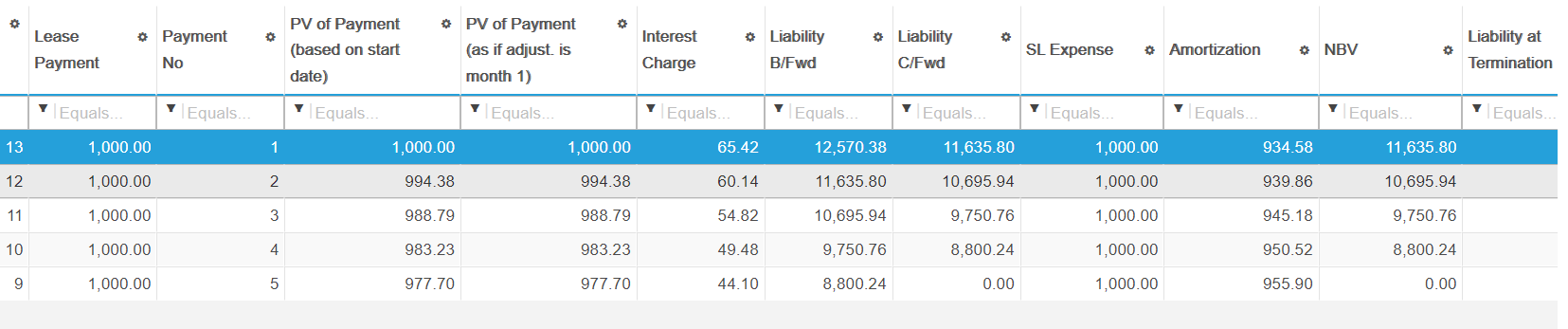
FMIS ASC 842 operating lease schedule showing straight-line expense, lease payments, liability balances and ROU asset amortisation
FMIS operating lease schedule showing straight-line expense alongside liability movements and ROU asset amortisation. This software example is separate from the illustrative annual schedules above. Open the full-size screenshot.

Reassessments, modifications and impairment

Reassessment under existing terms

A significant event within the lessee’s control may change whether an option is reasonably certain to be exercised. Actual option decisions or contractually specified events can also trigger reassessment. External market movements alone do not automatically change the accounting term.

Where the term or purchase-option assessment changes, review classification, remeasure the liability and adjust the ROU asset. Retain the event date and supporting decision. ASC 842-10-35-1

Negotiated modifications

A modification is a separate contract when it adds a right of use and the additional consideration is commensurate with its stand-alone price, adjusted for the circumstances. Otherwise reallocate remaining consideration, remeasure using the modification-date rate and reassess classification.

An immediate reduction in leased space or equipment can create a partial termination and gain or loss. Simply reducing the remaining lease term follows a different rule; it generally adjusts the ROU asset. A contract labelled “termination” therefore needs its substance assessed. ASC 842-10-25-8 to 25-13

Index-linked rent changes

Under ASC 842, a change in the index or rate alone does not trigger liability remeasurement. Additional payments are recognised as variable lease cost when incurred. Update index-linked payments when another qualifying remeasurement event requires it. ASC 842-10-35-4 to 35-5

Impairment

Assess ROU assets under ASC 360 where relevant indicators arise. An impairment does not itself extinguish the payment obligation. After operating ROU impairment, subsequent cost no longer follows the usual level single-cost pattern. Do not continue an unchanged schedule automatically. ASC 842-20-35-9 to 35-10

Financial statement presentation and disclosures

Maintain separate operating and finance lease balances. Present the relevant assets and liabilities separately, or disclose them with the financial statement line items containing them. Operating and finance balances must not be combined into the same line item. Apply current/non-current classification where relevant.

Operating lease cash payments are generally operating cash flows. Finance principal repayments are financing cash flows; interest payments are operating cash flows under US GAAP. Initial non-cash recognition also needs appropriate disclosure. ASC 842-20-45

The disclosure package should explain the portfolio and significant judgements, alongside quantitative information. Relevant figures include operating lease cost, finance interest and amortisation, short-term and variable lease costs, cash paid, non-cash additions, weighted-average remaining terms and discount rates.

Prepare separate maturity analyses for operating and finance liabilities, covering annual payments for at least the next five years and the remaining total. Reconcile undiscounted payments to recognised liabilities. ASC 842-20-50

A liability report alone cannot supply every narrative disclosure. Assign responsibility for policies, options, restrictions and significant judgements. Reconcile the reporting pack to the general ledger and retain the approved reporting date, portfolio scope and calculation version.

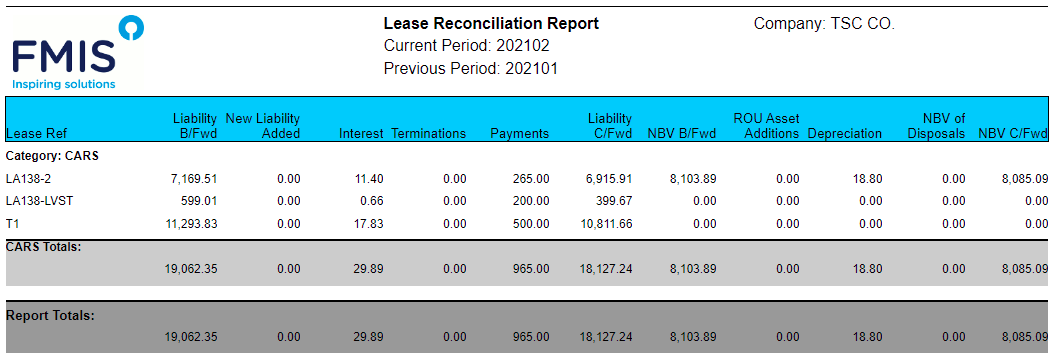
FMIS Lease Reconciliation Report showing opening and closing lease liability and ROU asset balances, payments, interest and movements
FMIS Lease Reconciliation Report showing liability and ROU asset movements between reporting periods. Reconcile these outputs to the ledger and supplement them with the required classification-specific and narrative disclosures. Open the full-size screenshot.

Other arrangements and IFRS reporting differences

Common-control leases, subleases, sale-and-leaseback transactions and business combinations need additional analysis. A group relationship does not automatically remove lease accounting from individual-entity reporting.

For qualifying common-control arrangements, consider applicable ASU 2023-01 provisions, including the eligible-entity written-terms practical expedient and rules for leasehold improvements. FASB: common-control amendments

Sublease classification under US GAAP uses the underlying asset, rather than the head-lease ROU asset. Sale-and-leaseback accounting depends on whether a sale has occurred. KPMG handbook; specialist topics

Preparing both US GAAP and IFRS figures

Do not assume that an IFRS 16 schedule can be copied directly into the US GAAP reporting pack. Compare:

  • The operating/finance distinction and expense pattern.
  • The absence of an ASC 842 low-value exemption.
  • Short-term purchase-option conditions.
  • Index-linked payment remeasurement and impairment treatment.

Use a documented reconciliation of accounting policies and balances. A shared contract record can support both frameworks, but it does not make their resulting figures identical. IFRS and US GAAP lease differences

Period-end review checklist

  1. Completeness: confirm additions, renewals and potential embedded leases with contract owners.
  2. Inputs: agree dates, payment timing, options, components and incentives to supporting documents.
  3. Decisions: retain approved classification, term, rate and policy elections.
  4. Changes: review modification, reassessment and impairment events before rerunning schedules.
  5. Reconciliation: agree opening balances, additions, movements, payments and closing figures to the ledger.
  6. Reporting: separate operating and finance amounts and review the complete disclosure pack.
  7. Evidence: retain source contracts, review notes, calculation versions and journal approvals.

Use the master guide’s general period-end checklist alongside these ASC 842-specific checks. Assign a clear owner for changes reported by property, operational and legal teams, so finance receives them before close.

Transition is a separate exercise

This guide focuses on ongoing application. For first-time US GAAP reporting or a change in reporting status, establish the applicable transition requirements and eligibility for elections before importing historical balances. An implementation migration and an accounting transition are different tasks.

Common ASC 842 questions

Generally no. A recognised operating lease creates an ROU asset and liability. Its subsequent expense pattern differs from a finance lease. The elected short-term recognition exemption is a separate matter.

ASC 842 has no equivalent specific low-value exemption. Assess materiality separately and document the US GAAP policy; an IFRS threshold is not automatically applicable.

An eligible non-public business entity can elect it by underlying asset class. A readily determinable implicit rate still takes priority. Assess eligibility and disclose the election and classes covered.

A change in the index alone does not trigger ASC 842 remeasurement. Additional payments are generally variable lease cost. Another qualifying event can require remeasurement using the current index.

They are one reasonable approach in implementation guidance, rather than mandatory universal thresholds. Document the classification approach and apply it consistently.

No. Prepayments, incentives and initial direct costs can create an initial difference. Subsequent finance amortisation, modifications or impairment can also produce different balances. The worked examples show a subsequent difference even with equal initial amounts.

For general terminology, data preparation and the accounting workflow, return to the main lease accounting guide.

Managing the accounting process with FMIS

FMIS Lease Accounting supports lease records, calculated schedules, adjustments and reporting outputs. Finance retains responsibility for classification, policy elections and accounting judgements. For the available ASC 842 reporting functionality, see the commercial product page.

Sources and further reading

Sources checked 10 October 2026. The current FASB Accounting Standards Codification and applicable amendments govern US GAAP treatment. Accounting Standards Updates explain amendments; they are not themselves the authoritative Codification. Accounting-firm guidance supplies supporting interpretation. Complex arrangements require assessment of their particular terms.

  1. Deloitte: lessee accounting overviewASC 842-20 scope and recognised balances.
  2. Deloitte: definition of a leaseASC 842-10-15; control and identified assets.
  3. Deloitte: non-lease componentsASC 842-10-15-30 to 15-37; components and elections.
  4. Deloitte: allocating considerationASC 842-10-15-33; relative stand-alone prices.
  5. Deloitte: lessee lease classificationASC 842-10-25-2 to 25-3 and 55-2.
  6. Deloitte: lease termASC 842-10-30-1; option assessments.
  7. Deloitte: lease paymentsASC 842-10-30-5; included payments.
  8. FASB: ASU 2021-09Amendments to ASC 842-20-30-3 and 50-10; non-PBE risk-free rate election.
  9. Deloitte: lessee policy decisionsASC 842-20-25-2; short-term election.
  10. Deloitte: initial direct costsASC 842-10-30-9 to 30-10.
  11. Deloitte: recognition and measurementASC 842-20-25 and 35; subsequent accounting and impairment.
  12. Deloitte: reassessing term and purchase optionsASC 842-10-35-1; qualifying events.
  13. Deloitte: lease modificationsASC 842-10-25-8 to 25-13; separate contracts and term/scope changes.
  14. Deloitte: index- or rate-linked paymentsASC 842-10-35-4 to 35-5; remeasurement distinction.
  15. Deloitte: lessee presentationASC 842-20-45; financial statements and cash flows.
  16. Deloitte: lessee disclosuresASC 842-20-50; quantitative and qualitative disclosures.
  17. Deloitte: IFRS and US GAAP lease comparisonSelected differences between the frameworks.
  18. KPMG: Leases handbook, September 2026Specialist arrangements and detailed examples.
  19. FASB: ASU 2023-01Common-control written-terms expedient and leasehold improvements.
  20. FASB: Accounting Standards CodificationThe authoritative source of nongovernmental US GAAP; use current Topic 842 and applicable amendments.

Back to the top