A practical guide for finance teams

Fixed asset management guide

Understand fixed asset accounting, controls and reporting, from capitalisation and depreciation to reconciliation and disposal.

This guide is for accountants, finance managers and financial controllers responsible for fixed assets. It explains the financial lifecycle of property, plant and equipment, with practical checks, an original worked example and supporting downloads.

Content owner: Vicky Stanley · Sources checked 15 October 2026 · About 27 minutes to read

The detailed accounting discussion focuses on tangible fixed assets. IFRS and FRS 102 treatments are identified where relevant; other reporting frameworks and specialist assets need their own assessment.

Browse all fixed asset resources for specialist guidance, articles and related case studies.
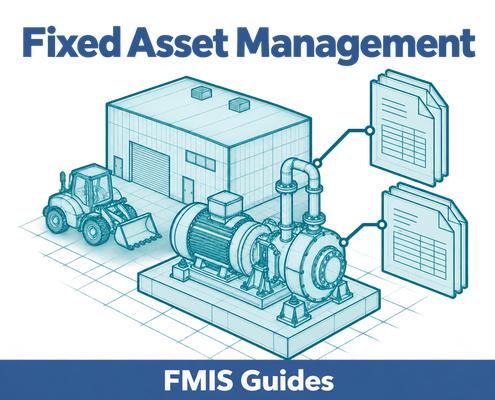
Technical illustration of equipment, a building and a vehicle connected with financial records

What is fixed asset management?

Fixed asset management is the process of identifying, recording and controlling the long-term assets an organisation uses. From a finance perspective, it connects acquisition and capitalisation with depreciation, changes in value, physical verification, reporting and eventual disposal.

The aim is to maintain a reliable explanation of the fixed asset balance. Finance needs to know which assets should be recognised, how their carrying amounts were calculated, what changed during the period and which evidence supports those conclusions. The register, ledger and operational records each contribute to that explanation.

Accounting and physical tracking work together

Fixed asset accounting addresses recognition, measurement and financial reporting. Physical tracking records identity, location, custody and movements. The same item can appear in both records, but the information serves different purposes. A laptop may need tracking even when its cost has been expensed. A fully depreciated machine may remain in daily use.

A physical count cannot establish the correct carrying amount by itself. Equally, a depreciation schedule does not show that an asset still exists or that finance has received every relevant purchase and disposal. A useful process connects these records through stable identifiers and agreed responsibilities.

Which assets does this guide cover?

The detailed accounting discussion focuses on tangible fixed assets, commonly described as property, plant and equipment, or PPE. IAS 16 covers tangible items used in operations, administration or rental to others over more than one period. [1]

Scroll sideways to view the full table.

Identify the accounting subject first
Asset or arrangement Starting point
Operational buildings, vehicles and equipment PPE requirements under the applicable framework.
Goods held for sale or consumption Consider inventory classification rather than assuming fixed asset treatment.
Software and other intangible assets Consider intangible asset requirements and the substance of the arrangement.
Property held for rental income or capital appreciation Check investment property requirements and relevant exceptions.
An asset used under a lease Assess lease accounting, including any right-of-use asset, before applying the appropriate subsequent requirements.

This classification matters before selecting a calculation. The guide explains the financial lifecycle of PPE, with signposts where another framework or specialist subject needs closer attention.

  1. Establish the basis

    Agree the framework, policies, responsibilities and evidence.

  2. Recognise and record

    Assess costs and create complete financial records.

  3. Calculate and update

    Process depreciation and approved asset events.

  4. Verify and reconcile

    Investigate differences and explain reported balances.

Set the accounting policy and responsibilities

For practical guidance and an editable template, read our fixed asset management policy and procedures guide.

A controlled fixed asset process starts with agreed decisions about recognition, measurement and responsibility. Document the policies before building calculations around them. Otherwise, similar purchases can receive different treatment simply because different people entered them.

Identify the framework and reporting period

Confirm the reporting basis for the legal entity and any additional group reporting requirements. The country where an asset is located does not determine all of its accounting. A subsidiary may prepare local accounts and supply a different reporting package to its parent.

IFRS Accounting Standards

Start with IAS 16 for PPE, with related standards for matters such as impairment and borrowing costs. Check the requirements effective for the reporting period. [1]

FRS 102

Section 17 addresses PPE. Use the applicable edition and amendments, including relevant changes for periods beginning on or after 1 January 2026. [2]

Other reporting bases

US GAAP and sector-specific frameworks need their own assessment. For example, component depreciation requirements differ between IFRS and US GAAP. [8]

Public sector, charity and other specialist reporting can introduce additional requirements or adaptations. Establish those requirements at policy stage rather than treating this general PPE guide as a complete sector reporting manual.

Document the decisions that affect everyday entries

Your policy should address capitalisation and materiality, asset classes, grouped purchases, component identification, measurement models, depreciation inputs and the approval of subsequent changes. A capitalisation threshold is an organisation-specific application of policy and materiality, not a universal amount to copy from another business.

Budget approval and accounting recognition are separate decisions. Approval to spend money does not establish that every cost in the project should be capitalised. Similarly, tax relief does not determine the financial reporting treatment. HMRC explicitly distinguishes PPE accounting principles from the capital/revenue assessment for tax. [7]

Check in practice

Choose a recent mixed-cost purchase. Can the preparer identify the policy applied, the reason for capitalising each item, the date used and the person who reviewed the treatment? If those answers depend on memory, improve the evidence before increasing automation.

Assign ownership at each handover

  • Purchasing and project teams: supply invoices, approvals and completion information.
  • Operational custodians: report location changes, condition, replacements and disposals.
  • Finance preparers: assess and record transactions, calculate balances and investigate differences.
  • Finance reviewers: challenge significant judgements, review reconciliation and approve the close.

Separate preparation and review where practical. Smaller teams may need a documented management review instead of several approval layers. The useful question is whether the control addresses the risk and leaves evidence that it operated. [9]

Decide what to capitalise and when

Capitalisation means recognising expenditure as part of an asset rather than charging it immediately as an expense. Assess the nature of the asset, the relevant recognition requirements and the costs needed to bring it to the required location and condition.

Identify the asset and its initial cost

Under IAS 16, recognition depends on probable future economic benefits and reliably measurable cost. Initial cost includes the purchase price after discounts and rebates, relevant non-refundable taxes and directly attributable costs. Certain dismantling and restoration obligations also form part of the initial assessment. [1]

Separate an invoice into its underlying items. A machine, installation service, training course and maintenance agreement may require different treatment even when they are purchased together. Keep the allocation and supporting explanation with the transaction.

Scroll sideways to view the full table.

A practical cost review
Question Evidence to consider
What asset has been acquired or constructed? Specification, agreement, invoice and intended use.
Which costs bring it to the necessary location and condition? Delivery, installation and other directly attributable work.
Which costs relate to ongoing operation? Separate service, maintenance, training and operating charges.
Are any significant parts accounted for separately? Component assessment, cost allocation and expected replacement pattern.
Are other requirements relevant? Borrowing costs, restoration obligations, grants and specialist arrangements.

The worked example below separates eligible equipment costs from training and routine maintenance. It illustrates the decision, rather than setting a rule that every installation charge or project invoice is automatically capital expenditure.

Separate repairs, replacements and improvements

Routine servicing generally maintains the benefits already expected from an asset. A significant replacement or major inspection may require capitalisation when the recognition conditions are met, with removal of the replaced part’s carrying amount where applicable. Assess the actual work rather than relying on the supplier’s description of an invoice as a repair or improvement. [3]

Component records help where parts have materially different replacement cycles or patterns of use. They also make it easier to avoid retaining the old component’s value after recording its replacement. The level of detail should support the accounting and subsequent control of the asset.

Control assets under construction

For assets under construction, maintain a record of eligible accumulated costs and the work to which they relate. Reconcile that record to the ledger. Review incomplete projects for unexplained balances, costs awaiting allocation, delays and changes in the expected outcome.

Record the available-for-use assessment with commissioning or completion evidence. Invoice date, payment date and first actual use can all differ from the date an asset is capable of operating as intended. A delay in beginning production does not automatically justify leaving a completed asset outside depreciation. [4]

Where a project becomes ready in stages, consider whether identifiable parts are available for use before the whole project is complete. Retain the basis for allocating costs and dates. This makes later questions about depreciation and project balances easier to resolve.

Borrowing costs need a separate decision

IAS 23 requires directly attributable borrowing costs on a qualifying asset to form part of its cost. FRS 102 Section 25 permits a capitalisation policy for qualifying assets, applied consistently to a class. Establish the framework and policy before including interest in a project balance. [5] [2]

Build and maintain the fixed asset register

The fixed asset register is the detailed record supporting the reported asset balances. It should explain each asset’s identity, classification, cost, depreciation basis, subsequent movements and current carrying amount, with links to the evidence behind significant entries.

Use fields that support decisions and checks

A long list of fields is not necessarily a useful register. Each required field should have a purpose, an owner and a clear definition. Decide which information finance needs for calculations and reporting, and which operational details are needed to identify and verify the item.

Scroll sideways to view the full table.

Core information in a financial asset register
Field group Typical information Purpose
Identity Asset reference, description, component relationships. Distinguish the item and avoid duplicates.
Reporting Entity, class, book, cost centre and ledger mapping. Assign balances to the correct reporting basis.
Cost and dates Purchase evidence, eligible costs, capitalisation and available-for-use dates. Support recognition and timing.
Calculation Method, useful life, residual value and accumulated movements. Explain depreciation and carrying amount.
Operational control Location, custodian, serial or tag reference and status. Connect the accounting record with the item.
Evidence Approvals, valuations, verification findings and disposal records. Support review of transactions and changes.

Control additions and subsequent changes

Use stable asset references and check whether a purchase creates a new asset, a component or an additional cost. Review imported records for missing identifiers, duplicate invoices, unexpected classes and incorrect dates before accepting them into the live financial record.

Reconcile the population of additions to purchasing and project information. A perfectly completed record does not address the risk that another purchase never reached the register. Ask operational teams about assets received without the expected paperwork and projects brought into use before the invoice arrived.

Maintain an evidence trail for significant changes. The record should explain what changed, its effective date, who authorised it and how the accounting was updated. Preserve historical disposal and verification information even when an asset no longer contributes to the current balance.

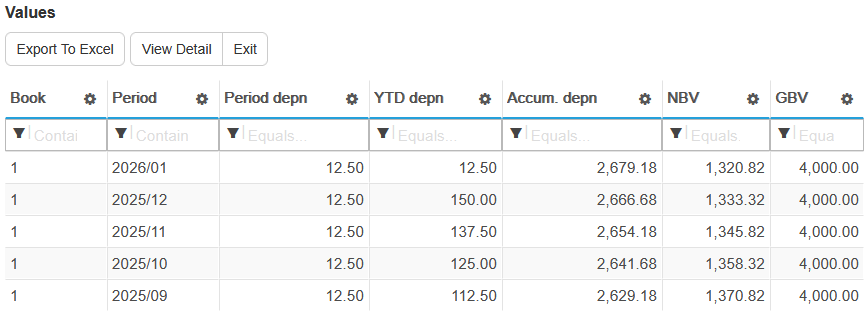
FMIS Fixed Assets Values list showing period depreciation, accumulated depreciation, net book value and gross book value

Values list from the FMIS Fixed Assets 12.47 user manual, section 5.4. The manual’s illustrative data is separate from the worked example in this guide. Open screenshot full size (new tab).

For more detailed field design and governance, see the guide to fixed asset registers.

Calculate and review depreciation

Depreciation allocates an asset’s depreciable amount over its useful life. It helps explain the cost attributable to each period of use. The calculation depends on the measurement basis, residual value, useful life, method and relevant dates.

Understand the inputs before selecting a method

Depreciable amount
The amount to allocate over the useful life, after allowing for the estimated residual value.
Useful life
The period or units of production over which the organisation expects to use the asset.
Residual value
Under IAS 16, an estimate of the net amount obtainable now if the asset were already at its expected end-of-life age and condition.
Carrying amount or net book value
The amount recognised after accumulated depreciation and impairment, reflecting the measurement basis and other relevant movements.

Under a simple cost model, carrying amount is cost less accumulated depreciation and impairment. It is an accounting amount, rather than an estimate of replacement cost or an automatic indication of sale proceeds. The net book value guide explores that distinction further.

Match the method to the pattern of use

Straight-line depreciation spreads the depreciable amount evenly over the useful life. Reducing-balance methods produce a different pattern, while units-of-production methods relate the allocation to usage. The selected method should reflect the expected consumption of the asset’s benefits. [4]

Set the calculation frequency and partial-period treatment consistently with the reporting policy. Check acquisition and disposal periods, relevant components and rounding. A convenient system default should be assessed before it becomes the organisation’s accounting convention.

Review estimates and unusual records

IAS 16 requires useful lives and residual values to be reviewed at least at each financial year-end, with the depreciation method also reviewed at least at each financial year-end. FRS 102 uses indicators of significant changes to trigger reviews of estimates and methods. A finance team can operate a regular review process while keeping the underlying framework requirements clear. [4] [2]

Challenge unexplained zero charges, negative balances, assets beyond their expected lives and large groups using a default life. Ask whether idle equipment remains available for use, whether damage indicates impairment and whether items have actually been disposed of. Under the normal PPE model, becoming idle does not by itself stop depreciation; a usage-based charge may be zero when production is zero. [2]

A revised estimate normally changes future charges rather than rewriting earlier periods. A mistake in the original records may instead be an error requiring a different assessment. Record the reason for the change before recalculating. The separate estimate-change illustration shows the prospective calculation.

Fully depreciated does not mean disposed of

Keep an operational record of assets still in use. Review whether the useful-life assumptions remain reasonable for similar assets and whether disposals are reaching finance promptly. Do not restore an asset’s value simply because it is still useful.

Changes, revaluation and impairment

Asset records need updating when circumstances change, but different events require different accounting decisions. Identify the event first, then establish its effective date, supporting evidence and effect on the records.

Distinguish administrative and accounting changes

A move between rooms may change only location information. A move between cost centres may affect the allocation of future charges. A transfer to another legal entity can require accounting in both entities and a separate group assessment. These should not all be treated as the same change of description.

Use a change record to connect the operational notification with finance’s assessment. If a machine has been modified, for example, ask whether the expenditure is a repair, a capitalised replacement or another event, and whether the expected remaining life has changed.

Separate revaluation from impairment

A revaluation updates amounts under an applicable revaluation model. IAS 16 permits a cost or revaluation model, applied consistently to a class of PPE. The recognition of a revaluation increase or decrease depends partly on previous movements for that asset. It is not appropriate to send every change directly to the same expense account. [6]

Impairment addresses a different question: is the recorded amount recoverable? Under IAS 36, relevant indicators can lead to an assessment using the asset or an appropriate cash-generating unit. Recoverable amount compares value in use with fair value less costs of disposal, taking the higher amount. [10]

Damage, obsolescence, closure plans and adverse changes in use can prompt investigation. Reviewing indicators is different from performing a detailed impairment model for every item. Keep the evidence supporting the assessment, including the absence or presence of matters requiring further work.

Scroll sideways to view the full table.

Turn asset changes into a controlled assessment
Event Finance question Evidence
Location or custodian changes Is this an administrative update or a reportable transfer? Movement notification and responsible team.
Significant replacement What is recognised and what old balance is removed? Specification, costs and component history.
Life or use changes Do estimates or the depreciation method need revision? Operational assessment and approved effective date.
Valuation or impairment review Which framework and measurement requirements apply? Assessment, valuation evidence and approval.

Update subsequent depreciation after an approved change where required. Retain the previous calculation and the reason for the new one so that a reviewer can explain the movement. Complex valuations and impairment models require more detail than a register adjustment alone provides.

Process disposals and derecognition

Disposal accounting closes the financial record when an asset is derecognised. The process should connect the authorisation and physical event with the removal of its carrying amount and the recording of any proceeds, gain or loss.

Establish the event and the correct date

Confirm the asset reference, disposal method, authorisation and relevant date. A sale, scrapping exercise and missing item may require different evidence. Investigate a missing asset before deciding whether it has moved, been disposed of or needs another accounting treatment.

A plan to sell does not itself mean that the asset has already been derecognised. Under IFRS 5, qualifying held-for-sale classification introduces separate measurement requirements and stops depreciation. FRS 102 does not simply reproduce that model. Establish the applicable requirements before changing the calculation. [11] [2]

Clear all relevant balances

Under IAS 16, derecognition is required on disposal or when no further benefits are expected from use or disposal. For a straightforward cost-model sale, establish the carrying amount at the disposal date, remove the asset cost and accumulated balances, and compare net proceeds with the carrying amount. A gain or loss explains the difference. The main worked example shows the entries for an asset sold after three years.

Check partial disposals carefully. Identify the part being removed and its associated cost and accumulated amounts. A previously revalued asset may also have reserve movements to consider. Do not assume that the remaining balance should be written off without examining the asset history. [6]

Retain the approved disposal, sale documents, proceeds and journal references. Update operational records so that teams no longer expect to find the item. Preserve its historical record rather than deleting the evidence behind prior reporting.

UK capital allowances and tax disposal adjustments are separate from the accounting gain or loss. Keep the tax record connected to the asset evidence, while assessing the treatment under the relevant tax rules. See the fixed asset disposal guide for more practical detail.

Verify assets and resolve differences

Use our fixed asset audit checklist to plan the work, record evidence and resolve discrepancies, with downloadable Excel and PDF templates.

Physical verification checks the connection between asset records and the items held or used. A useful exercise produces investigated exceptions and approved updates, rather than a count total that cannot be connected back to the financial register.

Test in both directions

Book to floor: select recorded assets and establish whether they can be found and identified. Floor to book: select items physically present and trace them to an appropriate record. The two directions address different risks. Checking only recorded items can miss assets that never entered the register.

Plan coverage around the asset population and risks. High-value mobile equipment may need a different approach from fixed building components. Agree the scope, locations, cut-off, evidence and follow-up responsibilities before work starts. Distinguish this management verification exercise from an external auditor’s independent procedures.

Investigate exceptions before changing balances

Record missing, unrecorded, duplicate, incorrectly located and damaged items separately. Include the asset reference, finding, proposed explanation, owner and evidence. An item not found during a visit may be on loan, under repair or held elsewhere. An item found without a tag may already be recorded under another identifier.

Only post the accounting adjustment after establishing the appropriate treatment. Verification can identify a matter for investigation, but physical presence alone does not prove ownership, complete cost information or a correct valuation.

  • Prepare: reconcile the population and define the records used.
  • Identify: capture stable references, with barcode or QR code where appropriate.
  • Investigate: assign exceptions and obtain evidence.
  • Approve: distinguish operational corrections from financial adjustments.
  • Close: update the records and retain the outcome of each exception.

FMIS Fixed Assets includes barcode-based audit functions, with mobile camera scanning of barcodes or QR codes, and lists of assets found or not found. These tools support the verification work. Finance still needs to establish the investigation, approval and accounting process around the findings.

Make unresolved findings visible

Keep open exceptions after the physical exercise ends. Review material items at period end and record the action, owner and target date. A completed site visit should not silently become a completed financial control when differences remain unexplained.

Reconcile and report at period end

Period-end reconciliation should explain the opening balance, movements and closing balance, and agree the register to the relevant general ledger accounts. Matching only the net balance can conceal offsetting errors in cost and accumulated depreciation.

Start with a consistent reporting population

Confirm the entity, book, period, asset classes, currency and status filters. Retain the report parameters with the output. Differences caused by comparing a group report with a single entity, or a forecast with actual values, should be resolved before investigating individual transactions.

Check that additions, disposals, transfers and other relevant changes for the period have reached the financial records. Review pending batches and late notifications. Complete the depreciation calculation, then examine material or unexpected movements before preparing journals.

Explain the balances separately

Scroll sideways to view the full table.

Illustrative annual reconciliation, equipment example (£)
Movement Gross cost Accumulated depreciation Carrying amount
Opening balance, 1 January 2028 50,000 9,000 41,000
Depreciation in 2028 0 9,000 (9,000)
Closing balance, 31 December 2028 50,000 18,000 32,000

Accumulated depreciation is shown as a positive contra-asset balance in this table. In a ledger export it may appear as a credit or negative amount. Agree the sign convention before comparing reports. Extend the movement analysis for impairment, revaluation, transfers, currency effects and other items where applicable.

Investigate missing or duplicated postings, direct journals to asset control accounts, incorrect mappings, different cut-offs and unprocessed events. Maintain a list of reconciling items with explanations, owners and evidence. A timing difference still needs a clear resolution, rather than being carried forward indefinitely.

Complete the close checklist

  • Completeness: review purchases, project completions, operational notifications and pending items.
  • Inputs: check significant dates, classifications, depreciation inputs and approved changes.
  • Processing: confirm the intended periods and populations have been processed successfully.
  • Movements: explain significant additions, disposals and adjustments.
  • Ledger: agree cost, accumulated depreciation, impairment and carrying amount to the correct accounts.
  • Review: approve journals, exceptions and the close evidence.
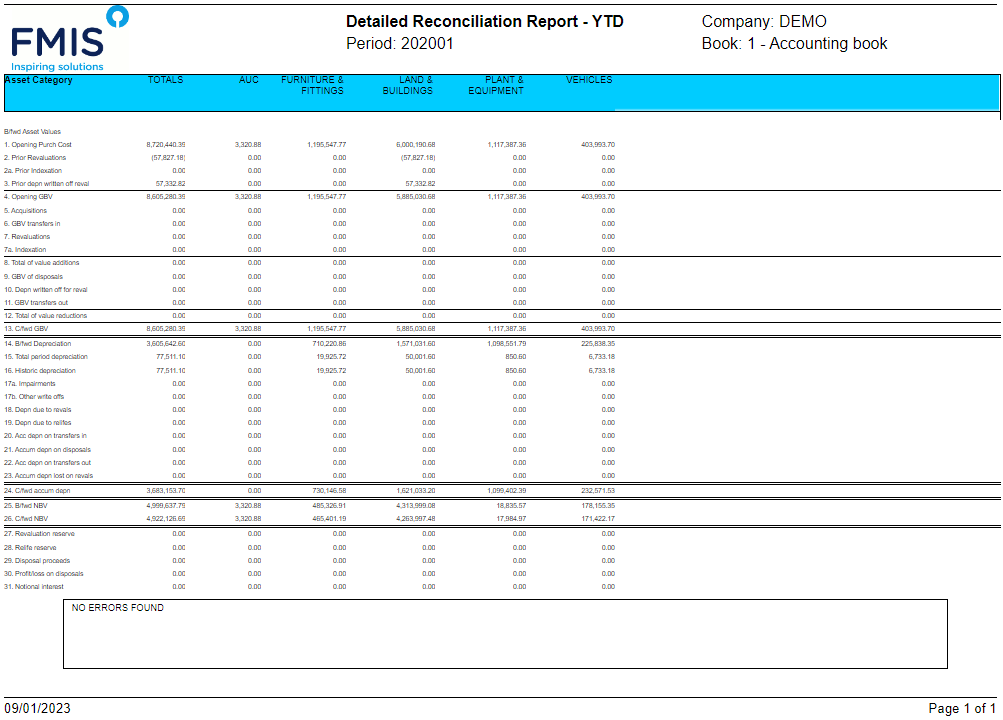
FMIS Detailed Reconciliation Report showing opening balances, asset movements, depreciation and closing balances

Detailed Reconciliation Report reproduced from the FMIS Fixed Assets 12.47 user manual, section 8.5, using its DEMO company data. It illustrates the report structure and does not show this guide’s worked example. Open screenshot full size (new tab).

Prepare reporting and audit evidence

Keep the signed reconciliation alongside the policy, report parameters, movement schedules, significant transaction evidence and assessment of estimates. Record who prepared and reviewed the work, the date and any matters still open. This gives the reviewer a route from the financial statement balance into its supporting records.

Prepare the applicable disclosure information, including measurement bases and relevant movement reconciliations. Reporting requirements depend on the framework and disclosure regime. A register report supplies inputs, but it should not be assumed to be the complete statutory disclosure. [3]

Consider financial statement effects together. A capital purchase, depreciation charge and disposal proceeds affect different parts of the reporting package. Review the applicable cash-flow presentation separately from the profit-and-loss treatment.

Know the scope of the audit evidence

FMIS’s Audit Log records changes to specified main asset and user data, with filtering and summary/detail options. The 12.47 manual states that In Tray entries and modifications are excluded. Retain the separate controls and evidence needed for pending work rather than assuming every preparatory change appears in that log.

Manage multiple entities, books and currencies

An entity, an accounting book and a reporting currency describe different dimensions of the records. Keep those distinctions explicit so that an accurate local register does not become an ambiguous group report.

Scroll sideways to view the full table.

Distinguish the reporting dimensions
Dimension Question to establish
Entity Which organisation recognises the asset and its transactions?
Book Which reporting purpose, policies and calculation basis do these values serve?
Currency Is this a transaction, functional or group presentation currency?

A group may need local statutory values, group reporting adjustments and separate tax calculations. Use consistent asset identifiers where records are connected, but preserve the differences in cost, dates, lives and measurement bases that explain the separate results.

Foreign currency accounting needs an assessment of the relevant transaction and measurement basis. Under IAS 21, different translation rules apply to monetary items, historical-cost non-monetary items and the translation of foreign operations. Do not apply a period-end exchange rate indiscriminately to every asset value. [12]

Similarly, moving an asset to another group entity is more than changing its location. Establish the entries in each entity and any group eliminations or adjustments. Adding entity totals together does not, by itself, complete consolidation accounting.

The FMIS 12.47 manual describes multiple companies, company groups and up to eight books, with book-level values and currency settings. Company and book configuration, licensing and permissions need to fit the intended reporting purposes. Confirm the accounting basis before relying on a combined output.

Where entities report under different frameworks, identify the differences explicitly. KPMG’s component accounting guidance, for example, explains that IFRS requires relevant significant components to be depreciated separately, whereas US GAAP permits the component approach without generally requiring it. [8]

Worked example: from purchase to disposal

This original example illustrates an equipment purchase under the IAS 16 cost model. It connects the cost decision, register, depreciation, reconciliation and disposal. It is separate from the software screenshots and is not a simulation of FMIS processing conventions.

Example assumptions

  • Equipment costs £48,000, delivery £1,200 and installation £800. All three qualify for capitalisation in this example.
  • Separate staff training costs £2,000 and routine maintenance services £3,000. Both are consumed in 2027 and treated as expenses.
  • The equipment is available for use on 1 January 2027. It has a five-year useful life and estimated residual value of £5,000.
  • Depreciation is straight-line, with calendar-year reporting and three full years before sale.
  • The asset is sold immediately after the 2029 depreciation charge, on 31 December 2029, for net proceeds of £25,000.
  • VAT, financing, grants, restoration obligations, components, impairment, revaluation and currency effects are excluded.

1. Establish cost and annual depreciation

The capitalised cost is £48,000 + £1,200 + £800 = £50,000. Training and routine maintenance are recorded separately from the asset cost. This assessment follows the facts assumed here; different services or arrangements may require a different timing assessment.

Annual depreciation = (£50,000 − £5,000) ÷ 5 = £9,000.

The register records the asset identity, evidence, capitalised cost, available-for-use date, method, useful life and residual value. The ledger records the acquisition and subsequent charges through the agreed account mappings.

2. Follow the carrying amount

Scroll sideways to view the full table.

Equipment depreciation before disposal (£)
Year ending 31 December Opening carrying amount Depreciation Accumulated depreciation Closing carrying amount
2027 50,000 9,000 9,000 41,000
2028 41,000 9,000 18,000 32,000
2029, before sale 32,000 9,000 27,000 23,000

The £5,000 residual value is the assumed current net disposal amount for equipment already at its expected age and condition after the original five-year useful life. It is not a forecast of future prices or of the proceeds from an earlier sale. After three years, the accounting carrying amount is £23,000 and the actual net proceeds are £25,000.

3. Record the acquisition and annual charges

Scroll sideways to view the full table.

Illustrative acquisition and expense entries (£)
Transaction Debit Credit Amount
Equipment, delivery and installation PPE: equipment cost Payables / cash 50,000
Training consumed in 2027 Training expense Payables / cash 2,000
Routine maintenance consumed in 2027 Maintenance expense Payables / cash 3,000
Each full year’s depreciation, 2027–2029 Depreciation expense Accumulated depreciation 9,000

These are simplified annual entries. Actual invoice, payment and service dates determine the payables, cash and accrual entries. In this example depreciation is an expense; in other circumstances a charge can form part of the cost of another asset.

4. Record the sale

Gain on disposal = £25,000 net proceeds − £23,000 carrying amount = £2,000.

Scroll sideways to view the full table.

Disposal entry at 31 December 2029 (£)
Account Debit Credit
Cash / receivable 25,000 0
Accumulated depreciation 27,000 0
PPE: equipment cost 0 50,000
Gain on disposal 0 2,000
Total 52,000 52,000

The sale clears the cost and accumulated depreciation, leaving no carrying amount for the asset after disposal. The historical record remains available. Total depreciation of £27,000 and the £2,000 disposal gain produce a net lifetime expense of £25,000 for the equipment, consistent with £50,000 cost less £25,000 net proceeds.

A separate illustration: revised remaining life

As an alternative to the main example, suppose the asset is retained. At the end of 2028 its carrying amount is £32,000. New evidence supports a revised remaining life of four years and residual value of £4,000. Future straight-line depreciation would be (£32,000 − £4,000) ÷ 4 = £7,000 a year, from the effective date of the revised estimate. This alternative is not combined with the sale above.

Review and improve your fixed asset process

Start improvement work with the source of recurring problems. A new calculation engine will not resolve unclear policies, missing purchase information or a disposal process that does not notify finance. Identify the underlying issue, then select the policy, data, process or system change that addresses it.

Choose a manageable review population

Trace several recent assets through purchase, recognition, register entry, depreciation and reporting. Include a disposal and a significant change. Ask another team member to follow the evidence without relying on the original preparer’s memory.

Record the gaps and prioritise those affecting material balances, repeated errors or reporting deadlines. Useful measures include the age of unresolved reconciling items, late asset notifications and open verification exceptions. Set targets that fit your risks and resources rather than adopting unsupported industry benchmarks.

Choose the support the process needs

A spreadsheet can be workable for a limited, controlled population. More entities, books, changes and reporting demands can make review and maintenance harder. Assess the actual requirements: repeatable calculations, controlled access, traceable changes, usable reports, imports and the connection with your finance system.

FMIS Fixed Assets supports financial asset records, depreciation processing, asset events and reporting. Its configuration needs to reflect the agreed accounting policies. For the available functionality and implementation discussion, explore FMIS fixed asset management software. For evaluation questions, use the software selection guide.

Turn the review into an action

For each issue, record the affected balance or control, the required change, owner, target date and evidence that will demonstrate completion. Revisit unresolved items at the next close. A short, maintained action list is more useful than a broad improvement plan with no accountable next step.

Key fixed asset terms

Capitalisation
Recognising expenditure as part of an asset, subject to the relevant accounting requirements.
Asset class
A grouping of assets with a similar nature and use for accounting and reporting.
Component
A part of an asset identified separately for relevant accounting purposes.
Gross carrying amount
The recorded amount before accumulated depreciation and impairment, reflecting the measurement basis.
Accumulated depreciation
The depreciation recognised against an asset up to the reporting date.
Impairment
A reduction when the carrying amount exceeds the recoverable amount under the applicable requirements.
Derecognition
Removing an asset’s carrying amount from the financial statements.
Assets under construction
Assets being constructed or prepared, with eligible costs accumulated before they become available for use.
Subledger
Detailed accounting records supporting the balances in the general ledger.
Book
A set of financial values maintained for a particular reporting purpose or basis.

Downloads and related fixed asset resources

Use the guide for the overall process and the resources below for a particular task. The downloadable tools accompany the explanations and worked example.

Common fixed asset management questions

Yes, where the records serve both purposes and ownership is clear. Finance needs accounting values and evidence; operational teams may need location, custody and status. Agree the shared asset reference, required fields and update responsibilities. Some low-value items may need operational tracking without being capitalised.

Set the frequency and coverage around your risks, asset types, reporting requirements and resources. A mobile equipment population may need a different cycle from fixed infrastructure. Document the rationale and investigate findings. There is no single count frequency established by this guide for every organisation.

No. A fully depreciated asset can remain in use and need tracking, maintenance and eventual disposal records. Preserve the information needed for control and reporting history. Review the underlying assumptions where useful, but do not increase the carrying amount simply because the asset is still working.

Software processes records and calculations according to its setup and inputs. Finance must establish the applicable framework, policies, judgements and approvals. Use system outputs as part of a controlled review, with evidence that the relevant records are complete and the settings are appropriate.

Support with fixed asset accounting

FMIS Fixed Assets provides asset and book records, depreciation processing, transfers, disposals, adjustments and financial reporting. The examples of software functionality in this guide are based on the Fixed Assets 12.47 user manual. Available options depend on the licensed setup, configuration and access permissions.

If you are reviewing your process, start with the reporting requirements, asset population and difficulties you need to resolve. FMIS can then discuss how the software and implementation approach fit those requirements.

Sources and further reading

Accounting references were checked on 15 October 2026. Use the requirements and amendments applicable to your reporting period. The operational checks in this guide are practical recommendations. They are not presented as a prescribed checklist from a standard setter.

  1. IFRS Foundation: IAS 16, Property, Plant and Equipment. Public overview of scope, recognition and cost.
  2. FRC: FRS 102 current edition and amendments. September 2024 edition, particularly Sections 17 and 25, with subsequent amendments and effective dates checked separately.
  3. ACCA: Property, plant and equipment. Technical explanation of IAS 16 costs, changes, components and accounting examples.
  4. ACCA: Property, plant and equipment, measurement and depreciation. Depreciation, available-for-use assessment and review of estimates.
  5. IFRS Foundation: IAS 23, Borrowing Costs. Qualifying asset borrowing costs.
  6. ICAEW: IAS 16 resource and public summary. Measurement models and related accounting topics.
  7. HMRC: BIM31060, tax and accountancy, PPE. Distinction between accounting recognition and tax assessment.
  8. KPMG: IFRS vs. US GAAP, PP&E component approach. Component accounting differences.
  9. ICAEW: Internal control component examples. Public guidance on control design, implementation and monitoring.
  10. IFRS Foundation: IAS 36, Impairment of Assets. Recoverability, indicators and impairment assessments.
  11. IFRS Foundation: IFRS 5, Non-current Assets Held for Sale and Discontinued Operations. Held-for-sale measurement and depreciation.
  12. IFRS Foundation: IAS 21, The Effects of Changes in Foreign Exchange Rates. Currency and translation principles.

Software reference: FMIS Fixed Assets User Manual v12.47, particularly sections 2.1, 2.5–2.6, 5.4, 5.9, 6.1, 8.4–8.5, 8.13, 9.1–9.4 and 10. Screenshots are reproduced from that manual. Its internal distribution copy is not linked as a public download.