FMIS Software
  • Home
  • Solutions
    • Fixed Asset Management Systems
      • Capital Projects
      • Enterprise Asset Management
      • Fixed Asset Management Software
    • Asset Tracking
      • Barcode Tracking
      • FMIS Mobile Asset Manager
    • Purchase to Pay
      • Purchase Order Processing
      • Sales Order Processing
    • Stock and Inventory
      • Kitting and Assembly
      • Material Requirements Planning (MRP)
      • Production Control
    • Equipment Maintenance
      • Field Service Management
    • Lease Accounting
      • Order Management
  • Market Sectors
    • Public Sector
      • Local Government and Councils
      • Central Government
      • Government Agencies and Public Bodies
      • Emergency Services
    • Commercial and Retail
    • Education
    • Health
    • Manufacturing
    • Non-Profit
    • Oil, Gas and Energy
  • Partners
    • Deltek
    • Find a partner
    • Become a Partner
  • Resources
    • Trust Centre
      • Certifications & Assurance
      • Data Protection & Privacy
      • Cloud Security & Infrastructure
    • News and articles
    • Case studies
    • Fixed asset management guide
  • About us
  • Contact
    • Request a demo
    • Pricing
    • Product information
    • Customer Support
    • Careers
    • Training Feedback
  • Click to open the search input field Click to open the search input field Search
  • Menu Menu
You are here: Home1 / Articles2 / Maintenance Schedule

Maintenance Schedule: How to Plan Preventive Maintenance

A maintenance schedule is what turns good intentions into work that actually happens. This guide explains what a maintenance schedule is, how to schedule preventive maintenance step by step, how to set sensible frequencies, and what a planned preventive maintenance regime looks like in practice.

Written by: John de Robeck • Published: September 21, 2026 • Updated: September 28, 2026

preventive-maintenance-schedule-tall

What is a Maintenance Schedule?

A maintenance schedule is a calendar of recurring inspections, services, and checks across your assets. Maintenance scheduling is the process behind it: deciding when each task should happen and assigning it to the right people and resources.

Scheduling is the operational half of preventive maintenance. Deciding to service a pump quarterly is a policy; the maintenance schedule is what makes sure the job is raised, resourced, and done every quarter without fail. The difference between the two is where most preventive programmes succeed or quietly fall apart.

How to Schedule Preventive Maintenance: Five Steps

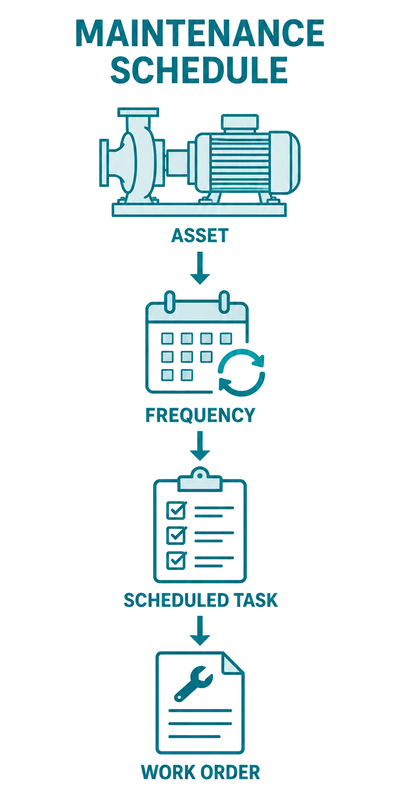
Build a maintenance schedule in five steps: list your assets, decide what each one needs, set a frequency for each task, assign it to a person or team, and record every completed job so the schedule stays honest.

  •     List every asset you intend to maintain, taken from the asset register so nothing is missed.
  •     Define specific tasks for each asset: visual inspection, lubrication, part change, or calibration.
  •     Set a frequency and assign an owner to each task.
  •     Record completion after every job, because a schedule without a feedback loop drifts within months.
  •     Use software to generate work orders automatically when tasks fall due, rather than relying on memory.

For a fuller walk-through, see our guide on how to create a preventive maintenance plan, which takes these steps from a blank sheet to a working programme.

Setting the Right Maintenance Frequency

Set maintenance frequency by time or by usage, whichever better reflects how the asset wears. Time-based scheduling suits assets that degrade with age. Usage-based scheduling, by running hours, cycles, or mileage, suits equipment whose wear tracks how hard it is worked.

Getting frequency right is a balance. Too frequent and you waste effort and parts on servicing that was not needed; too infrequent and you are back to reactive breakdowns. Start with the manufacturer’s recommendation, then adjust using your maintenance history: use the evidence to review the interval, while continuing to follow manufacturer, statutory, insurance and safety requirements.

What is Planned Preventive Maintenance (PPM)?

Planned preventive maintenance (PPM) is a structured, scheduled programme of preventive tasks carried out at set intervals. It is the formal version of preventive maintenance: a documented plan of what is done to each asset and when, rather than ad hoc servicing.

PPM is the term most common in UK facilities and engineering contracts, where a PPM schedule is often a contractual deliverable. In substance it is preventive maintenance organised into a repeatable plan: each asset has its tasks, each task has its frequency, and the whole thing runs on a rolling calendar. A CMMS is the natural home for a PPM schedule because it can hold hundreds of recurring tasks and raise them without anyone tracking dates by hand.

Building a Maintenance Schedule Template

A basic maintenance schedule template lists each asset, its maintenance tasks, the frequency of each, the responsible person, and the last and next due dates. That structure is enough to run a preventive programme and maps directly onto how a CMMS stores the same information.

A spreadsheet template is a sensible starting point and fine for a handful of assets. Its limits appear as you scale: it will not remind anyone, does not link to asset history, and is easily overwritten. Those limits are the reason teams move to software once the schedule outgrows a single page. The columns stay the same; reminders, history, and reporting are what get added.

From Schedule to Work Order

A schedule says what should happen; a work order makes it happen. When a scheduled task falls due, it becomes a work order assigned to a technician, who carries it out and records the result. The completed work order updates the asset history and resets the schedule for next time. How to run that side well is covered in our guide to work order management.

Common Maintenance Scheduling Mistakes

The three most common scheduling mistakes: servicing everything at the same interval regardless of need, setting frequencies once and never revisiting them, and failing to record completed work so the schedule cannot be tuned. Each quietly undermines the programme.

A maintenance schedule is a living thing. Intervals set at launch are only a best guess, and maintenance history is what tells you whether they were right. Teams that never review their frequencies either waste effort on unnecessary servicing or keep suffering failures they thought they had designed out. A periodic review, informed by what was found at each service, is what turns a static schedule into one that improves over time.

How a CMMS Automates Scheduling

A CMMS can automate scheduling by holding recurring tasks and raising work orders when they become due, using the trigger types supported by the configured system. FMIS equipment maintenance software raises scheduled work automatically, records completion against the asset, and reports on what is overdue, so the schedule holds even during a busy period. That reliability is what separates a PPM plan that works from one that exists only on paper.

Frequently Asked Questions

What is the difference between a maintenance schedule and a PPM schedule?

They are effectively the same thing. A PPM schedule is a maintenance schedule made up of planned preventive tasks. The term PPM is common in UK facilities and engineering contracts, where it often appears as a contractual deliverable.

Should maintenance be scheduled by time or usage?

Use whichever reflects how the asset wears. Time-based works for assets that degrade with age; usage-based, by hours or cycles, works for equipment whose wear depends on how hard it is used. Many programmes use both across different assets.

How often should preventive maintenance be done?

Start with the manufacturer’s guidance, then adjust based on your own history. Review intervals using your maintenance history, while continuing to follow manufacturer, statutory, insurance and safety requirements. The right frequency is the one your records support.

What should a maintenance schedule template include?

At minimum: the asset name and ID, the specific tasks, the frequency of each, the owner, and the last and next due dates. As the programme matures, add cost codes, parts required, and estimated labour time.

Can you run a PPM schedule on a spreadsheet?

For a small number of assets, yes. The problems start when the schedule grows: spreadsheets do not send reminders, do not link jobs to asset history, and are easily overwritten. Most teams move to a CMMS when missed schedules start causing breakdowns.

About the author

John de Robeck leads new business and partnerships at FMIS, working with organisations to understand asset and equipment maintenance requirements, software fit and related compliance considerations.

Read full bio

Share this content
  • Facebook Facebook Share on Facebook
  • X-twitter X-twitter Share on X
  • Whatsapp Whatsapp Share on WhatsApp
  • Linkedin Linkedin Share on LinkedIn
  • Mail Mail Share by Mail

Flow diagram showing the decision-making process between the different lease accounting standards for IFRS 16 and FRS 102

IFRS 16 vs FRS 102: Which Lease Accounting Standard Applies to You?

Compare IFRS 16 and FRS 102 lease accounting, including their scope, pre-2026 differences, the 2026 changes and the practical differences that remain.
https://www.fmis.co.uk/wp-content/uploads/2026/09/ifrs-16-vs-frs-102-lease-accounting-office-featured.webp 500 500 John de Robeck https://www.fmis.co.uk/wp-content/uploads/2026/04/FMISNavyTeal-1-150x80-1.webp John de Robeck2026-09-04 16:15:472026-09-29 16:33:37IFRS 16 vs FRS 102: Which Lease Accounting Standard Applies to You?
Simple flow diagrams showing the application of ASC 842 Lease Accounting for US GAAP Reporters

ASC 842 Lease Accounting: A Guide for US GAAP Reporters

Understand ASC 842 lease accounting, including classification, measurement, exemptions and the key differences from IFRS 16 and revised FRS 102.
https://www.fmis.co.uk/wp-content/uploads/2026/09/asc-842-lease-accounting-us-gaap-featured-image.webp 450 500 John de Robeck https://www.fmis.co.uk/wp-content/uploads/2026/04/FMISNavyTeal-1-150x80-1.webp John de Robeck2026-09-04 16:07:062026-09-29 16:34:53ASC 842 Lease Accounting: A Guide for US GAAP Reporters
Flow Diagram depicting the process to calculate right of use asset and lease liability

How to Calculate a Right-of-Use Asset and Lease Liability

Explore the calculation of lease liabilities and right-of-use assets under IFRS 16 and FRS 102, from present value and discount rates to depreciation.
https://www.fmis.co.uk/wp-content/uploads/2026/09/accounting-office-banner-calculating-lease-liability.webp 450 500 John de Robeck https://www.fmis.co.uk/wp-content/uploads/2026/04/FMISNavyTeal-1-150x80-1.webp John de Robeck2026-09-03 09:33:012026-09-29 16:30:34How to Calculate a Right-of-Use Asset and Lease Liability
IFRS 16 Journal entries flow diagram

IFRS 16 Journal Entries: A Step-by-Step Worked Example

A detailed guide to IFRS 16 journal entries, covering lease recognition, interest, liability repayments, depreciation and the transition to FRS 102 in 2026.
https://www.fmis.co.uk/wp-content/uploads/2026/09/diverse-accountants-ifrs16-lease-management.webp 450 500 John de Robeck https://www.fmis.co.uk/wp-content/uploads/2026/04/FMISNavyTeal-1-150x80-1.webp John de Robeck2026-09-03 09:27:172026-09-29 16:32:21IFRS 16 Journal Entries: A Step-by-Step Worked Example
Support Icon
Can we help?
Book a demo View products Contact support
Or call: +44 (0) 1227 773003
Mon–Fri, 9:00–17:00 (BST/GMT)

Explore More

  • What is new in FMIS Fixed Assets version 12.47
  • What is new in FMIS Lease Accounting version 12.47
  • AccountMate Fixed Asset Integration with FMIS
  • Asset Depreciation Methods Explained for UK Businesses
  • How to Conduct a Fixed Asset Audit: Step by Step

SOLUTIONS

  • Fixed Asset Management Systems
  • Asset Tracking
  • Purchase to Pay
  • Order Management
  • Equipment Maintenance
  • Lease Accounting
  • Stock and Inventory
  • View all solutions

Home › Articles › Maintenance Schedule

Market Sectors

  • Commercial and Retail
  • Education
  • Local and Central Government
  • NHS and Health
  • Manufacturing
  • Non-profit
  • Oil, Gas and Energy

FOLLOW US

FMIS Twitter FMIS Linkedin

CONTACT US

FMIS Ltd
167b John Wilson Business Park
Whitstable
Kent
CT5 3RA
United Kingdom

Phone:+44 (0) 1227 773003
Fax:+44 (0) 1227 773005
Sales:sales@fmis.co.uk
Support:support@fmis.co.uk

Copyright © 2024 - All rights reserved www.fmis.co.uk
  • Privacy Policy
  • Cookie Policy
Scroll to top