Case Study
Exponent: Enhanced Purchasing for Deltek Vantagepoint Case Study
Written by: John de Robeck • Published: August 22, 2014 • Updated: September 21, 2026
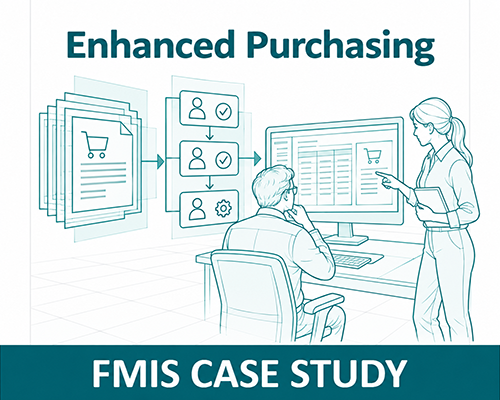

Case Study



Challenges

Client Overview: Exponent is an international engineering and scientific consulting company. Its teams work across a diverse range of projects, with purchasing needs that vary between groups. The company uses FMIS alongside Deltek to support purchasing processes and approval requirements.
Exponent uses FMIS Enhanced Purchasing alongside Deltek Vantagepoint to support demanding purchasing requirements, including high purchase order volumes, frequent change orders and flexible approval rules. Originally selected to standardise purchasing across teams using Deltek Vision, FMIS has remained part of Exponent’s purchasing processes for more than a decade.
For finance and purchasing teams evaluating an extension to Vantagepoint, Exponent illustrates how a dedicated purchasing system can accommodate operational requirements while keeping purchasing connected to Deltek.
Purchasing requirements varied across Exponent. Some groups purchased relatively little, while others relied heavily on purchasing to support their work. These teams had developed their own processes, making a consistent company-wide approach difficult.
Exponent needed to standardise purchasing without losing the flexibility to accommodate different approval responsibilities. Its requirements extended beyond creating an initial purchase order: teams also needed to amend requisitions, manage changes in order value and identify transactions by project, task, supplier and user.
As its Deltek environment evolved to Vantagepoint, Exponent continued to need purchasing functionality suited to its order volumes and working practices. FMIS Enhanced Purchasing provided a dedicated system alongside Deltek to support those requirements.
Approval flexibility was a central reason for choosing FMIS. Exponent needed requisitions to reach the appropriate people according to their approval limits and involvement in the project, before purchase orders were generated.
FMIS allowed Exponent to bring purchasing into a common process while accommodating its approval matrix. Reflecting on the original implementation alongside Deltek Vision, Sue Lawless explained:
This combination of consistency and flexibility remains relevant to organisations where purchasing is concentrated in particular teams, but financial controls need to apply across the business.
This combination of consistency and flexibility remains relevant to organisations where purchasing is concentrated in particular teams, but financial controls need to apply across the business.
For Exponent, the ability to manage changes was part of the original purchasing brief. Its evaluation identified requirements to amend or cancel requisitions, notify the appropriate requester or approver when values changed, and make change orders clear on purchase order documents.
The team also distinguished between changes affecting an order’s value and minor administrative amendments. That distinction matters when orders change frequently: purchasing staff need a practical way to maintain accurate records while directing financially significant changes to the right people.
These requirements shaped Exponent’s work with FMIS. They also provide a useful starting point for Vantagepoint users evaluating enhanced purchasing: the review should cover how an order is amended and approved throughout its life, as well as how it is first raised.
Exponent’s high monthly purchase order volumes made the connection with Deltek an important part of the implementation. Additional integration work included the use of a read-write ODBC connection to accommodate its purchasing workload.
ODBC is a database connection method that allows systems to exchange data. In this case, the integration work formed part of adapting the solution to Exponent’s volume requirements, alongside the purchasing workflows themselves.
The practical requirement was to keep purchasing information connected to Deltek as orders were created and updated. Exponent’s experience highlights why transaction volumes and the frequency of amendments need to be considered when planning a purchasing integration.
Exponent’s purchasing team uses FMIS for purchasing and invoice matching connected to Vantagepoint. Its process includes three-way matching, bringing together purchase orders, goods receipts and supplier invoices.
The integration also creates copies of FMIS purchase orders in Vantagepoint, where they can be viewed through the Purchasing module. This gives the team access to purchasing information within its Deltek environment while FMIS supports the purchasing workflow.
In 2025, Exponent’s purchasing and finance users reviewed their existing processes with FMIS, including invoice matching and opportunities to improve day-to-day use. The discussions reflected an established implementation being reviewed as users’ needs developed.
Exponent began evaluating FMIS in 2011 and has used the system for more than a decade. The relationship has continued as its Deltek environment has moved from Vision to Vantagepoint.
During 2026, FMIS worked with Exponent’s IT team on compatibility testing and upgrade planning. In September, Exponent confirmed that it had upgraded FMIS and successfully tested its Deltek API connection.
For organisations considering Enhanced Purchasing, this history provides a practical reference: Exponent has continued using FMIS alongside Deltek across changes in software versions, purchasing requirements and the people working with the system.
Exponent’s experience is particularly relevant where purchasing teams handle substantial order volumes, frequent amendments or approval requirements that need additional flexibility.
A useful evaluation should include:
Yes. Exponent originally selected FMIS to work with Deltek Vision and now uses FMIS purchasing alongside Vantagepoint. Its recent work with FMIS includes invoice matching discussions, compatibility testing and software upgrades.
Exponent needed to standardise purchasing across groups with different processes while retaining flexibility in its approval matrix. Integration with its existing Deltek system was also a central requirement.
Exponent’s requirements included changes to requisitions and purchase orders, approval of value changes and clear identification of change orders. These are important considerations for teams whose purchasing commitments change after an order is first raised.
Exponent has used FMIS for more than a decade. Initial evaluation correspondence dates from 2011, and the company continued working with FMIS on support and upgrades in 2026.
If your team needs greater purchasing flexibility alongside Deltek Vantagepoint, FMIS can review your approval rules, order volumes, change-order requirements and invoice matching process with you.
Arrange an FMIS demonstration to explore how Enhanced Purchasing could fit your organisation.



 https://www.fmis.co.uk/wp-content/uploads/2026/08/FMIS-Waste-Management-Case-Study.webp
400
500
John de Robeck
https://www.fmis.co.uk/wp-content/uploads/2026/04/FMISNavyTeal-1-150x80-1.webp
John de Robeck2025-01-14 15:22:002026-09-22 15:12:49North London Waste Authority: A Local Authority Fixed Asset Accounting Case Study
https://www.fmis.co.uk/wp-content/uploads/2026/08/FMIS-Waste-Management-Case-Study.webp
400
500
John de Robeck
https://www.fmis.co.uk/wp-content/uploads/2026/04/FMISNavyTeal-1-150x80-1.webp
John de Robeck2025-01-14 15:22:002026-09-22 15:12:49North London Waste Authority: A Local Authority Fixed Asset Accounting Case Study https://www.fmis.co.uk/wp-content/uploads/2024/05/Foth-Case-Study-495x400-v2.webp
400
495
John de Robeck
https://www.fmis.co.uk/wp-content/uploads/2026/04/FMISNavyTeal-1-150x80-1.webp
John de Robeck2024-05-29 14:55:592026-03-10 10:57:23Foth Enhances Procurement Efficiency with FMIS Solutions for Deltek
https://www.fmis.co.uk/wp-content/uploads/2024/05/Foth-Case-Study-495x400-v2.webp
400
495
John de Robeck
https://www.fmis.co.uk/wp-content/uploads/2026/04/FMISNavyTeal-1-150x80-1.webp
John de Robeck2024-05-29 14:55:592026-03-10 10:57:23Foth Enhances Procurement Efficiency with FMIS Solutions for Deltek https://www.fmis.co.uk/wp-content/uploads/2024/03/Hospital-Asset-Tracking-Case-Study-495x400-copy.webp
400
495
John de Robeck
https://www.fmis.co.uk/wp-content/uploads/2026/04/FMISNavyTeal-1-150x80-1.webp
John de Robeck2024-04-19 16:18:592026-03-10 10:57:28St Magnus Hospital Asset Tracking Case Study
https://www.fmis.co.uk/wp-content/uploads/2024/03/Hospital-Asset-Tracking-Case-Study-495x400-copy.webp
400
495
John de Robeck
https://www.fmis.co.uk/wp-content/uploads/2026/04/FMISNavyTeal-1-150x80-1.webp
John de Robeck2024-04-19 16:18:592026-03-10 10:57:28St Magnus Hospital Asset Tracking Case Study https://www.fmis.co.uk/wp-content/uploads/2023/07/N-SEA-Case-study-495x400-1.jpg
400
495
John de Robeck
https://www.fmis.co.uk/wp-content/uploads/2026/04/FMISNavyTeal-1-150x80-1.webp
John de Robeck2023-07-03 08:36:262026-03-10 11:05:18N-SEA Enhances Offshore Equipment Management with FMIS
https://www.fmis.co.uk/wp-content/uploads/2023/07/N-SEA-Case-study-495x400-1.jpg
400
495
John de Robeck
https://www.fmis.co.uk/wp-content/uploads/2026/04/FMISNavyTeal-1-150x80-1.webp
John de Robeck2023-07-03 08:36:262026-03-10 11:05:18N-SEA Enhances Offshore Equipment Management with FMIS


 Simpler together? Fixed assets in a new Scotland