Case Study
St George’s University Hospitals: NHS Fixed Asset and Lease Accounting Case Study
Written by: John de Robeck • Published: August 3, 2025 • Updated: October 3, 2026
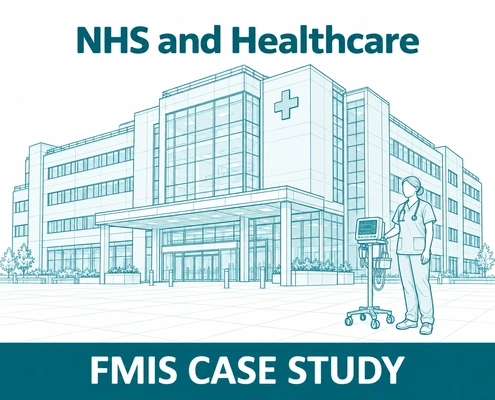

St George’s University Hospitals NHS Foundation Trust selected FMIS Fixed Assets in 2017 to replace an Access-based register with a system that supported its financial reporting requirements and offered flexible asset analysis. The Trust added FMIS Lease Accounting in 2022, extending the system to support its IFRS 16 transition and the relationship between lease records and fixed assets. Both modules now use UK cloud hosting.
Case Study



Challenges



Client Overview: St George’s University Hospitals NHS Foundation Trust provides general and specialist healthcare services in southwest London and beyond. Its main sites include St George’s Hospital in Tooting and Queen Mary’s Hospital in Roehampton. The finance team’s asset records cover a wide-ranging estate, including buildings, medical equipment, IT assets and furniture.
The Trust relied on a fixed asset register held in an Access database, which was both unreliable and not user-friendly. When evaluating replacement systems, the finance team wanted straightforward data entry, accessible reporting and enough flexibility to retain the information needed for financial analysis.
A key requirement was to simplify the creation of notes for the annual and management accounts while maintaining a strong audit trail. The register also needed to record depreciation, revaluations and impairments, accommodate corrections and support the Trust’s preferred classifications and cost centre analysis.
Migration also needed to preserve the information the finance team relied on, including descriptions, locations and medical equipment references. Where one financial asset record covered several equipment items, the new register needed to retain those cross-references.
NHS trusts and foundation trusts prepare their annual reports and accounts under the Department of Health and Social Care Group Accounting Manual. Accordingly, the Trust asset register must support the financial information required for reporting, alongside the organisation’s own asset classifications and accounting policies.
For St George’s, this included revaluation balances, depreciation on revalued assets, changes to useful lives and the timing of depreciation. Adding lease accounting later introduced a further requirement: connecting lease liabilities and right-of-use assets to the existing register without duplicating assets already recorded.

“Depreciation and revaluation are easy and accurate on the FMIS asset register.”
David Mallagh
Project Manager
St George’s University Hospitals NHSFT
A dedicated FMIS consultant helped the Trust prepare its existing records for the new register. Working with the finance team, they agreed the coding structure and how to retain longer descriptions, medical equipment references, locations and cost centres so the data would support the Trust’s reporting and analysis needs.
FMIS provided import templates and guidance on mapping the records, helping to reduce the risk of errors during migration. Practical training also helped the team start using the register for additions and other asset transactions.
FMIS helped the Trust configure its asset register around its accounting policies, using quarterly periods and setting depreciation to begin in the quarter after an asset became available for use.
The finance team also had specialist support to apply those policies to postings, transfers, revaluations and changes to useful lives. This included guidance on calculating depreciation after a revaluation and spreading the effect of a useful-life change over the asset’s remaining life.
The Trust added FMIS Lease Accounting in 2022 to support its IFRS 16 transition and link lease records with the associated right-of-use assets in Fixed Assets.
Existing finance leases required particular care because their assets were already on the register. FMIS provided a process for importing these leases, retaining existing asset identifiers and linking records between the two modules. This approach was designed to avoid creating duplicate right-of-use assets.
The finance team also had guidance on reconciling asset values held against lease records with existing net book values, and on how adjustments to a right-of-use asset differed from adjustments to the lease liability.
St George’s now uses FMIS Fixed Assets and Lease Accounting with UK cloud hosting, having extended its original fixed asset system to include lease accounting.
In their feedback on the fixed asset implementation in 2018, the Trust highlighted several practical benefits:
David also described migration from the old system as fairly straightforward, saying the helpful and knowledgeable FMIS team made the move easier.
St George’s experience shows how a fixed asset implementation can provide a foundation for later lease accounting work. The original project focused on usability, financial reporting and asset analysis. The subsequent expansion addressed the relationship between lease records, liabilities and existing fixed assets.
Why did St George’s choose FMIS Fixed Assets?
The Trust wanted a user-friendly system that met its statutory reporting requirements and allowed flexible analysis of asset data. Its testimonial also highlights bulk processing and helpful migration support.
How did the lease accounting project address assets already on the register?
FMIS provided a migration process that retained existing fixed asset identifiers and linked them to lease records. The approach was designed to avoid creating duplicate right-of-use assets and to support reconciliation of asset values.
Did the implementation replace the Trust’s medical equipment database?
The project focused on the financial asset register, retaining references to the Trust’s separate medical equipment database so the finance team could match records between the two.
Which FMIS modules does the Trust use?
St George’s uses FMIS Fixed Assets and Lease Accounting, with UK cloud hosting. The relationship began with Fixed Assets in 2017, and Lease Accounting was added in 2022.
FMIS provides fixed asset accounting software, lease accounting software and implementation support for healthcare organisations.
Learn more about FMIS software for the NHS and healthcare sector, or request a product demonstration to discuss your requirements.
 https://www.fmis.co.uk/wp-content/uploads/2026/09/FMIS-Fixed-Assets-version-12.47-product-update.webp
396
495
John de Robeck
https://www.fmis.co.uk/wp-content/uploads/2026/04/FMISNavyTeal-1-150x80-1.webp
John de Robeck2026-09-17 15:15:282026-09-17 15:15:30What is new in FMIS Fixed Assets version 12.47
https://www.fmis.co.uk/wp-content/uploads/2026/09/FMIS-Fixed-Assets-version-12.47-product-update.webp
396
495
John de Robeck
https://www.fmis.co.uk/wp-content/uploads/2026/04/FMISNavyTeal-1-150x80-1.webp
John de Robeck2026-09-17 15:15:282026-09-17 15:15:30What is new in FMIS Fixed Assets version 12.47 https://www.fmis.co.uk/wp-content/uploads/2026/09/FMIS-Lease-Accounting-version-12.47-product-update.webp
396
495
John de Robeck
https://www.fmis.co.uk/wp-content/uploads/2026/04/FMISNavyTeal-1-150x80-1.webp
John de Robeck2026-09-17 15:14:582026-09-17 15:15:01What is new in FMIS Lease Accounting version 12.47
https://www.fmis.co.uk/wp-content/uploads/2026/09/FMIS-Lease-Accounting-version-12.47-product-update.webp
396
495
John de Robeck
https://www.fmis.co.uk/wp-content/uploads/2026/04/FMISNavyTeal-1-150x80-1.webp
John de Robeck2026-09-17 15:14:582026-09-17 15:15:01What is new in FMIS Lease Accounting version 12.47 https://www.fmis.co.uk/wp-content/uploads/2026/09/FMIS-AccountMate-Integration-for-FMIS-Fixed-Assets.webp
450
495
John de Robeck
https://www.fmis.co.uk/wp-content/uploads/2026/04/FMISNavyTeal-1-150x80-1.webp
John de Robeck2026-09-09 17:48:582026-09-21 18:12:04AccountMate Fixed Asset Integration with FMIS
https://www.fmis.co.uk/wp-content/uploads/2026/09/FMIS-AccountMate-Integration-for-FMIS-Fixed-Assets.webp
450
495
John de Robeck
https://www.fmis.co.uk/wp-content/uploads/2026/04/FMISNavyTeal-1-150x80-1.webp
John de Robeck2026-09-09 17:48:582026-09-21 18:12:04AccountMate Fixed Asset Integration with FMIS https://www.fmis.co.uk/wp-content/uploads/2026/08/Asset-Depreciation-Methods-.webp
450
500
John de Robeck
https://www.fmis.co.uk/wp-content/uploads/2026/04/FMISNavyTeal-1-150x80-1.webp
John de Robeck2026-08-27 12:51:012026-09-22 08:30:14Asset Depreciation Methods Explained for UK Businesses
https://www.fmis.co.uk/wp-content/uploads/2026/08/Asset-Depreciation-Methods-.webp
450
500
John de Robeck
https://www.fmis.co.uk/wp-content/uploads/2026/04/FMISNavyTeal-1-150x80-1.webp
John de Robeck2026-08-27 12:51:012026-09-22 08:30:14Asset Depreciation Methods Explained for UK Businesses
