FMIS Software
  • Home
  • Solutions
    • Fixed Asset Management Systems
      • Capital Projects
      • Enterprise Asset Management
      • Fixed Asset Management Software
    • Asset Tracking
      • Barcode Tracking
      • FMIS Mobile Asset Manager
    • Purchase to Pay
      • Purchase Order Processing
      • Sales Order Processing
    • Stock and Inventory
      • Kitting and Assembly
      • Material Requirements Planning (MRP)
      • Production Control
    • Equipment Maintenance
      • Field Service Management
    • Lease Accounting
      • Order Management
  • Market Sectors
    • Public Sector
      • Local Government and Councils
      • Central Government
      • Government Agencies and Public Bodies
      • Emergency Services
    • Commercial and Retail
    • Education
    • Health
    • Manufacturing
    • Non-Profit
    • Oil, Gas and Energy
  • Partners
    • Deltek
    • Find a partner
    • Become a Partner
  • Resources
    • Trust Centre
      • Certifications & Assurance
      • Data Protection & Privacy
      • Cloud Security & Infrastructure
    • News and articles
    • Case studies
    • Fixed asset management guide
  • About us
  • Contact
    • Request a demo
    • Pricing
    • Product information
    • Customer Support
    • Careers
    • Training Feedback
  • Click to open the search input field Click to open the search input field Search
  • Menu Menu
You are here: Home1 / Articles2 / Equipment Maintenance: A Complete UK Guide

Equipment Maintenance: A Complete UK Guide

Equipment maintenance keeps machinery running, safe, and supported by a reliable maintenance history. This guide explains what equipment maintenance is, the main approaches, what a CMMS does, and how the right software turns a reactive, firefighting operation into a planned one. Written for the teams that run the assets, not for a procurement checklist.

equipment-maintenance-complete-guide-square-500x450

Equipment maintenance keeps machinery running, safe, and supported by a reliable maintenance history. This guide explains what equipment maintenance is, the main approaches, what a CMMS does, and how the right software turns a reactive, firefighting operation into a planned one. Written for the teams that run the assets, not for a procurement checklist.

Stop Firefighting. Start Maintaining.

Equipment fails when maintenance is reactive. Costs rise, downtime is unpredictable, and the maintenance history that would explain why it keeps failing simply does not exist. A planned equipment maintenance programme, backed by the right software, solves all three problems in one place.

FMIS equipment maintenance software is built for UK engineering firms, asset-owning organisations, and facilities with equipment spread across multiple sites. When used alongside FMIS Fixed Assets, it can connect to the corresponding fixed asset register, helping maintenance and finance work from aligned records rather than disconnected systems.

 What Happens When Equipment Maintenance Has No System

Reactive maintenance looks cheap until you add up the damage: unplanned downtime on a production line, emergency call-out charges, parts sourced at premium, and the safety risk of sudden failure. Three common patterns signal a maintenance operation that has outgrown its spreadsheets:

  •     Schedules slip because no one tracks what is due until something breaks.
  •     Maintenance history disappears when engineers leave, leaving the next person with no idea what was done or what it cost.
  •     Finance and maintenance keep separate lists of the same equipment, so asset values drift out of line with reality.

Unaddressed, those patterns compound. Even one avoided breakdown can materially reduce the cost and disruption associated with unplanned maintenance.

What Equipment Maintenance Software Actually Does

Day to day, equipment maintenance software raises and assigns work orders, schedules preventive maintenance automatically, logs completed work against each asset, and reports on cost and reliability. It removes the manual chasing and transcription that slow paper and spreadsheet systems down.

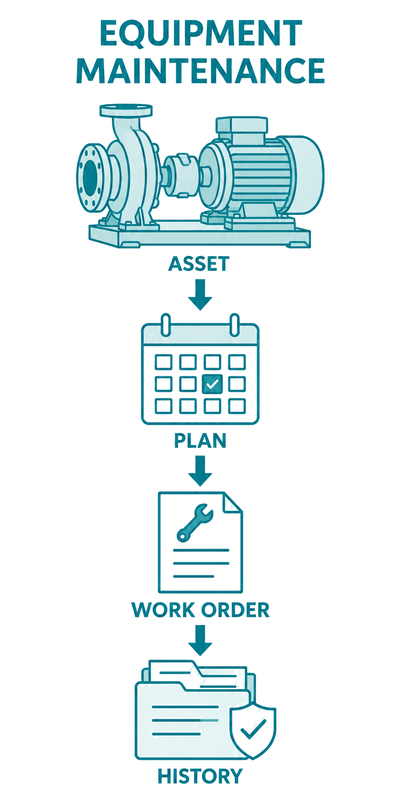
The core of any equipment maintenance system is four things working together:

  •     Work orders: every job captured, assigned, tracked, and closed, whether planned or reactive.
  •     Preventive maintenance scheduling: recurring tasks raised automatically when they fall due, with no manual tracking.
  •     Asset records: one record per asset holding make, location, and full maintenance history.
  •     Reporting: cost, downtime, and reliability figures that turn the record into decisions management can act on.

FMIS goes further by connecting maintenance directly to the fixed asset register. Where FMIS Equipment Maintenance is configured alongside FMIS Fixed Assets, maintenance activity can be associated with the corresponding asset record. The disposal process can then be reflected across the relevant maintenance and accounting records, subject to the configured workflow. This integration helps reduce the risk of ghost assets and of asset information becoming inconsistent between teams.

Preventive Maintenance That Actually Runs

Most preventive programmes fail not from poor intent but from no reliable trigger. When a schedule lives in a spreadsheet, tasks slip in busy periods and no one notices until equipment fails. FMIS raises the work order automatically when it falls due, by date or by usage, so the schedule holds regardless of workload. Our guide on how to create a preventive maintenance plan sets out the practical steps.

A Complete Maintenance History Per Asset

Every closed work order in FMIS records what was done, who did it, the parts and time used, and the cost, all against the asset it relates to. Over time that record answers the questions spreadsheets cannot: how often does this machine fail, what has it cost this year, and is it approaching the point where replacement is cheaper than repair? Those answers inform better capital decisions, not just better maintenance decisions.

 Integration with Fixed Asset Management

Standalone maintenance tools can create a second system that finance has to reconcile against. FMIS Equipment Maintenance can be used alongside the fixed asset register, so maintenance history and disposal information can be associated with the corresponding asset record. This can help maintenance and finance keep their records aligned.


Built for Practical Implementation, Not Months of Configuration

A common reason maintenance software fails is an implementation so heavy the team never fully adopts it. FMIS is built around the practical middle ground: it handles the core maintenance job without the configuration overhead of a large enterprise platform. Implementation timescales depend on scope, data readiness and configuration, without necessarily requiring the extended implementation associated with some larger enterprise platforms.

Compliance Evidence on Demand

For regulated organisations, a maintenance record is not optional; it provides evidence that equipment was inspected and serviced on schedule. FMIS keeps a timestamped record of every job, so demonstrating compliance is a matter of running a report rather than reconstructing history from paper and memory.

Proven Across UK Organisations

NHS Bristol Barcode tracking of assets across multiple hospital sites, with maintenance and asset records aligned.
N-SEA Offshore equipment management across a demanding oil and gas environment.


Read the full N-SEA offshore equipment management case study and our equipment and maintenance case study for detailed, quantified outcomes.

How FMIS Equipment Maintenance Works

  1. Set up your asset records: import from your existing register or build from scratch. Every asset gets its own record with location, details, and schedule.
  2. Define your maintenance schedules: set frequencies by time or usage for each asset. FMIS raises work orders automatically when they fall due.
  3. Raise and close work orders: planned and reactive jobs managed in one place, each recorded against the asset with parts, time, and findings.
  4. Report and improve: cost, downtime, and overdue-task reports tell you which assets are reliable and which are candidates for replacement.


Why FMIS Rather Than a Standalone Maintenance Tool

Fixed asset integration Linked maintenance and fixed asset records can reduce reconciliation, duplicate disposal entries and the risk of ghost assets.
Focused maintenance scope FMIS focuses on maintaining equipment and facilities assets. It can support facilities teams where this is the core requirement, but it is not a complete CAFM platform for space, property or wider estates management. It can also manage maintenance records and schedules for vehicles treated as assets, but it is not a full fleet management system for routing, drivers, fuel or telematics.
40 years of UK experience Built around the way UK engineering, public sector, and manufacturing organisations actually run maintenance.
G-Cloud 14 listed Procurement-ready for NHS Trusts, local authorities, universities, and other public sector bodies.
ISO 27001 certified Data security standards that regulated and public sector clients require.
Practical implementation Implementation scope and timescale depend on requirements, data and configuration; many organisations can operate FMIS without a dedicated system administrator.

What is Equipment Maintenance?

Equipment maintenance is the coordinated planning, scheduling, and recording of all work done to keep machinery and assets in working order. Its aim is to maximise uptime and asset life while controlling cost and meeting safety and compliance obligations.

In practice it covers a handful of connected activities: deciding what maintenance each asset needs, scheduling it, raising and tracking the work, and recording what was done. Done well, those records feed back into better decisions, such as when to service, when to repair, and when to replace. Equipment maintenance is therefore as much about information as it is about spanners: the value comes from a reliable history for every asset, not just from the individual jobs.

What is a CMMS?

A CMMS, or computerised maintenance management system, is software that manages equipment maintenance in one place: raising work orders, scheduling preventive maintenance, holding a record for each asset, and reporting on it. It replaces the spreadsheets and paper job cards that most teams start with.

The Main Types of Maintenance

There are several maintenance approaches used by UK organisations. Reactive maintenance fixes things after they fail. Preventive maintenance services equipment on a schedule to stop failures. Planned maintenance is any work organised in advance. Most teams use a blend. The right split depends on the consequence of failure for each asset.

More advanced approaches such as predictive and condition-based maintenance suit sensor-heavy, specialised environments. For most engineering firms and asset-owning organisations, a solid preventive and planned regime delivers the gains without the instrumentation overhead. Our guide to preventive versus reactive maintenance sets out when to use each.

CMMS vs Spreadsheets: When to Move

A spreadsheet is a fine place to start and a poor place to stay. The move to a CMMS is worth making once schedules start slipping, history is lost when people leave, or no one can quickly say what an asset has cost to maintain. Those are the signals the spreadsheet has been outgrown.

How Equipment Maintenance Software Pays Back

The return rarely shows as a single dramatic saving. It can accumulate through fewer avoidable breakdowns, better adherence to service schedules, and answers pulled from the record rather than memory. Over time, the benefits may be reflected in improved uptime and reduced emergency maintenance spend.

Equipment Maintenance and Compliance

In sectors from healthcare to engineering, an incomplete maintenance record is a genuine risk. Regulators and insurers expect equipment to be inspected and serviced on a defined schedule, and expect records to prove it. A maintenance system keeps a timestamped record of every scheduled and completed job, so demonstrating compliance is a matter of running a report rather than reconstructing history.

Frequently Asked Questions

What is equipment maintenance?

Equipment maintenance is the planning, scheduling, and recording of all work done to keep machinery and assets in working order. It aims to maximise uptime and asset life while controlling cost and meeting safety and compliance obligations. It covers reactive, preventive, and planned work.

What does CMMS stand for?

CMMS stands for computerised maintenance management system. It is software that centralises equipment maintenance work orders, preventive schedules, asset records, and reporting in one place.

What is the difference between a CMMS and an EAM?

A CMMS focuses on maintenance: work orders, schedules, and asset history. Enterprise asset management (EAM) is broader, covering the full asset lifecycle including procurement and finance. For most maintenance teams, a practical CMMS integrated with their asset and financial systems covers the need without the scope of a full EAM.

Is a CMMS the same as CAFM?

Toggle Content go

No. CAFM (computer-aided facilities management) is aimed at managing buildings and space, including room booking and space planning. A CMMS is aimed at maintaining equipment and assets. There is overlap, but they solve different problems.

es here

Do small teams really need equipment maintenance software?

If a spreadsheet still tells you exactly what is due, what was done, and what it cost, it may be enough. Most teams outgrow that quickly: schedules get missed, history is lost when people leave, and reporting becomes guesswork. A simple system can become worthwhile once missed maintenance starts causing material downtime or administrative effort.

Does FMIS replace a CAFM system?

No, and it is not designed to. FMIS supports equipment and facilities maintenance but is not a full CAFM platform for space planning or room booking. It works best where the priority is maintaining equipment and keeping a clear history per asset.

How does FMIS equipment maintenance connect to the fixed asset register?

FMIS maintenance sits alongside the fixed asset register so work orders can be associated with the corresponding FMIS asset record. Configured workflows can help keep maintenance and fixed asset records aligned when an asset is disposed of, reducing duplicate records and ghost-asset risk.

Can FMIS handle equipment maintenance across multiple sites?

Yes. FMIS can support organisations with assets distributed across multiple sites. Asset records, maintenance schedules, and work orders are managed centrally with site-level visibility.

See FMIS Equipment Maintenance Software in Action

Book a demo and see how FMIS integrates equipment maintenance and fixed asset management in one practical system.

Book a Demo View Case Studies

About the author

John de Robeck leads new business and partnerships at FMIS, working with organisations to understand asset and equipment maintenance requirements, software fit and related compliance considerations.

Read full bio

Pages

  • Accessibility
  • Account
  • Book a Call with FMIS
  • Book an Exploratory Call with FMIS
  • Brochure-download
  • Case Studies
  • Central Government
  • Certifications & Assurance
  • Cloud Security & Infrastructure
  • Cookie Policy
  • Data Protection & Privacy
  • Demo
  • Emergency Services
  • Exploratory call
  • Feedback Call Confirmation
  • FMIS Asset Tracking and CMMS Demo
  • FMIS Asset Tracking Capterra
  • FMIS CMMS Capterra
  • FMIS Fixed Asset Management Capterra
  • FMIS Lease Accounting Capterra
  • FMIS Mobile Asset Manager Demo
  • FMIS phone support
  • FMIS Training Feedback
  • Government Agencies and Public Bodies
  • Incident Management & Business Continuity
  • Landing Page – Capterra – CMMS Software
  • Landing Page – FMIS Asset Management Software
  • Landing Page – FMIS Fixed Asset Management
  • Landing Page – FMIS Fixed Asset Management
  • Landing Page – fmis-fixed-asset-management-softwaresuggest
  • Landing Pages
  • Local Government and Councils
  • Login
  • Logout
  • Members
  • Password Reset
  • Portfolio
  • PPlus Test page
  • Pricing
  • Production Control
  • Public Sector
  • Regional Compliance
  • Register
  • Secure Development
  • Trust Centre
  • Trust Centre FAQs
  • User
  • Vulnerability Management & Testing
  • Deleting your FMIS Mobile Asset Manager Account
  • Deltek Marketplace Partner
  • Enhanced Purchasing
  • Fixed Asset Management Systems
  • FMIS Fixed Asset Management Software
  • FMIS Fixed Assets Demo
  • FMIS Mobile Asset Manager
  • FMIS Solutions
  • Partner Plus Book A Call
  • Request a product demonstration
  • Asset Tracking
  • Deltek Brochure Download
  • Market Sectors
  • Materials Management
  • Optimising Production for Engineering Firms Guide
  • Request product information
  • Add-on solutions and Partners
  • Enhanced Asset Management
  • Purchase to Pay
  • FMIS Partner Plus Program
  • Stock and Inventory
  • Contact
  • Deltek Product Information
  • Equipment Maintenance
  • Lease Accounting
  • About FMIS
  • About FMIS – Draft
  • Barcode Tracking
  • Capital Projects
  • Demo confirmation
  • Field Service Management
  • Fixed Asset Software for Charities Non-profit organisations
  • News & Resources
  • Privacy policy
  • Purchase Order Processing
  • Resources
  • Staff Training Log
  • Access Group add-ons
  • Asset Management Software for Retail and the Commercial Sector
  • Asset Tracking Glossary
  • Equipment Maintenance Glossary
  • Fixed Asset Management Glossary
  • Fixed Asset Management software
  • Fixed asset management software guide
  • Lease Accounting Glossary
  • Sales Order Processing
  • FMIS Customer Support
  • Careers
  • Enterprise Asset Management
  • Fixed Asset Management for Education
  • Enterprise Asset Management for Oil and Gas
  • Fixed Asset Software for Local and Central Government
  • Fixed Asset Software for the NHS and Health Sector
  • Kitting and Assembly
  • Order Management
  • Solutions for Manufacturing Companies
  • Client Patch June 2016
  • Material Requirements Planning (MRP)

Categories

  • Access
  • AccountMate
  • Aerospace
  • Archive
  • Asset Tracking
  • Automotive
  • Awards
  • Barcode
  • Canada
  • Case studies
  • Case study
  • Commercial
  • Construction
  • Deltek
  • Deltek Ajera
  • Deltek for Professional Services
  • Deltek Vantagepoint
  • Education
  • Emergency Services
  • Energy
  • Engineering
  • Environmental
  • Equipment Maintenance
  • Events
  • Fixed Assets
  • FMIS Internal
  • Frontpage Article
  • Health and NHS
  • Infosec
  • Ireland
  • Kitting and Assembly
  • Lease Accounting
  • Logistics
  • Manufacturing
  • Market Sectors
  • News
  • Not for Profit
  • Oil, Gas and Energy
  • Partners
  • Product Updates
  • Public Sector
  • Purchase Order Processing
  • Purchase to Pay
  • Recruitment
  • Region
  • Resources
  • Sales Order Processing
  • Solutions
  • Stock and Inventory
  • Training
  • Uncategorized
  • United Kingdom
  • United States
  • Vision
  • Vision case study

Archive

  • September 2026
  • August 2026
  • April 2026
  • March 2026
  • February 2026
  • January 2026
  • October 2025
  • June 2025
  • May 2025
  • January 2025
  • December 2024
  • October 2024
  • July 2024
  • May 2024
  • April 2024
  • March 2024
  • November 2023
  • October 2023
  • September 2023
  • August 2023
  • July 2023
  • June 2023
  • May 2023
  • April 2023
  • March 2023
  • February 2023
  • January 2023
  • December 2022
  • November 2022
  • October 2022
  • September 2022
  • June 2022
  • April 2022
  • November 2021
  • October 2021
  • March 2021
  • April 2020
  • March 2020
  • February 2020
  • December 2019
  • October 2019
  • July 2019
  • April 2019
  • March 2019
  • December 2018
  • June 2018
  • February 2018
  • December 2017
  • July 2017
  • March 2017
  • December 2016
  • November 2016
  • May 2016
  • April 2016
  • March 2016
  • December 2015
  • September 2015
  • June 2015
  • March 2015
  • February 2015
  • November 2014
  • September 2014
  • August 2014
  • July 2014
  • June 2014
  • May 2014

SOLUTIONS

  • Fixed Asset Management Systems
  • Asset Tracking
  • Purchase to Pay
  • Order Management
  • Equipment Maintenance
  • Lease Accounting
  • Stock and Inventory
  • View all solutions

Home › Articles › Equipment Maintenance: A Complete UK Guide

Market Sectors

  • Commercial and Retail
  • Education
  • Local and Central Government
  • NHS and Health
  • Manufacturing
  • Non-profit
  • Oil, Gas and Energy

FOLLOW US

FMIS Twitter FMIS Linkedin

CONTACT US

FMIS Ltd
167b John Wilson Business Park
Whitstable
Kent
CT5 3RA
United Kingdom

Phone:+44 (0) 1227 773003
Fax:+44 (0) 1227 773005
Sales:sales@fmis.co.uk
Support:support@fmis.co.uk

Copyright © 2024 - All rights reserved www.fmis.co.uk
  • Privacy Policy
  • Cookie Policy
Scroll to top