
A practical guide for finance teams

Lease accounting guide

Understand lease accounting, from identifying an agreement to calculating lease balances and preparing year-end reports.

This guide is for accountants, finance managers and financial controllers responsible for lessee accounting. It covers the main concepts in IFRS 16, revised FRS 102 Section 20 and ASC 842, with a worked IFRS 16 example and practical checks for your finance team.

Written by John de Robeck · Sources checked 9 October 2026 · About 18 minutes to read

This guide focuses on accounting for property, equipment and other assets your organisation leases. The accounting treatment depends on your reporting framework and the terms of each agreement.

Browse all lease accounting resources for specialist guides, practical articles and related case studies.
FMIS Lease Accounting Guide Feature Image

What is lease accounting?

Lease accounting is the process of recognising, measuring and reporting the financial effects of lease agreements. It connects the right to use an asset with the obligation to make payments for that use.

The lessee uses the asset and makes lease payments. The lessor provides the asset. For a finance team leasing office space or equipment, accounting involves more than recording the rental invoice: it may also require a lease liability, a right-of-use asset, subsequent expenses and disclosures.

Does the agreement contain a lease?

Start with the substance of the agreement. Under IFRS 16, a lease involves control over the use of an identified asset for a period in exchange for consideration. Ask whether the customer obtains substantially all the economic benefits and directs how and for what purpose the asset is used. A supplier’s substantive substitution rights can affect whether there is an identified asset. [1]

A contract described as a service may contain a lease. Conversely, paying for access to equipment does not automatically mean the customer controls it. Review the relevant standard’s definition and scope before calculating anything.

Practical starting point: compare the lease register with property, procurement and operational records. Ask colleagues about assets used under service agreements as well as contracts labelled “lease”.

Which lease accounting standard applies?

Your organisation’s financial reporting framework determines the standard. A group may need more than one reporting basis; location alone does not determine the answer.

IFRS 16

For entities reporting under IFRS Accounting Standards. Lessees generally recognise a right-of-use asset and lease liability, with depreciation and interest accounted for separately. Optional recognition exemptions cover qualifying short-term leases and leases of low-value assets. [2]

Read the IFRS 16 lease accounting guideFMIS software for IFRS 16

FRS 102 Section 20

For entities applying FRS 102. Revised lessee requirements generally bring leases onto the balance sheet, with short-term and low-value exemptions. The principal Periodic Review 2024 changes apply to periods beginning on or after 1 January 2026. Early application requires the relevant amendments to be applied together. [3] [5]

Read the FRS 102 changes overviewRead the FRS 102 lease accounting guideFMIS software for FRS 102

ASC 842

For entities applying US GAAP. Both operating and finance leases are generally recognised on the balance sheet. Classification affects expense recognition and cash-flow presentation: operating leases generally have a single lease cost, while finance leases have separate interest and amortisation. [4]

Read the ASC 842 lease accounting guideFMIS software for ASC 842

Check the reporting period and the available elections

A FRS 102 period beginning before 1 January 2026 may still use the previous requirements if the amendments have not been adopted early. Transition accounting also differs from accounting for a new lease. Establish the applicable version and transition choices before preparing opening balances. [5]

The standards are not interchangeable. In particular, ASC 842 has no equivalent general low-value lease exemption, and revised FRS 102 does not prescribe a universal £5,000 low-value threshold. Document your assessment and policy elections under the relevant framework. [3] [6]

Under IFRS 16 and revised FRS 102, a short-term lease has a term of 12 months or less at commencement and contains no purchase option. IFRS 16 assesses low value using the underlying asset’s value when new. Revised FRS 102 has a broader low-value exemption: assess the underlying asset on an absolute basis under Section 20, rather than by annual rent or an automatic monetary threshold. See the FRS 102 lease accounting guide for the specific eligibility rules. [3] [9]

Key lease accounting terms and judgements

Lease liability
The obligation to make the lease payments included in the calculation. At commencement, these future payments are discounted to their present value. Payment timing matters: an amount due immediately is not discounted in the same way as a future payment.
Right-of-use asset
The asset representing the lessee’s right to use the underlying property or equipment. Its initial cost can include adjustments for prepayments, incentives, qualifying initial direct costs and restoration obligations, so it need not equal the initial liability. [7]
Lease term and options
The accounting term may differ from the first stated contract period. Under IFRS 16, assess the enforceable period and whether extension options are reasonably certain to be exercised, or termination options reasonably certain not to be exercised. Economic incentives and leasehold improvements can matter. Keep evidence supporting the conclusion. [8]
Lease payments and service components
Separate the invoice total from the accounting inputs. Fixed payments, index- or rate-linked amounts, usage-based charges, incentives and service components may require different treatment. Identify lease and non-lease components and any permitted separation election under your standard before building the schedule.
Discount rate
The rate used to convert future payments into today’s value. IFRS 16 uses the rate implicit in the lease if readily determinable, otherwise the lessee’s incremental borrowing rate. Revised FRS 102 also permits an obtainable borrowing rate as an alternative to the incremental borrowing rate when the implicit rate is not readily determinable. Check the framework rather than copying a default rate across the register. [7] [3]

ASC 842 also uses the implicit rate when readily determinable, otherwise the incremental borrowing rate. Lessees that are not public business entities may elect a suitable risk-free rate by class of underlying asset when the implicit rate is not readily determinable. [10]

Record the reasoning, not just the result. A reviewer should be able to trace the term, rate, payment treatment and exemptions to the agreement and your accounting policies. Software can calculate from these inputs; the finance team remains responsible for the judgements.

From lease agreement to financial reporting

A controlled process separates contract facts, accounting decisions and calculated outputs. Assign an owner to each stage so that new agreements and changes reach finance promptly.

  1. Identify and assess

    Find agreements containing leases. Confirm the framework, scope, components and any recognition exemption. Keep a record of excluded agreements and the reason for exclusion.

  2. Gather the contract facts

    Record the entity, asset, agreement reference, commencement date, payment dates and amounts, options, incentives and amendments. Reconcile the payment schedule to the signed agreement.

  3. Approve the accounting inputs

    Agree the lease term, discount rate and relevant elections. Establish how service charges, variable payments and initial asset adjustments will be treated. Record who approved the assumptions.

  4. Calculate and review

    Calculate opening balances and subsequent schedules under the applicable framework. Check advance or arrears payments, rate frequency and the final balance. Investigate unexpected results before posting.

  5. Post and reconcile

    Prepare the required journals using your account mappings. Reconcile the lease records, right-of-use assets and general ledger. Retain evidence of checks and approval.

  6. Monitor and report

    Review changes during the lease, complete period-end controls and prepare the information required for presentation, disclosures and audit.

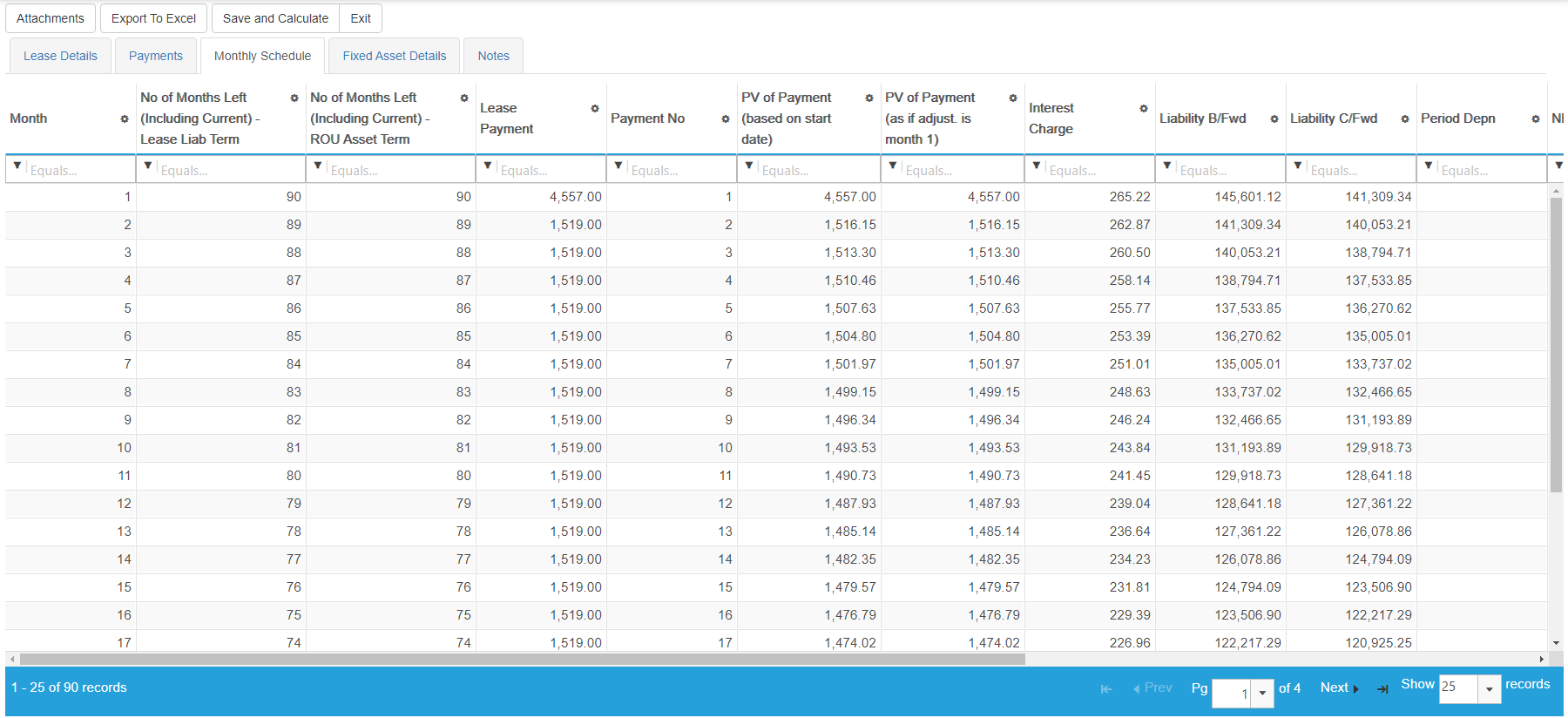
FMIS lease accounting Monthly Schedule showing lease payments, interest and opening and closing liability columns.

FMIS Monthly Schedule, using demonstration data. This is a software illustration and does not show the worked example below. Open screenshot full size (new tab).

A simple lease accounting example

This example illustrates the IFRS 16 lessee cost model for a new equipment lease. It is not a transition calculation or an ASC 842 operating lease example.

Example assumptions

  • The lease commences on 1 January 2027 and ends on 31 December 2029.
  • Three fixed payments of £12,000 are due annually in arrears, on each 31 December.
  • The effective annual discount rate is 5%, assumed appropriate after assessment.
  • No recognition exemption applies. There are no extension or purchase options, ownership transfer, service components, variable payments, incentives, prepayments, initial direct costs or restoration obligations.
  • The asset’s useful life exceeds the three-year lease term. Depreciation is straight-line over that term. VAT, impairment and subsequent changes are excluded.

1. Calculate the opening balances

The initial liability is the present value of the three unpaid lease payments:

£12,000 ÷ 1.05 + £12,000 ÷ 1.052 + £12,000 ÷ 1.053 = £32,678.98

With no initial asset adjustments, the opening right-of-use asset is also £32,678.98. The total contractual payments are £36,000; discounting accounts for the difference.

2. Follow the liability through the lease

Each year, interest increases the liability and the payment reduces it.

Scroll sideways to view the full table.

IFRS 16 annual lease liability schedule (£)
Year ending
31 December
Opening
liability
Interest Payment Closing
liability
2027 32,678.98 1,633.95 12,000.00 22,312.93
2028 22,312.93 1,115.65 12,000.00 11,428.58
2029 11,428.58 571.42 12,000.00 0.00

Figures are rounded to pennies. Final-year interest includes a £0.01 rounding adjustment so the fixed payment clears the liability. Total interest is £3,321.02.

3. Depreciate the right-of-use asset separately

Annual depreciation is approximately £10,892.99. It reduces the asset, rather than the lease liability.

Scroll sideways to view the full table.

Right-of-use asset schedule (£)
Year ending
31 December
Depreciation Closing carrying
amount
2027 10,892.99 21,785.99
2028 10,892.99 10,893.00
2029 10,893.00 0.00

Final-year depreciation includes a £0.01 rounding adjustment. The liability and asset start at the same amount but follow different paths.

4. Prepare the opening and first-year journals

Scroll sideways to view the full table.

Illustrative IFRS 16 entries (£)
When Debit Credit Amount
1 January 2027 Right-of-use asset Lease liability 32,678.98
Year ended 31 December 2027 Interest expense Lease liability 1,633.95
Payment on 31 December 2027 Lease liability Cash 12,000.00
Year ended 31 December 2027 Depreciation expense Accumulated depreciation: right-of-use asset 10,892.99

These annual entries simplify the illustration. Your posting frequency, account codes and actual transaction dates will determine the operational journals.

What does this mean for the financial statements?

At the end of 2027, this example has a lease liability of £22,312.93 and a right-of-use asset carrying amount of £21,785.99. Interest and depreciation total £12,526.94, although the cash payment is £12,000.00. Accounting expense, cash paid and outstanding liability therefore answer different questions.

Do not copy this expense pattern into an ASC 842 operating lease calculation. Classification under ASC 842 changes subsequent measurement and the expense pattern, even though operating leases are generally on the balance sheet. [4]

Lease changes, reporting and audit

Review changes before recalculating

An extension, termination, rent review or renegotiation is a prompt for assessment. Establish what changed, when it takes effect and whether it is a modification, reassessment or another event under your framework. That assessment determines the accounting, including whether to revise the discount rate, adjust the asset or recognise a gain or loss.

Keep the signed amendment, the approved treatment and the previous calculation. Also consider whether circumstances indicate impairment of the right-of-use asset. Sale-and-leaseback arrangements, subleases, foreign-currency leases and complex modifications require more detailed guidance than this introductory example.

Complete the period-end checks

  • Completeness: confirm new leases, amendments and ended agreements have reached the register.
  • Inputs: review effective dates, payment changes and any assumptions requiring reassessment.
  • Movements: explain changes in liability and asset balances, including additions, payments, interest, depreciation and adjustments.
  • Reconciliation: agree the schedules to the general ledger and investigate differences.
  • Presentation: check asset and liability classifications, including current and non-current amounts where required.
  • Disclosure information: prepare the framework-specific qualitative and quantitative information and record review approval.

Prepare disclosures as well as balances

A liability schedule alone is not the financial statement note. Your reporting framework may require information about lease expenses, cash flows, maturity of payments, right-of-use assets, exemptions and significant judgements. Use a disclosure checklist for the applicable standard and reporting period; requirements differ. [3] [4]

Keep evidence that another person can follow

Retain agreements and amendments, the rationale for judgements and exemptions, approved input records, schedules, journal mappings, reconciliation results and review sign-offs. A colleague or auditor should be able to trace a reported balance back to its source and understand changes since the previous period.

Common mistakes to check for

  • Using contract signature rather than asset availability to identify commencement.
  • Discounting the full invoice without assessing service and variable components.
  • Using the wrong payment timing or mixing annual rates with monthly periods.
  • Assuming the asset and liability must remain equal.
  • Applying the same exemption, rate or modification treatment under every standard.
  • Updating a schedule without updating postings, evidence and reconciliations.

Lease accounting guides and practical resources

Use the guide as a starting point, then follow the route relevant to your work.

Common lease accounting questions

Spreadsheets can support a small, stable portfolio if calculations, changes and review controls are well managed. As the number of leases, users or reporting requirements grows, consider how you will preserve versions, review inputs, reconcile balances and reproduce prior-period results. Assess software against those needs.

Lease administration manages the agreement, dates, obligations and operational actions. Lease accounting determines how the agreement is recognised and reported in the financial statements. The same contract records support both, so finance and operational teams need a clear handover for new agreements and changes.

The responsible finance team should approve accounting judgements, with contract facts supplied by the relevant property, procurement or operational owners. Technical accounting support may be needed for unusual terms. Establish these responsibilities before importing the register or generating journals.

Do not assume so. Confirm the accounting basis, classification, elections and reporting period for each requirement. An IFRS 16 example does not establish the expense treatment for an ASC 842 operating lease, and FRS 102 transition balances need their own assessment.

Support with your lease accounting process

FMIS Lease Accounting helps finance teams maintain lease records, calculate schedules, manage adjustments and prepare reporting outputs for IFRS 16, FRS 102 and ASC 842. FMIS Lease Accounting does not support multi-currency. If your next step is to review how your organisation manages that work, explore the software or discuss your requirements with our team.

Sources and further reading

Use the current applicable standard for detailed application. The links below support the principal accounting points in this guide; historical summaries and updates are identified as such.

  1. IFRS Interpretations Committee: definition of a lease and substitution rights · March 2023 Update, April 2023 addendum.
  2. IFRS Foundation: IFRS 16 Leases and IFRS 16 project summary · Overview and explanation of the lessee model.
  3. FRC: FRS 102 and subsequent amendments · See Section 20 of the September 2024 edition and applicable amendments.
  4. FASB: Accounting Standards Codification · ASC 842 is the authoritative US GAAP reference. The 2016-02 issuance document explains the original amendments and is not a substitute for current codification.
  5. FRC: FRS factsheets · Factsheet 9 (May 2026) addresses initial application; Factsheet 11 addresses lessee accounting.
  6. FASB: September 2020 leases roundtable paper · Historical background on the Board’s decision about a low-value exemption.
  7. HMRC Business Leasing Manual: initial measurement under IFRS 16 · Explanation of liability and right-of-use asset measurement.
  8. IFRS Interpretations Committee: lease term and useful life of leasehold improvements · November 2019 agenda decision.
  9. HMRC Business Leasing Manual: scope and exemptions · IFRS 16 and revised FRS 102 overview.
  10. FASB ASU 2021-09: discount rates for lessees that are not public business entities · Issuance document explaining the risk-free rate election.