Transformational impact
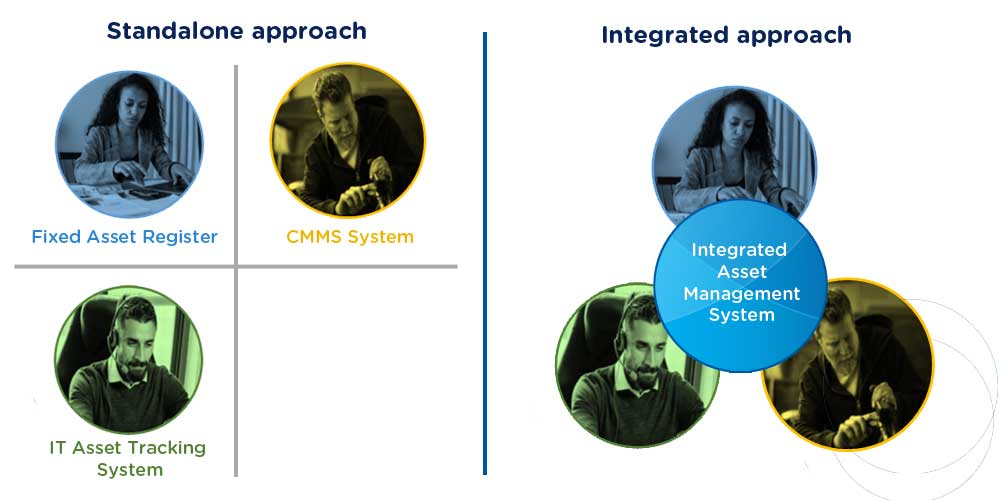
Creating an integrated approach to asset management can have a transformative impact on business efficiency and reporting:
- Improved accuracy in balance sheet reporting
- Greater visibility of assets from both financial and operational perspectives
- Increased income from the disposal of unwanted assets and consumables
- Increased efficiency through automating transfers, disposals, and capitalisation of large refit items.
- Providing change control and financial authorisation for key asset events
- Prevention of data duplication and need for manual data entry
- Enables accurate capital investment forecasts and planned equipment replacement strategies
- Provides an accurate total cost of ownership
Blockers to a holistic approach
Creating a joined-up approach to asset management will require you to overcome a number of potential blockers:
- Operational vs financial lifespan – Finance teams are primarily interested in the financial lifespan of a fixed asset regardless of what actual operational life it may have
- Different data sources – Different departments, organisations and systems may be involved in recording operational equipment details whilst fixed assets accounting is typically a specialist system managed by one or two people
- Big picture vs specifics – Finance teams are usually interested in a macro view of assets, while operations and IT will need a much more granular level of detail
- Capital vs non-capitalised – Capitalised property, plant and equipment is often only a sub-set of all operational equipment that requires tracking and perhaps maintenance, regardless of the balance sheet treatment
The three key processes
Any holistic approach will require a change in three key processes:
- Asset identification
- Asset linking
- Asset updates
Asset identification
Effective identification of new assets will require a coordinated approach to procurement. There are two key points where the identification of the equipment and then the asset needs to be harmonised:
- An equipment voucher in Accounts Payable (AP) or expenses for capital items
- Goods Receipt
Hopefully your purchasing process already identifies how new purchases should be treated at the point of order. Most organisations will have clear criteria for determining whether an asset is current (consumable) or fixed. Effectively classifying assets at the point of order is important for building a coherent register and tracking that asset over the full lifecycle.
Purchase orders may be generated either within the same system where the asset will be tracked or created in a separate ERP/finance system and then imported. If the asset management system includes its own Purchase Orders module like FMIS, this should allow users to check the availability of an asset before raising a PO/Requisition without moving between systems. This feature cuts down on duplicate purchases and streamlines the approval process.
Goods receipt will be the first time the equipment/asset item will appear within the asset eco-system. It is important to synchronise this step between the ERP and Equipment systems. From an ERP perspective, the goods receipt process is normally only significant if the commitment has to be recognised. In a joined-up view, it is important that this goods receipt event is pushed into the equipment system (or goods receipt is recorded in the global equipment system and then sent through to ERP).
Operational goods receipt will involve recording serial numbers and any bar code reference that can then be added to the unique equipment ref assigned by the receiving operational equipment system. By also recording the related purchase order details, the physical equipment record can then be associated automatically with any AP Invoice voucher raised in the ERP system.
Three-way invoice matching
The invoice matching process is key to achieving an integrated approach to asset management. From a simple accounting perspective, invoice matching against goods receipt may be sufficient, but this approach (two-way matching) has a number of important limitations for effective asset tracking. Firstly, it usually requires the double-entry of much of the purchase information for an asset contained in the purchase order (PO). Where the PO is held in the same system as the asset is tracked, then this information can be automatically linked to the new asset and does not need to be manually input. Secondly, two-way matching creates a disconnect in the asset record. There is no ready link between the purchase record and the actual asset.
Asset updates
Finance teams will often stop tracking assets from the point of receipt. They are simply added to the register and depreciated for the expected useful life. In practice, the asset lifecycle is seldom so linear. Over its lifetime, a piece of equipment may be transferred, repaired, partially disposed of or re-lifed. When it fully is disposed of, it may be sold on or scrapped and there may be costs/proceeds arising from that disposal.
It is impossible to build up an accurate cost of ownership for an asset, or even to know what assets are currently active if there is a disconnect between tracking systems for finance and operations.
Find out more
FMIS has implemented integrated fixed asset management in over 40 countries and over 30 years. For more information on how to get started with dashboards on your FMIS solution, please contact us via email at support@fmis.co.uk or call us on +44 (0) 1227 773003.


 Mike Clements is a senior consultant at FMIS with over 20 years experience in deploying integrated asset management and equipment tracking systems around the world.