What is fixed asset disposal?
| Fixed asset disposal is the removal of an asset from a business when it is sold, scrapped, donated, or otherwise retired from use. In accounting terms, disposal means taking the asset and its accumulated depreciation off the balance sheet and recording any resulting gain or loss. |
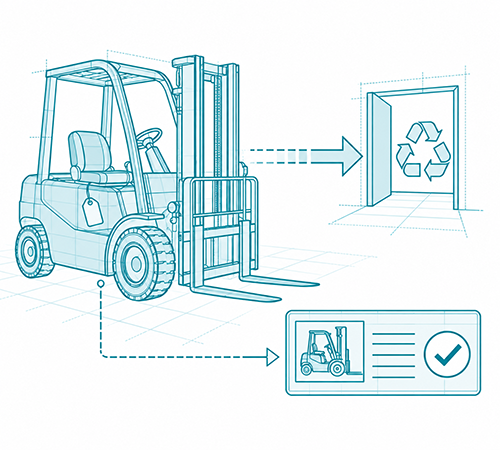
Every asset reaches the end of its working life eventually, whether it wears out, becomes obsolete, or is simply no longer needed. Disposal has two sides that must stay in step: the physical side, where the item leaves the business, and the accounting side, where its record is closed out. When only the physical side happens, the asset lingers on the books as a ghost asset, and the accounts drift out of line with reality.
When and why businesses dispose of fixed assets
A disposal is triggered whenever an asset stops earning its place on the register. It is the final stage of the asset lifecycle, and the most common reasons for reaching it are:
- The asset has reached the end of its useful life and is being replaced.
- It has become obsolete, superseded by newer technology or equipment.
- It is damaged beyond economic repair.
- It is being sold to raise cash or fund an upgrade.
- It is surplus to requirements after a restructure or site move.
Methods of disposing of a fixed asset
There is more than one way to retire an asset, and the method decides the accounting entries. The table below sets out the main routes.
| Method |
What it involves |
Accounting effect |
| Sale |
Sold to a third party for proceeds |
Compare proceeds against net book value for a gain or loss |
| Scrapping or write-off |
Physically discarded with no proceeds |
Loss equal to the remaining net book value |
| Donation |
Given to a charity or another body |
Loss equal to net book value; possible tax relief |
| Part-exchange |
Traded in against a new asset |
Trade-in value is treated as the proceeds |
| Internal transfer |
Moved to another group entity |
Recorded at the agreed transfer value |
The fixed asset disposal process step by step
A sound disposal follows the same sequence regardless of method. Work through these steps in order.
- Obtain approval. Confirm the disposal is authorised under your asset policy before anything leaves the building.
- Check the asset’s record. Pull its original cost, accumulated depreciation, and net book value from the register.
- Depreciate up to the disposal date. Charge depreciation for the part of the final period the asset was in use.
- Record the method and proceeds. Note whether it was sold, scrapped, or traded, and any amount received.
- Post the disposal journal. Clear the cost and accumulated depreciation, and book the gain or loss.
- Remove the asset from the register. Close the record so it stops attracting depreciation.
- Retain the evidence. Keep the approval, sale documents, and journal for the audit trail.
How to account for the disposal of fixed assets
| To account for a disposal, remove the asset’s original cost and its accumulated depreciation from the accounts, record any sale proceeds, and post the difference as a gain or loss on disposal. The net book value at the disposal date is the figure the proceeds are compared against. |
In practice the journal removes the asset cost with a credit, removes the accumulated depreciation with a debit, and brings in any proceeds as a debit to cash or receivables. The balancing figure is the gain or loss: a credit if you have made a gain, a debit if you have made a loss. The key figure driving all of this is the asset’s net book value, which is its cost minus accumulated depreciation at the disposal date.
Calculating the gain or loss on disposal (worked example)
| The gain or loss on disposal equals the sale proceeds minus the asset’s net book value. If the proceeds exceed net book value you record a gain; if they fall short you record a loss. |
Take a machine that cost £24,000 and has £20,000 of accumulated depreciation, giving a net book value of £4,000. Sell it for £5,000 and you record a £1,000 gain. Sell it for £3,000 and you record a £1,000 loss. Scrap it for nothing and the full £4,000 net book value is written off as a loss. The proceeds change; the net book value is always the benchmark.
Updating the fixed asset register after disposal
Once the journal is posted, close the asset in the fixed asset register so it stops accruing depreciation, but keep the historic record for reference and audit. This is the step most often missed. An asset that is physically gone but still sitting on the register becomes a ghost asset, quietly overstating the assets recorded in your accounts. Removing it correctly keeps the register and the accounts telling the same story.
A dedicated fixed asset management software can support this process by recording the disposal date and proceeds, stopping future depreciation, retaining the historical record and producing an audit trail. Journal posting and integration depend on the system and its configuration.
Capital allowances and disposal
For tax, disposal is handled separately from the accounting gain or loss. Where an asset sits in a main or special-rate pool, its disposal value is normally deducted from the pool; this may create a balancing charge, while a balancing allowance on those pools generally arises only when the qualifying activity ceases. Assets on which full expensing or a first-year allowance was claimed can require a separate disposal adjustment. Keep records of disposal proceeds for every asset and check current HMRC guidance or take professional advice, as the treatment depends on the allowance and circumstances.
Common fixed asset disposal mistakes
- Not depreciating the asset up to the disposal date, which distorts the gain or loss.
- Removing the asset physically but never from the register, creating ghost assets.
- Recording proceeds without clearing the accumulated depreciation.
- Disposing of assets with no approval or supporting paperwork.
- Confusing the accounting gain or loss with the tax balancing charge.
A worked example: the disposal journal
A worked journal makes the accounting concrete. Say a machine cost £24,000, has £20,000 of accumulated depreciation, and is sold for £5,000. You credit the asset cost account £24,000 to remove the machine, debit accumulated depreciation £20,000 to clear the charges built up against it, and debit cash £5,000 for the sale. The entries leave a £1,000 credit, which is the gain on disposal. Had the machine sold for £3,000, the same steps would leave a £1,000 debit, recorded as a loss. Scrap it for nothing and the full £4,000 net book value is written off.
Profit or loss on disposal and where it appears
| A profit or loss on disposal is recognised in profit or loss. Whether it is shown separately depends on the entity’s accounts, materiality and accounting policy. |
The distinction matters for anyone reading the accounts. A large gain on disposal can flatter operating results if it is buried in revenue, so it should be presented clearly in accordance with the entity’s accounting policy and the applicable reporting requirements. A profit on disposal arises when proceeds beat net book value, which often means the asset was depreciated faster than it actually lost value. A loss signals the reverse. Neither is a failure in itself, but a run of consistent gains or losses is a useful prompt to revisit your depreciation estimates.
Balancing charges, balancing allowances, and disposal proceeds
The tax treatment of a disposal uses the statutory disposal value, which may be the amount received or, in some cases, market value. This is separate from the accounting net book value. For assets in a main or special-rate pool, the disposal value is normally deducted from the pool, subject to the applicable limits. A balancing charge can arise in some circumstances, but a balancing allowance on these pools generally arises only when the qualifying activity ceases. Assets claimed under full expensing or a first-year allowance can be subject to separate disposal rules, so current HMRC guidance should be checked.
Disposal is one part of the wider discipline of fixed asset management, which keeps the asset register, depreciation, and retirement in step.