What is a Maintenance Schedule?
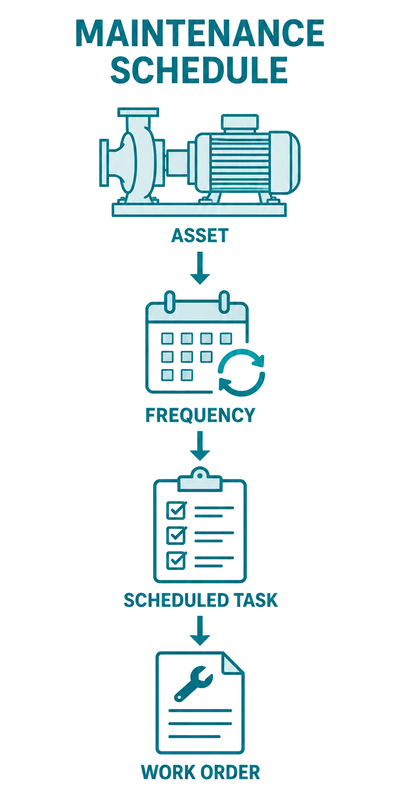
A maintenance schedule is a calendar of recurring inspections, services, and checks across your assets. Maintenance scheduling is the process behind it: deciding when each task should happen and assigning it to the right people and resources.
Scheduling is the operational half of preventive maintenance. Deciding to service a pump quarterly is a policy; the maintenance schedule is what makes sure the job is raised, resourced, and done every quarter without fail. The difference between the two is where most preventive programmes succeed or quietly fall apart.
How to Schedule Preventive Maintenance: Five Steps
Build a maintenance schedule in five steps: list your assets, decide what each one needs, set a frequency for each task, assign it to a person or team, and record every completed job so the schedule stays honest.
- List every asset you intend to maintain, taken from the asset register so nothing is missed.
- Define specific tasks for each asset: visual inspection, lubrication, part change, or calibration.
- Set a frequency and assign an owner to each task.
- Record completion after every job, because a schedule without a feedback loop drifts within months.
- Use software to generate work orders automatically when tasks fall due, rather than relying on memory.
For a fuller walk-through, see our guide on how to create a preventive maintenance plan, which takes these steps from a blank sheet to a working programme.
Setting the Right Maintenance Frequency
Set maintenance frequency by time or by usage, whichever better reflects how the asset wears. Time-based scheduling suits assets that degrade with age. Usage-based scheduling, by running hours, cycles, or mileage, suits equipment whose wear tracks how hard it is worked.
Getting frequency right is a balance. Too frequent and you waste effort and parts on servicing that was not needed; too infrequent and you are back to reactive breakdowns. Start with the manufacturer’s recommendation, then adjust using your maintenance history: use the evidence to review the interval, while continuing to follow manufacturer, statutory, insurance and safety requirements.
What is Planned Preventive Maintenance (PPM)?
Planned preventive maintenance (PPM) is a structured, scheduled programme of preventive tasks carried out at set intervals. It is the formal version of preventive maintenance: a documented plan of what is done to each asset and when, rather than ad hoc servicing.
PPM is the term most common in UK facilities and engineering contracts, where a PPM schedule is often a contractual deliverable. In substance it is preventive maintenance organised into a repeatable plan: each asset has its tasks, each task has its frequency, and the whole thing runs on a rolling calendar. A CMMS is the natural home for a PPM schedule because it can hold hundreds of recurring tasks and raise them without anyone tracking dates by hand.
Building a Maintenance Schedule Template
A basic maintenance schedule template lists each asset, its maintenance tasks, the frequency of each, the responsible person, and the last and next due dates. That structure is enough to run a preventive programme and maps directly onto how a CMMS stores the same information.
A spreadsheet template is a sensible starting point and fine for a handful of assets. Its limits appear as you scale: it will not remind anyone, does not link to asset history, and is easily overwritten. Those limits are the reason teams move to software once the schedule outgrows a single page. The columns stay the same; reminders, history, and reporting are what get added.
From Schedule to Work Order
A schedule says what should happen; a work order makes it happen. When a scheduled task falls due, it becomes a work order assigned to a technician, who carries it out and records the result. The completed work order updates the asset history and resets the schedule for next time. How to run that side well is covered in our guide to work order management.
Common Maintenance Scheduling Mistakes
The three most common scheduling mistakes: servicing everything at the same interval regardless of need, setting frequencies once and never revisiting them, and failing to record completed work so the schedule cannot be tuned. Each quietly undermines the programme.
A maintenance schedule is a living thing. Intervals set at launch are only a best guess, and maintenance history is what tells you whether they were right. Teams that never review their frequencies either waste effort on unnecessary servicing or keep suffering failures they thought they had designed out. A periodic review, informed by what was found at each service, is what turns a static schedule into one that improves over time.
How a CMMS Automates Scheduling
A CMMS can automate scheduling by holding recurring tasks and raising work orders when they become due, using the trigger types supported by the configured system. FMIS equipment maintenance software raises scheduled work automatically, records completion against the asset, and reports on what is overdue, so the schedule holds even during a busy period. That reliability is what separates a PPM plan that works from one that exists only on paper.