FMIS Software
  • Home
  • Solutions
    • Fixed Asset Management Systems
      • Capital Projects
      • Enterprise Asset Management
      • Fixed Asset Management Software
    • Asset Tracking
      • Barcode Tracking
      • FMIS Mobile Asset Manager
    • Purchase to Pay
      • Purchase Order Processing
      • Sales Order Processing
    • Stock and Inventory
      • Kitting and Assembly
      • Material Requirements Planning (MRP)
      • Production Control
    • Equipment Maintenance
      • Field Service Management
    • Lease Accounting
      • Order Management
  • Market Sectors
    • Commercial and Retail
    • Education
    • Government
    • Health
    • Manufacturing
    • Non-Profit
    • Oil, Gas and Energy
  • Partners
    • Deltek
    • Find a partner
    • Become a Partner
  • Resources
    • Trust Centre
    • News and articles
    • Case studies
    • Fixed asset management guide
  • About us
  • Contact
    • Request a demo
    • Pricing
    • Product information
    • Customer Support
    • Careers
    • Training Feedback
  • Click to open the search input field Click to open the search input field Search
  • Menu Menu
You are here: Home1 / Solutions2 / Asset Tracking3 / What are the Stages of Asset Lifecycle Management?

What are the Stages of Asset Lifecycle Management?

From the moment you identify an asset need to its eventual disposal, here’s how you can optimise the use of your organisation’s assets at every lifecycle stage

Written by: John de Robeck • Published: September 29, 2022 • Updated: March 10, 2026

  • Stages of the asset lifecycle
  • Benefits of asset lifecycle management
  • Asset management software

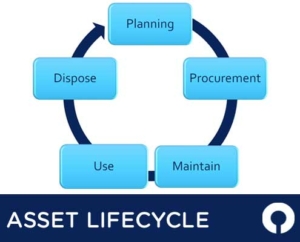
Asset lifecycle management allows you to get optimal performance from all the assets your organisation uses, no matter whether you’re a small business with a few pieces of equipment or a major enterprise with tens of thousands of assets across multiple locations. To boost efficiency across your asset management strategy, here’s everything you need to know about the five stages of asset lifecycle management.

What is an asset? 

An asset is an item that is owned by an organisation or individual that has value. Assets are split into tangible assets (physical assets such as land and machinery) and intangible assets (copyrights, trademarks, and IT assets such as computer software).

Within tangible assets, there are two sub-categories: current assets (cash, inventory) and fixed assets (equipment, buildings, machinery, and other physical resources which are used in a business’ operations and are unlikely to be sold). When we talk about asset lifecycle management, we’re talking about managing the lifecycles of fixed assets.

What is the asset lifecycle?

The asset lifecycle refers to each stage of an asset’s life within an organisation. Beginning with planning and procurement, the asset lifecycle covers operation, maintenance, and the eventual disposal of an asset. This process will differ between different assets, with various asset types having different useful lives. There may be a difference between the useful life of an asset from an accounting perspective and an operational perspective. From an accounting perspective, the useful life will be the period over which the asset is depreciated, but operationally, this may be until the cost of maintenance and repair eventually outweigh the cost of replacement.

What is asset lifecycle management?

Asset lifecycle management is a strategy used to optimise the efficiency and operational life of an asset during its lifecycle. This includes providing preventative maintenance and tracking assets. Without this strategy, assets may be poorly maintained or operated inefficiently, shortening their lifespan and leading to more frequent and often costly replacements.

Lifecycle management also allows organisations to plan ahead, forecasting when assets will reach their peak performance and how long they will last after that. This allows for more accurate planning that will maximise the useful life and uptime of assets.

Stages of asset lifecycle management

At each stage of the cycle, asset management allows you to get the most from the asset. Here’s how organisations can manage each phase of the process.

Planning

Although some people consider procurement to be the first part of the asset lifecycle, in most cases, planning is the real first step. This is where you identify a requirement, determine the asset specification and secure the necessary budget. This might mean considering a range of different assets to do the job, taking into account factors like price, maintenance costs, and expected operational life, and doing a cost-benefit analysis. Because organisations are reliant on their assets to function effectively, planning ahead is an essential part of asset management. Stakeholders such as operations teams and finance specialists will weigh in at this stage.

Procurement

This phase covers the purchasing, transportation, and installation of the asset in the facility. Depending on the scale and type of asset, this may be an expensive or lengthy process; vehicles or infrastructure assets may be cost-intensive in this phase, while smaller assets such as a hand-held tool or small piece of furniture are easier and cheaper. Safety checks and other preliminary checks may be conducted at this stage. An integrated purchasing solution will allow organisations to track assets seamlessly from planning to use through goods receipt.

Use

Use or utilisation should be an asset’s longest lifecycle stage. In this phase, the organisation should optimise the use of the asset to maximise uptime and effectiveness. Management of assets in this stage includes tracking, auditing, reporting, and maintaining the assets. As time goes on, the asset might need upgrades and patch fixes to stay up to date.

Maintenance

Managing the maintenance of the asset requires deciding which type of maintenance to use: preventative, predictive, routine, or another strategy. Planning maintenance also means understanding the asset’s maintenance requirements and how frequently it will need to be maintained. Because maintenance can be expensive and time-consuming, it’s important to plan maintenance to occur at optimal times in the lifecycle of the asset to maximise efficiency.

Disposal 

Once the maintenance costs of the asset outweigh the total cost of a replacement, or the asset becomes obsolete, it’s time for disposal. This includes assessing the cost and manner of disposal. At this stage, an organisation will need to decide how best to dispose of the asset. This may involve selling, repurposing, recycling, or throwing away the asset, depending on its type. With certain assets, the disposal process may include dismantling the asset so it can be recycled in an environmentally friendly manner, or in the case of IT asset management, removing or transferring all data before disposal.

Then, the asset management lifecycle begins again with planning for a new asset.

Benefits of asset lifecycle management

Strategic management is important at every stage of the asset lifecycle. Full lifecycle management has many benefits:

Reduce equipment downtime

With asset lifecycle management, organisations can reduce downtime by scheduling maintenance activities and planning ahead for new acquisitions. This allows them to get the maximum amount of use out of assets while minimising disruption to operations.

Optimise maintenance to extend asset lifespan

Maintenance management allows organisations to extend an asset’s period of peak performance, sometimes even allowing the asset to perform better than it originally did. Managing maintenance at the most effective times for the asset allows it to be kept operational for longer while minimising maintenance costs.

A more cost-effective approach to asset management

Increasing the efficiency and lifespan of assets results in a more cost-effective approach to asset management, as longer asset lifespans and fewer replacements mean spending less money. Proactive maintenance can be cheaper than reactive maintenance, allowing organisations to save costs on maintaining their assets.

A data-driven approach

Careful management of the asset lifecycle allows for a more data-driven decision-making process, with increased knowledge about the lifecycle and maintenance needs of assets. Asset information collected over the lifetime of an asset can be used to reduce asset costs and improve utilisation for example a high number of maintenance requests over a given period may indicate a wider issue and lead to early disposal or replacement.

Asset management software

Software can automate and streamline the process of asset management in many ways. A good asset management solution brings together data about the entire asset register, including information about asset status, history, location, condition, depreciation, and information about maintenance needs. Not only that, but it can automatically create work orders to carry out this maintenance. Moreover, the software can store asset information such as warranty documents, photos, and purchase history, which is useful for planning and maintenance.

Looking for new software to enhance your asset management capabilities? You may be interested in FMIS asset management and tracking software. Comprised of a range of integrated modules for fixed asset management, asset tracking, stock and inventory, equipment maintenance, and more, our solution can help you optimise your assets across the entire lifecycle. It is available as a cloud-based or on-premises solution, allowing you to choose the option that best suits your organisation, and even offers mobile asset management capabilities.

To learn more about the benefits of FMIS asset management solution, request a demo or get in touch today.

Share this entry
  • Share on Facebook
  • Share on X
  • Share on WhatsApp
  • Share on Pinterest
  • Share on LinkedIn
  • Share on Tumblr
  • Share on Reddit
  • Share by Mail
Best Practice in Fixed Asset Management

Best Practices in Fixed Asset Management

March 18, 2024
Capital Asset Management

What is Capital Asset Management Software? (CAM)

December 9, 2024
Integrated Fixed Asset Management

Integrated Fixed Asset Management

October 1, 2021
Scotland - simpler fixed assets | FMIS

Simpler together? Fixed assets in a new Scotland

September 11, 2014
G-Cloud 15 - Government Commercial Agency Supplier logo

FMIS awarded G-Cloud 15 supplier status

August 12, 2026
FMIS Asset Management Software awarded G-Cloud 15 Supplier Status for Fixed Asset Management, Lease Accounting, Asset Tracking & Equipment Maintenance software.
https://www.fmis.co.uk/wp-content/uploads/2026/08/GCA-Supplier-logo-G-cloud-15-500px.webp 500 500 John de Robeck https://www.fmis.co.uk/wp-content/uploads/2026/04/FMISNavyTeal-1-150x80-1.webp John de Robeck2026-08-12 16:28:312026-08-17 14:18:48FMIS awarded G-Cloud 15 supplier status
UK public-sector indexation

Indexation in UK Public Sector Fixed Asset Accounting

April 15, 2026
Understanding how indexation fits alongside revaluation is now essential for finance teams managing non-current assets in the public sector.
https://www.fmis.co.uk/wp-content/uploads/2026/03/UK-public-sector-indexation.webp 1024 1536 John de Robeck https://www.fmis.co.uk/wp-content/uploads/2026/04/FMISNavyTeal-1-150x80-1.webp John de Robeck2026-04-15 11:59:412026-04-15 11:59:44Indexation in UK Public Sector Fixed Asset Accounting
Non-Current Assets vs Fixed Assets In the UK public-sector

Why the UK Public Sector Is Moving from Fixed Assets to Non Current Assets

March 20, 2026
Why is the UK public sector shifting to non-current assets, and how does FMIS software enhance control and compliance?
https://www.fmis.co.uk/wp-content/uploads/2026/03/Non-Current-Assets-vs-Fixed-Assets.webp 500 500 Vicky Stanley https://www.fmis.co.uk/wp-content/uploads/2026/04/FMISNavyTeal-1-150x80-1.webp Vicky Stanley2026-03-20 15:49:272026-03-20 15:54:11Why the UK Public Sector Is Moving from Fixed Assets to Non Current Assets
FRS 102 Fixed Assets

FRS 102 Fixed Asset Accounting: A Practical Guide for UK Businesses

June 20, 2025
https://www.fmis.co.uk/wp-content/uploads/2025/06/Feature-image-495x400-copy.webp 400 495 John de Robeck https://www.fmis.co.uk/wp-content/uploads/2026/04/FMISNavyTeal-1-150x80-1.webp John de Robeck2025-06-20 15:08:202026-03-10 10:56:00FRS 102 Fixed Asset Accounting: A Practical Guide for UK Businesses
Support Icon
Can we help?
Book a demo View products Contact support
Or call: +44 (0) 1227 773003
Mon–Fri, 9:00–17:00 (BST/GMT)

Explore More

  • FMIS awarded G-Cloud 15 supplier status
  • Indexation in UK Public Sector Fixed Asset Accounting
  • Why the UK Public Sector Is Moving from Fixed Assets to Non Current Assets
  • Preparing for Charities SORP Lease Accounting Changes 2026
  • FRS 102 lease accounting changes 2026: what UK organisations need to know

SOLUTIONS

  • Fixed Asset Management Systems
  • Asset Tracking
  • Purchase to Pay
  • Order Management
  • Equipment Maintenance
  • Lease Accounting
  • Stock and Inventory
  • View all solutions

Home › What are the Stages of Asset Lifecycle Management?

Market Sectors

  • Commercial and Retail
  • Education
  • Local and Central Government
  • NHS and Health
  • Manufacturing
  • Non-profit
  • Oil, Gas and Energy

FOLLOW US

FMIS Twitter FMIS Linkedin

CONTACT US

FMIS Ltd
167b John Wilson Business Park
Whitstable
Kent
CT5 3RA
United Kingdom

Phone:+44 (0) 1227 773003
Fax:+44 (0) 1227 773005
Sales:sales@fmis.co.uk
Support:support@fmis.co.uk

Copyright © 2024 - All rights reserved www.fmis.co.uk
  • Privacy Policy
  • Cookie Policy
Link to: Why Use Web-Based Asset Tracking? Link to: Why Use Web-Based Asset Tracking? Why Use Web-Based Asset Tracking?Web Based Asset Tracking Link to: Asset Management vs Asset Tracking – What is the Difference? Link to: Asset Management vs Asset Tracking – What is the Difference? Asset Management vs Asset TrackingAsset Management vs Asset Tracking – What is the Difference?
Scroll to top
We use cookies on our website to give you the most relevant experience by remembering your preferences and repeat visits. By clicking “Accept All”, you consent to the use of ALL the cookies. However, you may visit "Cookie Settings" to provide a controlled consent.
Cookie SettingsAccept All
Manage consent

Privacy Overview

This website uses cookies to improve your experience while you navigate through the website. Out of these, the cookies that are categorized as necessary are stored on your browser as they are essential for the working of basic functionalities of the website. We also use third-party cookies that help us analyze and understand how you use this website. These cookies will be stored in your browser only with your consent. You also have the option to opt-out of these cookies. But opting out of some of these cookies may affect your browsing experience.
Necessary
Always Enabled
Necessary cookies are absolutely essential for the website to function properly. These cookies ensure basic functionalities and security features of the website, anonymously.
CookieDurationDescription
cookielawinfo-checkbox-advertisement1 yearSet by the GDPR Cookie Consent plugin, this cookie is used to record the user consent for the cookies in the "Advertisement" category .
cookielawinfo-checkbox-analytics11 monthsThis cookie is set by GDPR Cookie Consent plugin. The cookie is used to store the user consent for the cookies in the category "Analytics".
cookielawinfo-checkbox-functional11 monthsThe cookie is set by GDPR cookie consent to record the user consent for the cookies in the category "Functional".
cookielawinfo-checkbox-necessary11 monthsThis cookie is set by GDPR Cookie Consent plugin. The cookies is used to store the user consent for the cookies in the category "Necessary".
cookielawinfo-checkbox-others11 monthsThis cookie is set by GDPR Cookie Consent plugin. The cookie is used to store the user consent for the cookies in the category "Other.
cookielawinfo-checkbox-performance11 monthsThis cookie is set by GDPR Cookie Consent plugin. The cookie is used to store the user consent for the cookies in the category "Performance".
CookieLawInfoConsent1 yearRecords the default button state of the corresponding category & the status of CCPA. It works only in coordination with the primary cookie.
PHPSESSIDsessionThis cookie is native to PHP applications. The cookie is used to store and identify a users' unique session ID for the purpose of managing user session on the website. The cookie is a session cookies and is deleted when all the browser windows are closed.
viewed_cookie_policy11 monthsThe cookie is set by the GDPR Cookie Consent plugin and is used to store whether or not user has consented to the use of cookies. It does not store any personal data.
Functional
Functional cookies help to perform certain functionalities like sharing the content of the website on social media platforms, collect feedbacks, and other third-party features.
Performance
Performance cookies are used to understand and analyze the key performance indexes of the website which helps in delivering a better user experience for the visitors.
Analytics
Analytical cookies are used to understand how visitors interact with the website. These cookies help provide information on metrics the number of visitors, bounce rate, traffic source, etc.
CookieDurationDescription
CONSENT2 yearsYouTube sets this cookie via embedded youtube-videos and registers anonymous statistical data.
_ga2 yearsThe _ga cookie, installed by Google Analytics, calculates visitor, session and campaign data and also keeps track of site usage for the site's analytics report. The cookie stores information anonymously and assigns a randomly generated number to recognize unique visitors.
_gat_UA-48954022-11 minuteA variation of the _gat cookie set by Google Analytics and Google Tag Manager to allow website owners to track visitor behaviour and measure site performance. The pattern element in the name contains the unique identity number of the account or website it relates to.
_gid1 dayInstalled by Google Analytics, _gid cookie stores information on how visitors use a website, while also creating an analytics report of the website's performance. Some of the data that are collected include the number of visitors, their source, and the pages they visit anonymously.
Advertisement
Advertisement cookies are used to provide visitors with relevant ads and marketing campaigns. These cookies track visitors across websites and collect information to provide customized ads.
CookieDurationDescription
VISITOR_INFO1_LIVE5 months 27 daysA cookie set by YouTube to measure bandwidth that determines whether the user gets the new or old player interface.
YSCsessionYSC cookie is set by Youtube and is used to track the views of embedded videos on Youtube pages.
yt-remote-connected-devicesneverYouTube sets this cookie to store the video preferences of the user using embedded YouTube video.
yt-remote-device-idneverYouTube sets this cookie to store the video preferences of the user using embedded YouTube video.
Others
Other uncategorized cookies are those that are being analyzed and have not been classified into a category as yet.
SAVE & ACCEPT
Powered by CookieYes Logo