What is a Work Order?
A work order is a documented instruction to carry out a specific maintenance job. It records what needs doing, on which asset, by whom, and by when, and once complete it captures what was actually done, the parts and time used, and the cost. It is the record of a single piece of work.
Work orders come from two directions. Some are planned, generated from a preventive maintenance schedule when a service falls due. Others are reactive, raised when someone reports a fault. Either way, the work order is what turns a need into tracked, accountable action, and its completed record is what builds an asset’s maintenance history.
What is Work Order Management?
Work order management is the process of raising, prioritising, assigning, tracking, and closing maintenance work orders. Good work order management ensures every job is captured, the right jobs are done first, the risk of work being forgotten is reduced, and every completed job leaves a record.
Without a managed process, jobs live in people’s heads, on scraps of paper, and in email, so work is duplicated, forgotten, or done in the wrong order. A managed process gives everyone one list, one priority order, and one place to record what happened. That is where maintenance either holds together or unravels.
The Work Order Lifecycle
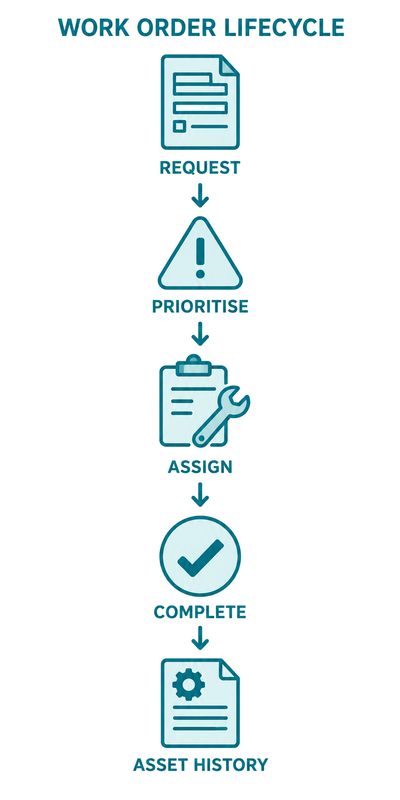
A work order moves through five stages: raised, prioritised and assigned, carried out, recorded, and closed. The recorded stage is the one most often skipped and the most valuable, because it turns completed work into a usable maintenance history.
- Raise: the job is captured with the asset, fault or task description, and any safety notes.
- Prioritise and assign: the job is ordered by consequence and given a clear owner.
- Carry out: the visible work happens.
- Record: parts, time, findings, and cost are captured against the asset.
- Close: the job is confirmed complete and, if scheduled, the next due date is reset.
Skip the recording step and you keep the equipment running but lose the data that would have explained why it keeps failing.
Work Order Tracking Best Practice
The core of good work order tracking: one shared, current list that everyone works from, clear priorities, and a discipline of recording completion. Every job is visible, its status is obvious, and nothing depends on a single person’s memory.
- Capture every job as a work order, however small, so nothing lives only in someone’s head.
- Prioritise by consequence, not by who reported the fault first.
- Assign clearly: each job needs one owner with no ambiguity.
- Record parts, time, and findings at completion. Unrecorded work is lost data.
- Review closed work orders regularly to spot assets that keep failing and tasks that recur.
Prioritising Work Orders
Prioritise work orders by the consequence of not doing them, not by who asked first. A safety-critical repair outranks a cosmetic one. A job on a production-critical asset outranks one on a spare. A clear, shared priority scheme stops the loudest request winning by default.
Most teams use a simple scale: safety, critical, routine, and low. The value is not the labels but the shared understanding. Everyone knows a safety job jumps the queue and a cosmetic one waits. Without that, prioritisation happens informally and inconsistently, which is how critical work ends up behind trivial jobs simply because the trivial job was reported more insistently.
Linking Work Orders to Asset History
Every work order should be tied to the asset it relates to, so the completed job becomes part of that asset’s permanent maintenance history. Over time that record shows which assets cost the most to keep running and which are candidates for replacement. Keeping that record reliable is covered in our guide to linking maintenance to asset records.
How a CMMS Manages Work Orders
A CMMS raises, assigns, and tracks work orders in one place, generates them automatically from preventive schedules, and records each completed job against its asset. FMIS equipment maintenance software handles scheduled and reactive work orders in the same system, keeps them tied to the asset record, and reports on status and cost, so the process stays reliable as volume grows.