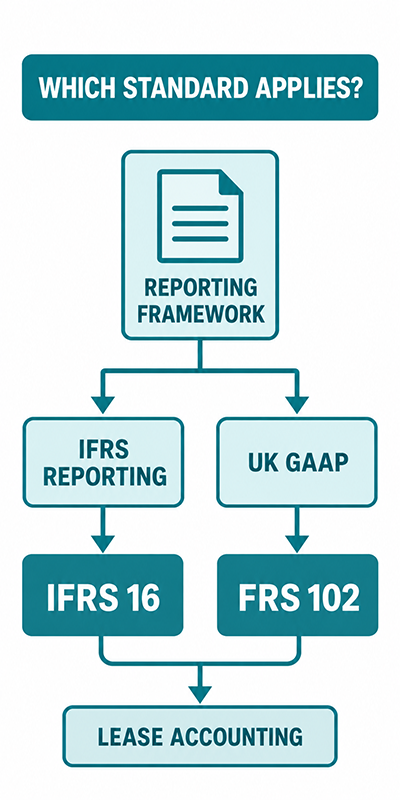
IFRS 16 vs FRS 102: which one applies?
IFRS 16 applies to entities that report under full international standards, typically listed groups and their subsidiaries, and others that choose IFRS. FRS 102 is UK and Ireland GAAP, applied by most private mid-market companies, charities, and groups that are not required to use full IFRS. Your reporting framework decides which lease rules you follow.
For most UK organisations the answer is FRS 102, because full IFRS is mainly required for listed entities and certain regulated groups. If you already prepare IFRS accounts, you are on IFRS 16. If you prepare UK GAAP accounts, you are on FRS 102, and the 2026 changes apply to you.
What is IFRS 16?
IFRS 16 is the international lease accounting standard, effective since 1 January 2019, issued by the IASB. It introduced a single lessee model that puts almost all leases on the balance sheet as a right-of-use asset and lease liability, replacing the old IAS 17 split between operating and finance leases for lessees.
IFRS 16 was the standard that started the shift to on-balance-sheet leasing. Our IFRS 16 explainer covers it in full, including the exemptions and the effect on the accounts.
What is FRS 102?
FRS 102 is the main financial reporting standard for UK and Ireland GAAP, used by entities that do not apply full IFRS. It is a single, simplified framework covering all of financial reporting, and it is reviewed periodically by the Financial Reporting Council. Its lease section was rewritten in the 2024 periodic review.
Until 2026, FRS 102 kept the older approach of splitting leases into operating and finance, similar to the pre-2019 international rules. The 2024 periodic review changed that. Our FRS 102 2026 guide covers the new lease model and the transition in detail.
How they differed before 2026
Before 2026 the difference was stark. IFRS 16 already put most leases on the balance sheet for lessees. FRS 102 still let lessees keep operating leases off the balance sheet and expense the rent, with only the commitments disclosed in the notes. Two similar businesses could look very different depending on which they used.
That gap mattered for anyone comparing an IFRS reporter with an FRS 102 reporter, or for a group with a mix of both. It is the main reason the FRC acted: to improve comparability and bring UK GAAP into line with the international approach.
How 2026 converges them
For periods beginning on or after 1 January 2026, FRS 102 adopts an on-balance-sheet lease model based on IFRS 16. Lessees stop splitting operating and finance leases and instead recognise a right-of-use asset and lease liability for most leases, just as IFRS 16 requires. The two standards now produce similar outcomes.
The direction of travel is clear: FRS 102 has moved to where IFRS 16 has been since 2019. For a lessee, the headline treatment is now the same under both, which is why the operating and finance distinction has effectively disappeared for most UK businesses.
The differences that remain after 2026
FRS 102 keeps the outcome of IFRS 16 but simplifies the method. The main remaining differences are a more practical discount rate, fewer triggers for remeasuring a lease, a simpler option for sale and leaseback, and lighter disclosures based on the standard for smaller entities.
- Discount rate: FRS 102 allows an obtainable borrowing rate, an easier alternative to IFRS 16’s incremental borrowing rate.
- Remeasurement: FRS 102 requires fewer situations to trigger a revised discount rate.
- Sale and leaseback: FRS 102 offers a simpler approach to recognising gains and losses.
- Disclosures: FRS 102 disclosures are lighter, based on the international standard for smaller entities.
- Low value: IFRS 16 does not prescribe a formal monetary threshold; FRS 102 also avoids a fixed figure and gives examples of assets that are not low value.
Which one do you report under?
If you prepare full IFRS accounts, you follow IFRS 16. If you prepare UK GAAP accounts under FRS 102, you follow FRS 102, including the 2026 changes. Charities apply FRS 102 through the Charities SORP, and UK public bodies follow IFRS 16 as adapted by the relevant government code.
So the practical route is to confirm your reporting framework first, then apply the matching lease rules. Charities should read our Charities SORP 2026 guide, and public sector bodies our public sector IFRS 16 guide, because each has sector-specific timing and detail.