A Complete Guide to Fixed Asset Registers
How finance teams build registers that enforce controls, support audit readiness and accelerate the period-end close.
Written by: John de Robeck • Published: September 27, 2023 • Updated: June 16, 2026
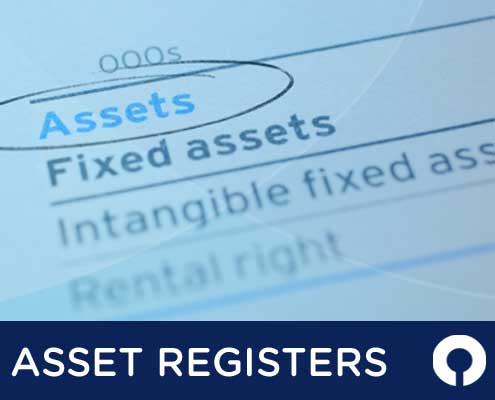

A fixed asset register is the single source of truth behind every depreciation charge, every impairment review and every fixed asset balance on the balance sheet. It is not just a record of what the business owns. It is the control through which finance teams maintain accuracy, enforce policy and satisfy auditors.
In practice, many organisations still manage their register in a spreadsheet, or split it across departments with no clear owner, no reconciliation routine and no audit trail. The result is predictable: misstated depreciation, ghost assets sitting on the balance sheet, failed physical verification counts, and a month-end close that takes longer than it should.
This guide is written for CFOs, financial controllers and finance managers who want to move past the basics. It covers what a register should contain, who should own it, how to build governance around it, the risks that come with multi-entity structures, and why specialist fixed asset accounting software generally outperforms ERP modules and spreadsheets.

Fixed assets are typically the largest or second-largest category on a balance sheet. Yet ownership of the register is often unclear. Facilities track locations. IT tracks serial numbers. Operations tracks maintenance. Finance is left reporting numbers from data it does not control.
This disconnect creates real risk. When nobody owns the register end to end, discrepancies between the physical asset base and the accounting records go undetected. Disposals are not recorded. Transfers between sites are missed. Capitalisation thresholds get applied inconsistently.
Finance should own the register because finance is accountable for the outputs: the capitalisation policy, the depreciation methodology, the impairment review process, and the reconciliation to the general ledger. Other departments can and should contribute data (location, condition, maintenance history) but the register itself must sit under finance.
In practice, this means the financial controller or a dedicated fixed asset accountant acts as the register’s custodian, with defined responsibilities for data integrity, periodic review and sign-off.
A well-structured register captures enough data to serve accounting, tax, operational and audit purposes at the same time. Each asset record should include, at a minimum:

FMIS asset record showing purchase and cost data
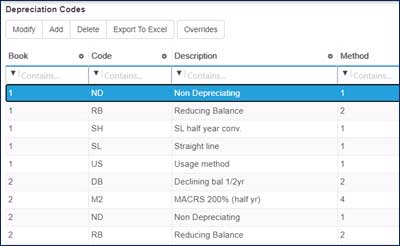
FMIS depreciation codes configuration
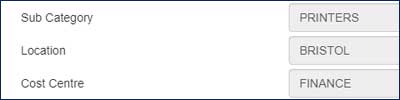
The depth of data captured should be proportionate to materiality. A £500 laptop does not need the same record detail as a £2 million production line, but every asset above the capitalisation threshold must be traceable from the general ledger to the register and back.
Fixed assets divide into two broad groups.

Physical assets with a useful life of more than one accounting period: land and buildings, plant and machinery, vehicles, IT equipment, furniture and fittings, and infrastructure assets such as roads or bridges. Each category typically carries its own depreciation policy.

Non-physical assets with identifiable future economic benefit: software licences, patents, trademarks, and development costs meeting the criteria for capitalisation under IAS 38 or FRS 102 Section 18. (Goodwill is typically managed separately for impairment testing.) Intangible assets are amortised rather than depreciated, and are often managed within the same register or a parallel register, but require the same standard of controls.
An accurate register is a controlled register. Without formal governance, data quality degrades over time. Assets get added without approval, disposals go unrecorded, and cost allocations are made on the basis of convenience rather than policy. The following controls should be embedded in the register workflow.

A written capitalisation policy defines the monetary threshold above which expenditure is treated as a fixed asset rather than expensed. It should also cover componentisation (whether a complex asset is recorded as one item or broken into separately depreciable components), the treatment of subsequent expenditure (repairs versus enhancements), and the criteria for capitalising internally generated intangibles. Review the policy annually and have the CFO or audit committee sign it off.
No single person should be able to create an asset record, approve its capitalisation, run the depreciation and authorise its disposal. Separating these responsibilities reduces the risk of error and fraud. In smaller teams where full segregation is not practical, compensating controls such as management review and periodic reconciliation become more important, not less.
Every addition, transfer, revaluation, impairment and disposal should pass through a defined approval workflow with a clear audit trail: who requested the change, who approved it, and when. Email-based approvals are difficult to audit and easy to bypass. Specialist asset management software enforces these workflows as a matter of course.
The register must reconcile to the general ledger at every reporting period. Total cost, accumulated depreciation and net book value in the register should tie exactly to the corresponding nominal codes in the finance system. Any variance needs investigating before the trial balance is finalised. This reconciliation is the single most important control over fixed asset data integrity.
Organisations with multiple legal entities, subsidiaries or international operations face a set of challenges that a single-entity register does not need to address.
Each entity may hold its own fixed assets, but the group financial statements require a consolidated view. If registers are maintained separately, in different systems or different versions of the same spreadsheet, consolidation becomes a manual exercise that is slow, error-prone and hard to audit. A single register platform that supports multi-entity structures significantly reduces manual consolidation effort.
When assets move between entities, the transfer must be reflected in both the originating and receiving entity’s records, with the correct transfer value, any resulting gain or loss, and proper elimination on consolidation. Spreadsheets and basic ERP modules rarely handle this cleanly. Specialist systems automate the double-sided posting and keep a full transfer history.
International groups may need parallel books: one under local GAAP, another under IFRS, and possibly a third for tax. Each book may apply different depreciation methods, useful lives or revaluation models to the same physical asset. These books operate in parallel, allowing different depreciation treatments without duplicating the underlying asset record. Managing this in spreadsheets or a single-book ERP module becomes unsustainable at scale. Purpose-built fixed asset software supports multiple parallel books with independent depreciation rules per asset.
Different jurisdictions impose different rules on capital allowances, asset write-down periods and disposal treatment. A register that cannot segregate assets by tax jurisdiction, or cannot run separate tax depreciation schedules alongside accounting depreciation, creates compliance risk that compounds with every entity added to the group.

External auditors test fixed assets as standard because the balances are material and the risk of misstatement is inherent. A register that is audit-ready before the auditors arrive shortens the audit, reduces fees and avoids the qualification risks that come with incomplete records.
Every transaction affecting an asset, from initial recognition through each depreciation run to eventual disposal, should be logged with a timestamp, user identity and reason. Auditors sample transactions and trace them from source document to general ledger. If the trail breaks at any point, they will extend their testing, and that costs time and money.
Auditors expect to see a documented reconciliation between the asset register and the general ledger for every reporting period. This should be a formal, signed-off control, not an informal check. The reconciliation should identify and explain any differences, however small.
Purchase invoices, capitalisation approval forms, revaluation reports, impairment assessments and disposal authorisations should all be accessible from the asset record. If the auditor has to chase documentation across email threads, shared drives and filing cabinets, it signals weak controls.
Auditors look for consistent application of accounting policies. If one entity depreciates vehicles over five years and another over eight, there should be a documented reason. If the capitalisation threshold changed mid-year, there should be a board minute. Inconsistency without explanation raises questions about the register as a whole.
For many finance teams, fixed assets are a bottleneck in the month-end and year-end close. Depreciation needs to run, disposals need finalising, capital work in progress needs reviewing, and the register needs to reconcile to the ledger before the trial balance can be signed off.
The root cause is almost always process, not volume. When the register is well governed, close tasks become routine. Depreciation runs are automated. Disposal journals are pre-prepared. Reconciliation variances are near zero because the register and ledger have been kept in step throughout the period.
When the register is poorly governed, typically because it sits in a spreadsheet or a disconnected system, close tasks expand to fill the time available. Someone has to manually calculate depreciation. Someone has to check whether disposals have been posted. Someone has to build the reconciliation from scratch. Each of these tasks introduces delay and error.
A well-implemented fixed asset system should reduce fixed asset close tasks to hours, not days. The key enablers are automated depreciation posting to the general ledger, reconciliation reporting, and a defined workflow for transferring capital work in progress to the live register.
Organisations broadly have three options for managing their register: spreadsheets, the fixed asset module within an ERP, or specialist fixed asset accounting software. Each suits a different level of complexity, but only one delivers the depth of functionality that mid-market and enterprise organisations need.

Spreadsheets are everywhere because they are free, flexible and familiar. For a startup with a handful of assets, they can work. Beyond that, they become a liability. There are no access controls, no audit trail, no automated depreciation engine, no reconciliation capability and no way to enforce approval workflows. They are vulnerable to formula errors, accidental deletion and version conflicts. Most critically, there is no separation between data entry and data approval, so there is no segregation of duties.
Organisations relying on spreadsheets for fixed asset management consistently spend more time on period-end close tasks and are more likely to find errors during audit than those using dedicated systems.
Most major ERP platforms include a fixed asset module. These modules handle basic depreciation and integrate natively with the ERP’s general ledger, which is a genuine advantage. However, they are typically designed as a secondary function within a system built for transactional processing, not asset lifecycle management.
Common limitations include restricted depreciation methods, limited support for parallel books, basic or absent asset tracking, no physical verification workflow, weak reporting, and an inability to handle complex scenarios such as componentisation, transfers between entities or capital work in progress. Customising an ERP module to fill these gaps is expensive, slow and creates upgrade risk.
Specialist fixed asset accounting software, such as FMIS, is built from the ground up for asset lifecycle management. It typically provides:
| Capability | Spreadsheet | ERP Module | Specialist (e.g. FMIS) |
|---|---|---|---|
| Automated depreciation engine | ✗ | ✓ Basic | ✓ Full |
| Unlimited parallel books | ✗ | ~ Limited | ✓ |
| Multi-entity consolidation | ✗ | ~ Limited | ✓ |
| Transfers between entities | ✗ | ~ Limited | ✓ |
| Role-based access controls | ✗ | ✓ | ✓ |
| Approval workflows | ✗ | ~ Basic | ✓ Configurable |
| Complete audit trail | ✗ | ~ Partial | ✓ |
| GL reconciliation | ✗ Manual | ✓ Native | ✓ Automated |
| Physical verification / barcode | ✗ | ✗ | ✓ |
| Capital WIP management | ✗ | ~ Basic | ✓ |
Specialist systems integrate with existing ERP and finance platforms without requiring those platforms to be the master record for fixed assets. Finance teams get the depth they need for asset management while the ERP continues to do what it does best: transactional processing.
In the UK, there, there is no standalone legal requirement to maintain a fixed asset register in a prescribed format. However, the Companies Act 2006 requires companies to keep adequate accounting records sufficient to show and explain the company’s transactions and to disclose the financial position of the company with reasonable accuracy at any time. In practice, it is very difficult to meet this obligation for fixed assets without a register.
HMRC expects businesses to maintain records that support capital allowance claims, including details of the asset, its cost, the date of purchase and the depreciation or allowance applied. The register is the most practical way to hold this information.
For public sector organisations, the Government Financial Reporting Manual (FReM) and the CIPFA Code of Practice explicitly require a fixed asset register. For charities, the Charities SORP requires disclosure of tangible fixed assets by category. For NHS bodies, the Department of Health and Social Care’s Group Accounting Manual mandates detailed asset records.
While the law does not use the words “fixed asset register”, the reporting and compliance obligations around fixed assets make one essential for any organisation of meaningful size.
A fixed asset register is a governance tool, a compliance tool and a financial control in one. It is the mechanism through which finance teams enforce capitalisation policy, maintain depreciation accuracy, manage multi-entity complexity and deliver the audit-ready data that stakeholders and regulators expect.
Getting it right requires clear ownership (finance), robust controls (segregation, approval workflows, periodic reconciliation and physical verification), and the right technology. Spreadsheets and basic ERP modules have a ceiling. Organisations with material fixed asset bases, multiple entities or complex reporting obligations will reach that ceiling faster than they expect.
Specialist fixed asset accounting software, such as FMIS, removes that ceiling. It automates depreciation, enforces controls, supports multi-book and multi-entity structures, accelerates the period-end close, and builds the audit trail that gives finance teams and their auditors confidence in the numbers.

 https://www.fmis.co.uk/wp-content/uploads/2024/03/SoftwareSuggest-Awards-2024-495x400-1.webp
400
495
John de Robeck
https://www.fmis.co.uk/wp-content/uploads/2026/04/FMISNavyTeal-1-150x80-1.webp
John de Robeck2024-03-26 10:29:322026-03-10 10:57:34SoftwareSuggest Awards – FMIS recognised for easy implementation
https://www.fmis.co.uk/wp-content/uploads/2024/03/SoftwareSuggest-Awards-2024-495x400-1.webp
400
495
John de Robeck
https://www.fmis.co.uk/wp-content/uploads/2026/04/FMISNavyTeal-1-150x80-1.webp
John de Robeck2024-03-26 10:29:322026-03-10 10:57:34SoftwareSuggest Awards – FMIS recognised for easy implementation https://www.fmis.co.uk/wp-content/uploads/2023/10/Asset-Valuation-Methods-495x400-1.jpg
400
495
John de Robeck
https://www.fmis.co.uk/wp-content/uploads/2026/04/FMISNavyTeal-1-150x80-1.webp
John de Robeck2023-10-26 13:16:202026-07-01 10:14:59Asset Valuation Methods
https://www.fmis.co.uk/wp-content/uploads/2023/10/Asset-Valuation-Methods-495x400-1.jpg
400
495
John de Robeck
https://www.fmis.co.uk/wp-content/uploads/2026/04/FMISNavyTeal-1-150x80-1.webp
John de Robeck2023-10-26 13:16:202026-07-01 10:14:59Asset Valuation Methods https://www.fmis.co.uk/wp-content/uploads/2019/06/Feature-image-495x400.jpg
400
495
John de Robeck
https://www.fmis.co.uk/wp-content/uploads/2026/04/FMISNavyTeal-1-150x80-1.webp
John de Robeck2019-12-18 11:23:412026-03-10 11:09:42FMIS announces new NHS partnership
https://www.fmis.co.uk/wp-content/uploads/2019/06/Feature-image-495x400.jpg
400
495
John de Robeck
https://www.fmis.co.uk/wp-content/uploads/2026/04/FMISNavyTeal-1-150x80-1.webp
John de Robeck2019-12-18 11:23:412026-03-10 11:09:42FMIS announces new NHS partnership https://www.fmis.co.uk/wp-content/uploads/2019/11/Govmoney2019-495x400.jpg
400
495
John de Robeck
https://www.fmis.co.uk/wp-content/uploads/2026/04/FMISNavyTeal-1-150x80-1.webp
John de Robeck2019-12-02 17:25:102026-03-10 11:09:51FMIS to sponsor GovMoney 2019
https://www.fmis.co.uk/wp-content/uploads/2019/11/Govmoney2019-495x400.jpg
400
495
John de Robeck
https://www.fmis.co.uk/wp-content/uploads/2026/04/FMISNavyTeal-1-150x80-1.webp
John de Robeck2019-12-02 17:25:102026-03-10 11:09:51FMIS to sponsor GovMoney 2019


 Deltek ProjectCon 2023