FMIS Software
  • Home
  • Solutions
    • Fixed Asset Management Systems
      • Capital Projects
      • Enterprise Asset Management
      • Fixed Asset Management Software
    • Asset Tracking
      • Barcode Tracking
      • FMIS Mobile Asset Manager
    • Purchase to Pay
      • Purchase Order Processing
      • Sales Order Processing
    • Stock and Inventory
      • Kitting and Assembly
      • Material Requirements Planning (MRP)
      • Production Control
    • Equipment Maintenance
      • Field Service Management
    • Lease Accounting
      • Order Management
  • Market Sectors
    • Public Sector
      • Local Government and Councils
      • Central Government
      • Government Agencies and Public Bodies
      • Emergency Services
    • Commercial and Retail
    • Education
    • Health
    • Manufacturing
    • Non-Profit
    • Oil, Gas and Energy
  • Partners
    • Deltek
    • Find a partner
    • Become a Partner
  • Resources
    • Trust Centre
      • Certifications & Assurance
      • Data Protection & Privacy
      • Cloud Security & Infrastructure
    • News and articles
    • Case studies
    • Fixed asset management guide
  • About us
  • Contact
    • Request a demo
    • Pricing
    • Product information
    • Customer Support
    • Careers
    • Training Feedback
  • Click to open the search input field Click to open the search input field Search
  • Menu Menu
You are here: Home1 / Articles2 / Ghost Assets: How to Find, Remove and Prevent Them

Ghost Assets: How to Find, Remove and Prevent Them

A ghost asset is an item that remains recorded as active in the asset register even though it has been disposed of, lost, stolen or destroyed. An asset that is idle or temporarily unlocated should be investigated but is not automatically a ghost asset. Ghost assets can affect financial reporting, insurance information and audit work, and regular asset tracking and audits can help identify them.

Written by: John de Robeck • Published: September 21, 2026 • Updated: September 28, 2026

ghost-assets-find-remove-prevent-tall

Ghost assets usually build up gradually. Disposals may go unrecorded, transfers may not be reconciled and duplicate records may be carried forward, allowing the register to drift away from physical reality. The resulting impact depends on factors such as the asset’s remaining carrying amount, insurance arrangements and the organisation’s audit requirements.

This guide explains what ghost assets are, how they build up, and the practical steps to find, correct and prevent them. It is written for finance and asset management teams that want a register they can trust.

Think ghost assets are distorting your register?

See how FMIS helps identify and reduce them

What Are Ghost Assets?

Ghost assets are items that remain recorded as active in the fixed asset register even though the organisation no longer holds or controls them. In this article, ‘zombie asset’ refers to a physical item in use that does not appear in the register. Both represent a mismatch between the records and physical reality, but they create different operational and financial risks.

Common examples include laptops disposed of without the register being updated, equipment scrapped without a disposal record and duplicate entries created during a migration. Where an asset still has a carrying amount, failure to record its disposal may overstate fixed assets and allow depreciation to continue incorrectly. A fully depreciated ghost asset may not affect net assets, but it still leaves the gross cost, accumulated depreciation and operational register inaccurate. Any insurance impact depends on how cover and declared values are determined.

The term is worth defining precisely because it is often used loosely. A ghost asset is not simply an idle asset or a fully depreciated asset: if the item still exists and remains under the organisation’s control, it is not a ghost merely because it is unused or has a nil net book value. Conversely, a disposed, lost or destroyed asset may remain a ghost record even if it was already fully depreciated.

Why Do Ghost Assets Cost Money?

Ghost assets can create financial, insurance and audit issues. Where an unrecorded disposal leaves a carrying amount in the accounts, fixed assets may be overstated and depreciation may continue incorrectly. Insurance costs may also be affected where declared values or asset schedules include items that are no longer held.

  • Potentially overstated assets: fixed assets may be overstated where ghost records retain a carrying amount.
  • Potential excess insurance: declared values or asset schedules may include items that are no longer held.
  • Incorrect depreciation: depreciation may continue after an asset should have been derecognised.
  • Audit queries: physical verification may identify differences between the register and the assets located.

Where insurance cover is priced using a schedule of assets or declared values, ghost records may contribute to unnecessary premiums. Correcting the schedule may therefore reduce insurance costs, although the effect will depend on the organisation’s policy and how the insurer calculates cover.

The audit impact can also be significant. When a recorded asset cannot be located, further investigation may be needed to establish whether it was transferred, disposed of, lost or incorrectly recorded. Repeated discrepancies can lead to additional audit queries and reconciliation work, whereas an accurate register provides better evidence for the figures reported.

How Do Ghost Assets Accumulate?

Ghost assets accumulate mainly because disposals are not recorded. When an asset is scrapped, sold or lost and no one updates the register, it becomes a ghost. Untracked transfers, duplicate entries during migrations, and insufficient reconciliation all contribute to the build-up.

A common root cause is an incomplete disposal process. An old laptop may be handed to IT for recycling, a broken machine scrapped or a piece of furniture discarded without the asset register being updated. Over time, these unrecorded disposals can build into a significant number of ghost records.

Migrations can also introduce problems. When a register is moved from one system or spreadsheet to another, duplicate and stale records may be carried across. Maintaining the register day to day and reconciling migrated data are important preventive measures. Our guide to maintaining an accurate asset register sets out the routine that can reduce the risk of ghost assets forming.

Clean up your register and reduce avoidable costs.

Talk to FMIS

How Do You Find and Remove Ghost Assets?

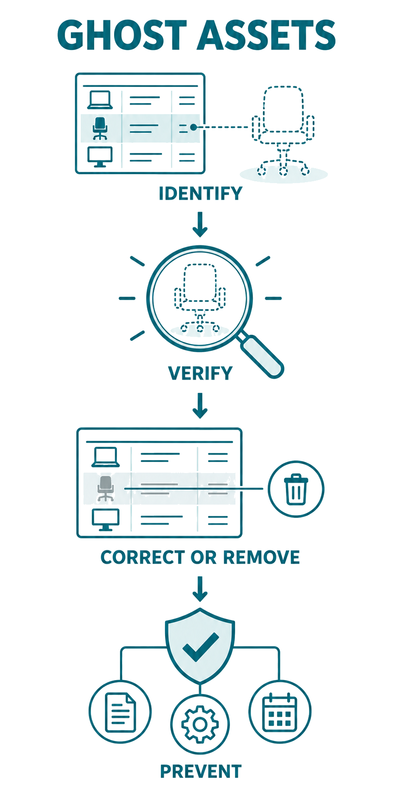
You find and correct ghost assets through a physical asset audit: verify the assets within the agreed scope, match the results against the register and investigate any recorded asset that was not located. Once a ghost record is confirmed, record the appropriate disposal or derecognition with the reason, date and authorisation, while retaining the audit history.

  1. Verify each physical asset within the agreed audit scope against the register, using barcode or QR tags where appropriate.
  2. Identify register entries with no matching scan: these are candidate ghost assets requiring investigation, not confirmed ghosts.
  3. Investigate each one: confirm whether it was disposed of, transferred, temporarily unlocated or lost.
  4. Record the appropriate disposal or derecognition for confirmed ghost records, with a documented reason and authorisation.
  5. Reduce recurrence by recording future disposals and transfers through a controlled process.

A structured physical audit provides a reliable way to identify potential ghost assets because it compares the agreed register population with the items located, rather than relying on memory. See our guide to asset audits and compliance for the full process.

The correction stage needs care and documentation. Depending on the asset’s carrying amount and circumstances, recording a disposal or derecognition may have an accounting effect. The reason, date and authorisation should be retained as part of the asset history, rather than deleting the record. The finance team or accountant should confirm the appropriate treatment for the organisation’s circumstances.

How Does Asset Tracking Help Prevent Ghost Assets?

Asset tracking can help prevent ghost assets by making disposals and transfers easier to record and reconcile. When in-scope assets are tagged and changes are captured in a central register, the risk of an asset leaving the organisation while remaining active in the records is reduced.

The process is most effective when updates are captured at the point of action. Recording a disposal or transfer as part of the physical process reduces reliance on a separate spreadsheet or later administrative update, while controlled approvals and reconciliation provide the necessary oversight.

Regular scan-based tracking can help organisations identify discrepancies earlier and reduce the risk of ghost records accumulating. It cannot make missed disposals impossible, because the process still depends on people following the agreed procedure. For the full picture, read the complete guide to asset tracking.

How Do Ghost Assets Affect the Balance Sheet?

Where a ghost asset has a remaining carrying amount, fixed assets and total assets may be overstated, and depreciation may continue incorrectly until the disposal is recorded. If the asset is fully depreciated, net assets may be unaffected, although gross cost, accumulated depreciation and the underlying register remain inaccurate.

When a confirmed ghost asset is corrected, the organisation should record the appropriate disposal or derecognition in line with its accounting policies. Any gain or loss will depend on factors including the disposal proceeds and carrying amount. Regular reconciliations generally make discrepancies easier to investigate than an infrequent large-scale clean-up.

This is why finance teams need to consider ghost assets even when individual items are low in value. Where the asset register feeds financial reporting, inaccurate records can affect the information produced. The specific accounting and tax treatment depends on the organisation’s circumstances and should be confirmed with a qualified accountant.

Keeping the register accurate is also a core part of managing assets well. The international standard ISO 55000 sets out general principles for realising value from assets across their life cycles. Accurate asset information supports those principles.

How Do You Prevent Ghost Assets From Returning?

You reduce the risk of ghost assets returning by improving the disposal process, tagging assets within the agreed scope, recording changes at the point of action and auditing on an appropriate cycle. Preventive controls can reduce the need for repeated large-scale clean-ups.

  • Fix disposals: make recording a disposal a required step whenever an asset leaves, not an optional afterthought.
  • Tag in-scope assets: consistent identification makes physical verification and reconciliation easier, with the tracking policy determining what should be tagged.
  • Record at the point of action: capture transfers and disposals promptly so the register is more likely to remain current.
  • Audit on a cycle: regular reconciliation catches the errors that slip through before they accumulate.

The disposal process deserves particular attention because unrecorded disposals are a common cause of ghost assets. A practical control is to require in-scope assets to be recorded as disposed, with a reason and authorisation, before they leave the organisation. Building this step into the disposal process makes the register more likely to remain accurate.

Ghost Assets vs Zombie Assets: What Is the Difference?

A ghost asset remains recorded even though the organisation no longer holds or controls it, while the term ‘zombie asset’ is used here for a physical asset in active use that was never recorded. A ghost record may overstate fixed assets where a carrying amount remains, while an unrecorded asset leaves the register incomplete. Both indicate that the register has drifted out of step with reality.

Unrecorded assets also matter. They may be omitted from asset-specific insurance information, maintenance schedules or capital planning, and there may be limited evidence of ownership or responsibility if they fail or are lost. A physical audit can help identify both types of discrepancy by confirming registered assets and recording relevant items found outside the register.

Ghost Asset FAQs

What Are Ghost Assets?

Ghost assets are items that remain recorded as active in the asset register even though they have been disposed of, lost, stolen or destroyed. Depending on their carrying amount and the organisation’s arrangements, they may affect financial reporting, insurance information and audit work until the records are corrected.

What Causes Ghost Assets?

Ghost assets are often caused by disposals that are not recorded, so an asset that has been scrapped, sold or lost stays on the register. Untracked transfers, duplicate entries during migrations and insufficient reconciliation can also contribute to the problem.

How Do You Get Rid of Ghost Assets?

You correct ghost assets by carrying out a physical audit, verifying the assets within scope, investigating register entries with no matching item and recording the appropriate disposal or derecognition for confirmed ghost records. A controlled disposal process reduces the risk of them returning.

How Common Are Ghost Assets?

Ghost assets can occur in any organisation where disposals, transfers and physical verification are not consistently reconciled with the register. The appropriate audit frequency depends on factors such as asset value, mobility, risk and organisational policy. Regular scan-based audits can help keep discrepancies under control.

Can Ghost Assets Affect Tax Calculations?

Yes, potentially, although the treatment varies by jurisdiction. In the UK, accounting depreciation and capital allowances are separate, and disposal of an asset may require the relevant capital allowance records to be updated. Organisations should confirm the appropriate treatment with their accountant or tax adviser.

How Do You Write Off a Ghost Asset?

First confirm that the asset has been disposed of, lost, stolen or destroyed rather than merely transferred or temporarily unlocated. Then record the appropriate disposal or derecognition with the reason, date and authorisation, while retaining the audit history. The finance team should confirm the accounting treatment.

Further Reading

  • Asset tracking: a complete guide
  • Maintaining an accurate asset register
  • Asset audits and compliance
  • FMIS asset tracking software
  • Complete guide to fixed asset registers
  • Essex Fire Authority fixed assets case study

Correct ghost assets and trust your register again.

Book an FMIS demo

Support Icon
Can we help?
Book a demo View products Contact support
Or call: +44 (0) 1227 773003
Mon–Fri, 9:00–17:00 (BST/GMT)

Explore More

  • What is new in FMIS Fixed Assets version 12.47
  • What is new in FMIS Lease Accounting version 12.47
  • AccountMate Fixed Asset Integration with FMIS
  • Asset Depreciation Methods Explained for UK Businesses
  • How to Conduct a Fixed Asset Audit: Step by Step

SOLUTIONS

  • Fixed Asset Management Systems
  • Asset Tracking
  • Purchase to Pay
  • Order Management
  • Equipment Maintenance
  • Lease Accounting
  • Stock and Inventory
  • View all solutions

Home › Articles › Asset Tracking: A Complete Guide › Ghost Assets: How to Find, Remove and Prevent Them

Market Sectors

  • Commercial and Retail
  • Education
  • Local and Central Government
  • NHS and Health
  • Manufacturing
  • Non-profit
  • Oil, Gas and Energy

FOLLOW US

FMIS Twitter FMIS Linkedin

CONTACT US

FMIS Ltd
167b John Wilson Business Park
Whitstable
Kent
CT5 3RA
United Kingdom

Phone:+44 (0) 1227 773003
Fax:+44 (0) 1227 773005
Sales:sales@fmis.co.uk
Support:support@fmis.co.uk

Copyright © 2024 - All rights reserved www.fmis.co.uk
  • Privacy Policy
  • Cookie Policy
Scroll to top