How Do You Find and Remove Ghost Assets?
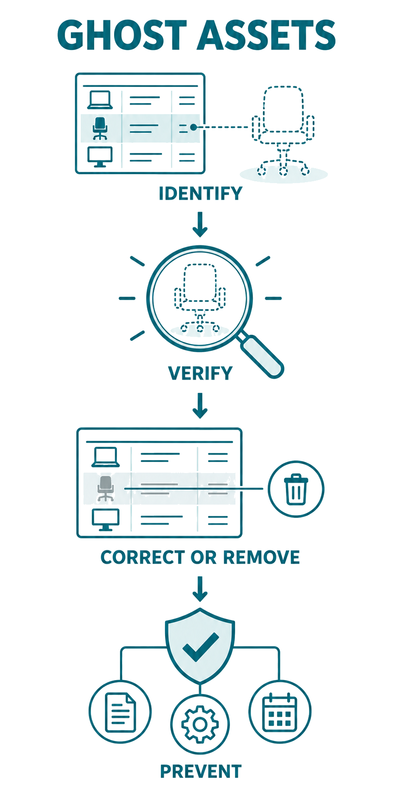
You find and correct ghost assets through a physical asset audit: verify the assets within the agreed scope, match the results against the register and investigate any recorded asset that was not located. Once a ghost record is confirmed, record the appropriate disposal or derecognition with the reason, date and authorisation, while retaining the audit history.
- Verify each physical asset within the agreed audit scope against the register, using barcode or QR tags where appropriate.
- Identify register entries with no matching scan: these are candidate ghost assets requiring investigation, not confirmed ghosts.
- Investigate each one: confirm whether it was disposed of, transferred, temporarily unlocated or lost.
- Record the appropriate disposal or derecognition for confirmed ghost records, with a documented reason and authorisation.
- Reduce recurrence by recording future disposals and transfers through a controlled process.
A structured physical audit provides a reliable way to identify potential ghost assets because it compares the agreed register population with the items located, rather than relying on memory. See our guide to asset audits and compliance for the full process.
The correction stage needs care and documentation. Depending on the asset’s carrying amount and circumstances, recording a disposal or derecognition may have an accounting effect. The reason, date and authorisation should be retained as part of the asset history, rather than deleting the record. The finance team or accountant should confirm the appropriate treatment for the organisation’s circumstances.
How Does Asset Tracking Help Prevent Ghost Assets?
Asset tracking can help prevent ghost assets by making disposals and transfers easier to record and reconcile. When in-scope assets are tagged and changes are captured in a central register, the risk of an asset leaving the organisation while remaining active in the records is reduced.
The process is most effective when updates are captured at the point of action. Recording a disposal or transfer as part of the physical process reduces reliance on a separate spreadsheet or later administrative update, while controlled approvals and reconciliation provide the necessary oversight.
Regular scan-based tracking can help organisations identify discrepancies earlier and reduce the risk of ghost records accumulating. It cannot make missed disposals impossible, because the process still depends on people following the agreed procedure. For the full picture, read the complete guide to asset tracking.
How Do Ghost Assets Affect the Balance Sheet?
Where a ghost asset has a remaining carrying amount, fixed assets and total assets may be overstated, and depreciation may continue incorrectly until the disposal is recorded. If the asset is fully depreciated, net assets may be unaffected, although gross cost, accumulated depreciation and the underlying register remain inaccurate.
When a confirmed ghost asset is corrected, the organisation should record the appropriate disposal or derecognition in line with its accounting policies. Any gain or loss will depend on factors including the disposal proceeds and carrying amount. Regular reconciliations generally make discrepancies easier to investigate than an infrequent large-scale clean-up.
This is why finance teams need to consider ghost assets even when individual items are low in value. Where the asset register feeds financial reporting, inaccurate records can affect the information produced. The specific accounting and tax treatment depends on the organisation’s circumstances and should be confirmed with a qualified accountant.
Keeping the register accurate is also a core part of managing assets well. The international standard ISO 55000 sets out general principles for realising value from assets across their life cycles. Accurate asset information supports those principles.
How Do You Prevent Ghost Assets From Returning?
You reduce the risk of ghost assets returning by improving the disposal process, tagging assets within the agreed scope, recording changes at the point of action and auditing on an appropriate cycle. Preventive controls can reduce the need for repeated large-scale clean-ups.
- Fix disposals: make recording a disposal a required step whenever an asset leaves, not an optional afterthought.
- Tag in-scope assets: consistent identification makes physical verification and reconciliation easier, with the tracking policy determining what should be tagged.
- Record at the point of action: capture transfers and disposals promptly so the register is more likely to remain current.
- Audit on a cycle: regular reconciliation catches the errors that slip through before they accumulate.
The disposal process deserves particular attention because unrecorded disposals are a common cause of ghost assets. A practical control is to require in-scope assets to be recorded as disposed, with a reason and authorisation, before they leave the organisation. Building this step into the disposal process makes the register more likely to remain accurate.
Ghost Assets vs Zombie Assets: What Is the Difference?
A ghost asset remains recorded even though the organisation no longer holds or controls it, while the term ‘zombie asset’ is used here for a physical asset in active use that was never recorded. A ghost record may overstate fixed assets where a carrying amount remains, while an unrecorded asset leaves the register incomplete. Both indicate that the register has drifted out of step with reality.
Unrecorded assets also matter. They may be omitted from asset-specific insurance information, maintenance schedules or capital planning, and there may be limited evidence of ownership or responsibility if they fail or are lost. A physical audit can help identify both types of discrepancy by confirming registered assets and recording relevant items found outside the register.