What are capital allowances?
| Capital allowances are a form of tax relief that lets UK businesses deduct the cost of qualifying assets, such as plant and machinery, from their taxable profits. They replace accounting depreciation, which HMRC does not allow as a deduction for tax. |
They are available to companies, partnerships, and sole traders whose profits are chargeable to UK corporation tax or income tax. The relief applies to capital spending, meaning the assets a business buys to use over the long term, rather than day-to-day running costs, which are deducted separately.
How do capital allowances work?
You claim capital allowances on your tax return at HMRC’s statutory rates, not at the depreciation rate in your accounts. Some allowances give 100% relief in the year of purchase, so the full cost reduces that year’s taxable profit. Others spread the relief over several years by adding the cost to a pool and writing down a percentage each year. Because the timing of relief affects cash flow, choosing the right allowance for each asset can make a real difference to the tax bill in a year of heavy investment.
Capital allowances vs depreciation (the key difference)
| Depreciation spreads an asset’s cost across your accounts; capital allowances spread it across your tax computation. Depreciation is added back when working out taxable profit, and capital allowances are deducted in its place. They are two separate systems for the same asset. |
This is the point that trips people up most often. The depreciation charge in your accounts has no direct effect on your tax bill, because it is added back and replaced by capital allowances. That is why a business can write an asset down slowly in its accounts using a chosen depreciation method, yet claim 100% tax relief on it in year one through the Annual Investment Allowance.
What qualifies for capital allowances?
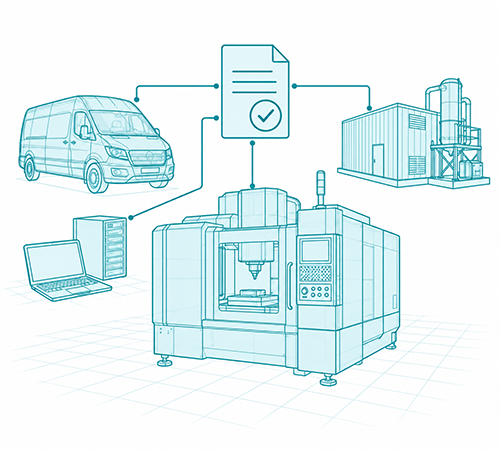
Most capital allowances are claimed on plant and machinery, which is a broad category covering the working assets of a business:
- Machinery, equipment, and tools used in the business.
- IT hardware, servers, and, in many cases, software.
- Commercial vehicles such as vans and lorries.
- Integral features of a building, such as heating, electrical, and lift systems.
- Certain fixtures and fittings.
Land does not qualify, and most buildings fall outside plant and machinery, though a separate structures and buildings allowance exists. Software can qualify as plant in many cases, though whether it is also treated as a fixed asset in your accounts depends on how it is bought. Cars are treated under their own rules, which we cover below.
The main types of capital allowance in 2026
Several allowances sit side by side. The table summarises the position for 2026 before we work through the most important.
| Allowance |
Rate |
Who and what |
| Annual Investment Allowance (AIA) |
100%, up to £1m a year |
All businesses; plant and machinery, not cars |
| Full expensing |
100%, no cap |
Companies only; new, unused main rate plant and machinery |
| 50% first-year allowance |
50% |
Companies; new special rate assets |
| 40% first-year allowance |
40% (from 1 January 2026) |
New main rate plant and machinery, including areas full expensing does not reach |
| Writing down allowance (main pool) |
14% from April 2026, reducing balance |
Expenditure not otherwise relieved |
| Writing down allowance (special rate pool) |
6%, reducing balance |
Integral features, long-life assets, higher-emission cars |
Annual Investment Allowance (AIA)
The Annual Investment Allowance gives 100% relief on up to £1 million of qualifying plant and machinery each year. It is available to companies, sole traders, and partnerships, which makes it the first allowance most businesses reach for. The £1 million limit is shared between connected businesses and group companies, so those rules need checking before assuming the full amount is available to each entity. Cars do not qualify.
Full expensing and first-year allowances
Full expensing gives companies 100% relief in the year of purchase on new, unused main rate plant and machinery, with no upper limit. It does not apply to sole traders or partnerships, to second-hand assets, to cars, or to assets bought for leasing. For new special rate assets, companies can claim a 50% first-year allowance instead. From 1 January 2026, a new 40% first-year allowance was introduced for qualifying new main rate plant and machinery, extending accelerated relief to some areas full expensing does not reach. New zero-emission cars keep a 100% first-year allowance, currently extended to 31 March 2027.
Writing down allowances (main pool and special rate pool)
Where spending is not fully relieved by the allowances above, the cost is added to a pool and written down each year on a reducing balance basis. From April 2026, the main pool rate fell from 18% to 14%, while the special rate pool remains at 6%. The main pool covers general plant and machinery; the special rate pool covers integral features, long-life assets, and higher-emission cars. Where an accounting period straddles April 2026, a hybrid rate applies for that period.
How to calculate capital allowances (worked example)
| To calculate capital allowances, apply the Annual Investment Allowance or full expensing first for 100% relief, then add any remaining expenditure to the relevant pool and apply the writing down allowance rate to the pool balance each year. |
Say a company buys £40,000 of new machinery. The Annual Investment Allowance covers the whole amount, so the full £40,000 is deducted from taxable profit in year one. Now say the company spends £1.2 million. The first £1 million is covered by the Annual Investment Allowance, and the remaining £200,000 can be claimed through full expensing if the assets qualify, or added to the main pool and written down at 14% a year if they do not. The order in which you apply the allowances is what determines how quickly the relief comes through.
How to claim capital allowances
Companies claim capital allowances on their Corporation Tax return, and sole traders and partnerships claim through Self Assessment. You claim in the accounting period in which the expenditure is incurred, and you keep records of each asset’s cost, purchase date, disposal proceeds, and pool balances, since HMRC may ask to see them. A live fixed asset register can provide the underlying cost, date, category and disposal information needed by finance teams and tax advisers. Fixed asset management software may support this process, but tax pool balances and claim calculations should be described separately unless the relevant software functionality has been confirmed.
Capital allowances and asset disposal
When an asset on which allowances have been claimed is disposed of, the statutory disposal value is applied under the rules for the relevant allowance or pool. For main and special-rate pools, the disposal value is normally deducted from the pool; a balancing allowance generally arises only when the qualifying activity ceases. Full-expensing and first-year allowance claims can require separate disposal adjustments. See our guide to optimising fixed asset lifecycles for the accounting side of disposal, and keep the tax calculation separate.
Common capital allowances mistakes
- Treating the depreciation charge in the accounts as the tax deduction; the two are separate.
- Missing the Annual Investment Allowance before the year end and losing the relief for that period.
- Ignoring the 2026 cut in the main pool rate when forecasting tax.
- Forgetting that cars are excluded from the Annual Investment Allowance and full expensing.
- Poor disposal records, so balancing charges and clawbacks are missed or miscalculated.
A worked example: writing down a pool
A short example shows how a pool behaves once the up-front allowances are used. Suppose £100,000 of expenditure sits in the main pool and is not covered by the Annual Investment Allowance. At the 14% rate, year one gives relief of £14,000, leaving £86,000. Year two gives 14% of £86,000, or £12,040, leaving £73,960, and so on, reducing each year. Relief continues on the falling balance, adjusted for later expenditure, disposals and any cessation of the qualifying activity. The slower 14% rate, down from 18%, means the same expenditure now takes noticeably longer to relieve in full, which is why claiming the Annual Investment Allowance or full expensing up front matters more than ever.
How capital allowances reduce your tax bill
| Capital allowances reduce taxable profit, so their cash value is the allowance multiplied by your tax rate. For a company paying corporation tax at 25%, every £100,000 of allowances claimed cuts the tax bill by £25,000. |
This is the practical reason timing matters. A 100% allowance such as full expensing or the Annual Investment Allowance delivers that £25,000 saving in a single year, which frees up cash exactly when a business has just spent on new assets. Spreading the same expenditure through the main pool at 14% a year delivers the identical total relief eventually, but it arrives slowly. Matching the right allowance to each purchase is therefore a cash-flow decision as much as a compliance one.
What about buildings? The structures and buildings allowance
Most buildings fall outside plant and machinery, but they are not left with no relief at all. The structures and buildings allowance gives relief on the cost of constructing or renovating non-residential structures, spread evenly over a long fixed period rather than on a reducing balance. It sits alongside plant and machinery allowances rather than replacing them, so a single building project can attract plant and machinery allowances on its integral features, such as heating and lifts, and the structures and buildings allowance on the fabric of the building itself. The two are claimed separately.
Keeping records that support the claim
Good records are what make a claim defensible. For each asset, keep the invoice, the purchase date, a description that supports the plant and machinery classification, and, once it is disposed of, the proceeds. Where assets sit in pools, keep the opening and closing pool balances for each year. A live fixed asset register that holds cost, dates, category and disposal information provides a reliable evidence base for finance teams and tax advisers. Tax pool balances and claim calculations may be maintained separately, depending on the software and process used.
Capital allowances are the tax side of fixed asset management, running in parallel with the depreciation recorded in your accounts.