FMIS Software
  • Home
  • Solutions
    • Fixed Asset Management Systems
      • Capital Projects
      • Enterprise Asset Management
      • Fixed Asset Management Software
    • Asset Tracking
      • Barcode Tracking
      • FMIS Mobile Asset Manager
    • Purchase to Pay
      • Purchase Order Processing
      • Sales Order Processing
    • Stock and Inventory
      • Kitting and Assembly
      • Material Requirements Planning (MRP)
      • Production Control
    • Equipment Maintenance
      • Field Service Management
    • Lease Accounting
      • Order Management
  • Market Sectors
    • Commercial and Retail
    • Education
    • Government
    • Health
    • Manufacturing
    • Non-Profit
    • Oil, Gas and Energy
  • Partners
    • Deltek
    • Find a partner
    • Become a Partner
  • Resources
    • Trust Centre
    • News and articles
    • Case studies
    • Fixed asset management guide
  • About us
  • Contact
    • Request a demo
    • Pricing
    • Product information
    • Customer Support
    • Careers
    • Training Feedback
  • Click to open the search input field Click to open the search input field Search
  • Menu Menu
You are here: Home1 / Solutions2 / Asset Tracking3 / Integrated Fixed Asset Management

Integrated Fixed Asset Management

Crossing the Finance vs Facilities divide to develop a joined-up approach to Fixed Asset Management that works for the whole organisation.

Written by: Alex Clements • Published: October 1, 2021 • Updated: March 10, 2026

Integrated Fixed Asset Management

What Is Integrated Fixed Asset Management?

Expert Insight

Mike Clements ProfileMike Clements is a senior consultant at FMIS with over 20 years experience in deploying integrated asset management and equipment tracking systems around the world.

To contact Mike or any of our consultants, please contact us here.

You can usually tell what a new client is looking for from an asset management system before you even speak to them. Just look at their job title.

If they are from finance, they probably want fixed asset accounting software to manage depreciation or leases. If they are from IT, it is usually asset tracking for the company’s IT equipment and if they are from facilities or operations, then they often want something to track and schedule maintenance.

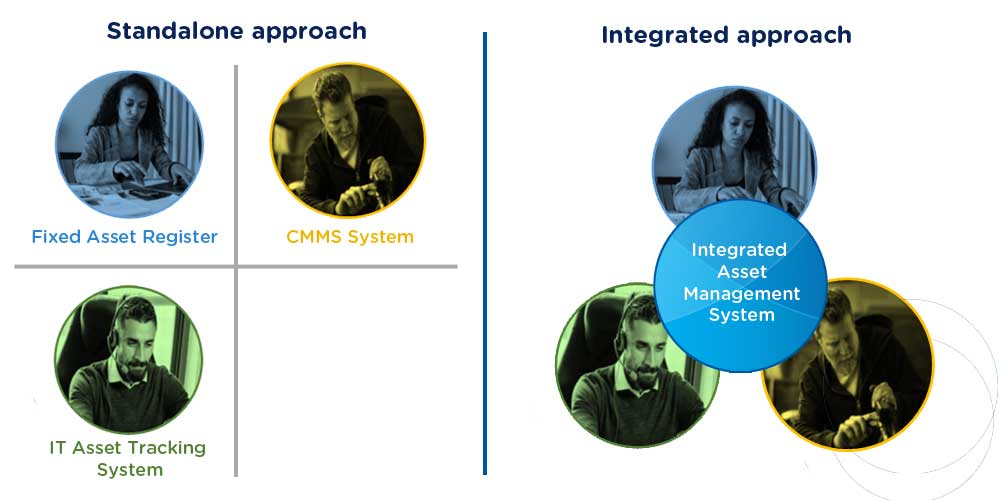
Admittedly, this is an over simplification, but it does illustrate the way that fixed asset management has often suffered from a very siloed approach when in practice the different disciplines in asset management are by definition, interdependent.

To understand the potential of having an integrated approach to managing your assets, it is helpful to look at the issue from the point of view of each area of the business:

Finance

Fixed Assets Manager

“Great reports, dodgy data”

Emma is the Fixed Asset Manager. This means that Emma is responsible for calculating depreciation, tracking lease payments, creating the various reports required by management and posting the relevant journals at period-end. The finance team maintain a fixed asset register on an Excel spreadsheet. Different departments within the business are supposed to inform finance whenever an asset is added, disposed of or moved within the business. In practice, few people outside of the finance department even know of this process and even then, not all of them will follow it all of the time.

The end result is that the business is tracking, insuring and depreciating large numbers of ghost assets, while at the same time unaware of the location of others and still others are simply not recorded on the register.

Facilities and Operations

Maintenance Manager

“Outdated and inefficient equipment”

Eric is the Workshop Manager for the company. He is responsible for all the factory floor equipment as well as the tools used by engineers in the field. The company invested in a tool tracking system a few years ago, but it doesn’t handle maintenance so Eric still tracks this manually using paper-based work orders.

Eric knows that the company spends a lot on maintaining old equipment and has argued for the business to invest in new equipment, but finance will not approve the capital expenditure without a full audit of existing equipment that is shown on the asset register. Eric started an audit last year but put the project on hold when he realised how out of date the finance asset register was, planning to resume it when “things were quieter”.

IT

IT Manager

“Purchase, misplace, repeat”

Vikram is the IT manager. His team are responsible for all the company IT equipment and track it using specialist IT tracking software. The software is ideal for his team and works well for large static assets such as servers, but Vikram is frustrated that so much of his budget is taken up with smaller items like cables, keyboards and even laptops that are frequently transferred within the business but these movements are not tracked within his tracking tool.

One manager recently ordered a laptop for a new starter in his team. When Vikram looked back, he discovered that the same team had purchased three new laptops in the last year despite several staff members leaving that team. When he asked about the other laptops, the team manager told Vikram that the laptops had been passed on to other teams when staff left but he was not sure where they were now.

Integrated vs siloed asset management

Transformational impact

Creating an integrated approach to asset management can have a transformative impact on business efficiency and reporting:

  • Improved accuracy in balance sheet reporting
  • Greater visibility of assets from both financial and operational perspectives
  • Increased income from the disposal of unwanted assets and consumables
  • Increased efficiency through automating transfers, disposals, and capitalisation of large refit items.
  • Providing change control and financial authorisation for key asset events
  • Prevention of data duplication and need for manual data entry
  • Enables accurate capital investment forecasts and planned equipment replacement strategies
  • Provides an accurate total cost of ownership

Blockers to a holistic approach

Creating a joined-up approach to asset management will require you to overcome a number of potential blockers:

  • Operational vs financial lifespan – Finance teams are primarily interested in the financial lifespan of a fixed asset regardless of what actual operational life it may have
  • Different data sources – Different departments, organisations and systems may be involved in recording operational equipment details whilst fixed assets accounting is typically a specialist system managed by one or two people
  • Big picture vs specifics – Finance teams are usually interested in a macro view of assets, while operations and IT will need a much more granular level of detail
  • Capital vs non-capitalised – Capitalised property, plant and equipment is often only a sub-set of all operational equipment that requires tracking and perhaps maintenance, regardless of the balance sheet treatment

The three key processes

Any holistic approach will require a change in three key processes:

  1. Asset identification
  2. Asset linking
  3. Asset updates

Asset identification

Effective identification of new assets will require a coordinated approach to procurement. There are two key points where the identification of the equipment and then the asset needs to be harmonised:

  1. An equipment voucher in Accounts Payable (AP) or expenses for capital items
  2. Goods Receipt

Hopefully your purchasing process already identifies how new purchases should be treated at the point of order. Most organisations will have clear criteria for determining whether an asset is current (consumable) or fixed. Effectively classifying assets at the point of order is important for building a coherent register and tracking that asset over the full lifecycle.

Purchase orders may be generated either within the same system where the asset will be tracked or created in a separate ERP/finance system and then imported. If the asset management system includes its own Purchase Orders module like FMIS, this should allow users to check the availability of an asset before raising a PO/Requisition without moving between systems. This feature cuts down on duplicate purchases and streamlines the approval process.

Goods receipt will be the first time the equipment/asset item will appear within the asset eco-system. It is important to synchronise this step between the ERP and Equipment systems. From an ERP perspective, the goods receipt process is normally only significant if the commitment has to be recognised. In a joined-up view, it is important that this goods receipt event is pushed into the equipment system (or goods receipt is recorded in the global equipment system and then sent through to ERP).

Operational goods receipt will involve recording serial numbers and any bar code reference that can then be added to the unique equipment ref assigned by the receiving operational equipment system. By also recording the related purchase order details, the physical equipment record can then be associated automatically with any AP Invoice voucher raised in the ERP system.

Three-way invoice matching

The invoice matching process is key to achieving an integrated approach to asset management. From a simple accounting perspective, invoice matching against goods receipt may be sufficient, but this approach (two-way matching) has a number of important limitations for effective asset tracking. Firstly, it usually requires the double-entry of much of the purchase information for an asset contained in the purchase order (PO). Where the PO is held in the same system as the asset is tracked, then this information can be automatically linked to the new asset and does not need to be manually input. Secondly, two-way matching creates a disconnect in the asset record. There is no ready link between the purchase record and the actual asset.

Asset updates

Finance teams will often stop tracking assets from the point of receipt. They are simply added to the register and depreciated for the expected useful life. In practice, the asset lifecycle is seldom so linear. Over its lifetime, a piece of equipment may be transferred, repaired, partially disposed of or re-lifed. When it fully is disposed of, it may be sold on or scrapped and there may be costs/proceeds arising from that disposal.

It is impossible to build up an accurate cost of ownership for an asset, or even to know what assets are currently active if there is a disconnect between tracking systems for finance and operations.

Find out more

FMIS has implemented integrated fixed asset management in over 40 countries and over 30 years. For more information on how to get started with dashboards on your FMIS solution, please contact us via email at support@fmis.co.uk or call us on +44 (0) 1227 773003.


Share this entry
  • Share on Facebook
  • Share on X
  • Share on WhatsApp
  • Share on Pinterest
  • Share on LinkedIn
  • Share on Tumblr
  • Share on Reddit
  • Share by Mail
Fixed Asset Management for AccountMate Software

Fixed Asset Management for AccountMate Software

September 14, 2022
Assets in Wonderland: An integrated asset management story

Assets in Wonderland: An Integrated Asset Management Story

February 5, 2015
Best Practice in Fixed Asset Management

Best Practices in Fixed Asset Management

March 18, 2024
Scotland - simpler fixed assets | FMIS

Simpler together? Fixed assets in a new Scotland

September 11, 2014
SoftwareSuggest Award

SoftwareSuggest Awards – FMIS recognised for easy implementation

March 26, 2024
FMIS recognised for Easy Implementation in the SoftwareSuggest 2024 awards
https://www.fmis.co.uk/wp-content/uploads/2024/03/SoftwareSuggest-Awards-2024-495x400-1.webp 400 495 John de Robeck https://www.fmis.co.uk/wp-content/uploads/2026/04/FMISNavyTeal-1-150x80-1.webp John de Robeck2024-03-26 10:29:322026-03-10 10:57:34SoftwareSuggest Awards – FMIS recognised for easy implementation
Asset Valuation Methods

Asset Valuation Methods

October 26, 2023
A comprehensive guide to Asset Valuation covering the four main methods, when to use them and the strengths and weakness of each
https://www.fmis.co.uk/wp-content/uploads/2023/10/Asset-Valuation-Methods-495x400-1.jpg 400 495 John de Robeck https://www.fmis.co.uk/wp-content/uploads/2026/04/FMISNavyTeal-1-150x80-1.webp John de Robeck2023-10-26 13:16:202026-07-01 10:14:59Asset Valuation Methods
NHS SBS Partner

FMIS announces new NHS partnership

December 18, 2019
FMIS announces new partnership with NHS Shared Business Services to supply FMIS Fixed Assets and IFRS 16 Leasing software to their clients.
https://www.fmis.co.uk/wp-content/uploads/2019/06/Feature-image-495x400.jpg 400 495 John de Robeck https://www.fmis.co.uk/wp-content/uploads/2026/04/FMISNavyTeal-1-150x80-1.webp John de Robeck2019-12-18 11:23:412026-03-10 11:09:42FMIS announces new NHS partnership
FMIS sponsors Govmoney 2019

FMIS to sponsor GovMoney 2019

December 2, 2019
FMIS to sponsor GovMoney2019 conference for public sector finance professionals.
https://www.fmis.co.uk/wp-content/uploads/2019/11/Govmoney2019-495x400.jpg 400 495 John de Robeck https://www.fmis.co.uk/wp-content/uploads/2026/04/FMISNavyTeal-1-150x80-1.webp John de Robeck2019-12-02 17:25:102026-03-10 11:09:51FMIS to sponsor GovMoney 2019
Support Icon
Can we help?
Book a demo View products Contact support
Or call: +44 (0) 1227 773003
Mon–Fri, 9:00–17:00 (BST/GMT)

Explore More

  • FMIS awarded G-Cloud 15 supplier status
  • Indexation in UK Public Sector Fixed Asset Accounting
  • Why the UK Public Sector Is Moving from Fixed Assets to Non Current Assets
  • Preparing for Charities SORP Lease Accounting Changes 2026
  • FRS 102 lease accounting changes 2026: what UK organisations need to know

SOLUTIONS

  • Fixed Asset Management Systems
  • Asset Tracking
  • Purchase to Pay
  • Order Management
  • Equipment Maintenance
  • Lease Accounting
  • Stock and Inventory
  • View all solutions

Home › Integrated Fixed Asset Management

Market Sectors

  • Commercial and Retail
  • Education
  • Local and Central Government
  • NHS and Health
  • Manufacturing
  • Non-profit
  • Oil, Gas and Energy

FOLLOW US

FMIS Twitter FMIS Linkedin

CONTACT US

FMIS Ltd
167b John Wilson Business Park
Whitstable
Kent
CT5 3RA
United Kingdom

Phone:+44 (0) 1227 773003
Fax:+44 (0) 1227 773005
Sales:sales@fmis.co.uk
Support:support@fmis.co.uk

Copyright © 2024 - All rights reserved www.fmis.co.uk
  • Privacy Policy
  • Cookie Policy
Link to: Three ways to improve production and procurement for Deltek Vision and Vantagepoint Link to: Three ways to improve production and procurement for Deltek Vision and Vantagepoint Three ways to improve production and procurement for Deltek Vision and Vant...3 ways to improve production for Deltek Link to: Aerospace Asset Tracking Case Study for SPS Aero Link to: Aerospace Asset Tracking Case Study for SPS Aero Aerospace Case StudyAerospace Asset Tracking Case Study for SPS Aero
Scroll to top
We use cookies on our website to give you the most relevant experience by remembering your preferences and repeat visits. By clicking “Accept All”, you consent to the use of ALL the cookies. However, you may visit "Cookie Settings" to provide a controlled consent.
Cookie SettingsAccept All
Manage consent

Privacy Overview

This website uses cookies to improve your experience while you navigate through the website. Out of these, the cookies that are categorized as necessary are stored on your browser as they are essential for the working of basic functionalities of the website. We also use third-party cookies that help us analyze and understand how you use this website. These cookies will be stored in your browser only with your consent. You also have the option to opt-out of these cookies. But opting out of some of these cookies may affect your browsing experience.
Necessary
Always Enabled
Necessary cookies are absolutely essential for the website to function properly. These cookies ensure basic functionalities and security features of the website, anonymously.
CookieDurationDescription
cookielawinfo-checkbox-advertisement1 yearSet by the GDPR Cookie Consent plugin, this cookie is used to record the user consent for the cookies in the "Advertisement" category .
cookielawinfo-checkbox-analytics11 monthsThis cookie is set by GDPR Cookie Consent plugin. The cookie is used to store the user consent for the cookies in the category "Analytics".
cookielawinfo-checkbox-functional11 monthsThe cookie is set by GDPR cookie consent to record the user consent for the cookies in the category "Functional".
cookielawinfo-checkbox-necessary11 monthsThis cookie is set by GDPR Cookie Consent plugin. The cookies is used to store the user consent for the cookies in the category "Necessary".
cookielawinfo-checkbox-others11 monthsThis cookie is set by GDPR Cookie Consent plugin. The cookie is used to store the user consent for the cookies in the category "Other.
cookielawinfo-checkbox-performance11 monthsThis cookie is set by GDPR Cookie Consent plugin. The cookie is used to store the user consent for the cookies in the category "Performance".
CookieLawInfoConsent1 yearRecords the default button state of the corresponding category & the status of CCPA. It works only in coordination with the primary cookie.
PHPSESSIDsessionThis cookie is native to PHP applications. The cookie is used to store and identify a users' unique session ID for the purpose of managing user session on the website. The cookie is a session cookies and is deleted when all the browser windows are closed.
viewed_cookie_policy11 monthsThe cookie is set by the GDPR Cookie Consent plugin and is used to store whether or not user has consented to the use of cookies. It does not store any personal data.
Functional
Functional cookies help to perform certain functionalities like sharing the content of the website on social media platforms, collect feedbacks, and other third-party features.
Performance
Performance cookies are used to understand and analyze the key performance indexes of the website which helps in delivering a better user experience for the visitors.
Analytics
Analytical cookies are used to understand how visitors interact with the website. These cookies help provide information on metrics the number of visitors, bounce rate, traffic source, etc.
CookieDurationDescription
CONSENT2 yearsYouTube sets this cookie via embedded youtube-videos and registers anonymous statistical data.
_ga2 yearsThe _ga cookie, installed by Google Analytics, calculates visitor, session and campaign data and also keeps track of site usage for the site's analytics report. The cookie stores information anonymously and assigns a randomly generated number to recognize unique visitors.
_gat_UA-48954022-11 minuteA variation of the _gat cookie set by Google Analytics and Google Tag Manager to allow website owners to track visitor behaviour and measure site performance. The pattern element in the name contains the unique identity number of the account or website it relates to.
_gid1 dayInstalled by Google Analytics, _gid cookie stores information on how visitors use a website, while also creating an analytics report of the website's performance. Some of the data that are collected include the number of visitors, their source, and the pages they visit anonymously.
Advertisement
Advertisement cookies are used to provide visitors with relevant ads and marketing campaigns. These cookies track visitors across websites and collect information to provide customized ads.
CookieDurationDescription
VISITOR_INFO1_LIVE5 months 27 daysA cookie set by YouTube to measure bandwidth that determines whether the user gets the new or old player interface.
YSCsessionYSC cookie is set by Youtube and is used to track the views of embedded videos on Youtube pages.
yt-remote-connected-devicesneverYouTube sets this cookie to store the video preferences of the user using embedded YouTube video.
yt-remote-device-idneverYouTube sets this cookie to store the video preferences of the user using embedded YouTube video.
Others
Other uncategorized cookies are those that are being analyzed and have not been classified into a category as yet.
SAVE & ACCEPT
Powered by CookieYes Logo