A practical reference for finance teams

IFRS 16 lease accounting guide

Recognition, measurement and reporting for lessees.

Use this guide to assess lease terms, payments and discount rates, calculate initial balances and account for later changes. It is written for accountants, finance managers and financial controllers applying IFRS 16.

For an introduction to lease accounting and the wider workflow, start with the main lease accounting guide.
Content owner: , Head of Finance, FMIS.

FMIS · Sources checked 10 October 2026 · About 18 minutes to read

IFRS 16 Lease Accounting Guide Feature Image

IFRS 16 scope and the lessee model

IFRS 16 generally requires a lessee to recognise a lease liability and a right-of-use asset. The liability represents the payment obligation; the asset represents the right to use the leased property or equipment. Recognition exemptions are available for qualifying short-term and low-value leases. The standard has applied to annual reporting periods beginning on or after 1 January 2019. [1]

This guide focuses on lessees applying IFRS, including the usual cost model. Lessor accounting retains operating and finance lease classification. Confirm the reporting framework before using the guidance: revised FRS 102 Section 20 and ASC 842 have their own requirements.

Scope exclusions include mineral exploration leases, lessee biological assets within IAS 41, IFRIC 12 service concessions, certain intellectual property licences and specified IAS 38 licensing rights. Other intangible-asset leases have an optional IFRS 16 application provision. [1] [3]

Start with the applicable framework. Public-sector adaptations, tax treatment and first-time IFRS adoption need separate assessment. For the broader workflow, definitions and introductory journals, read the main lease accounting guide.

Does the contract contain a lease?

Assess the contract at inception. A lease requires an identified asset and customer control of its use for a period in exchange for consideration. Control combines substantially all economic benefits with the right to direct how and for what purpose the asset is used. Protective supplier rights do not, by themselves, prevent a lease. [2]

An asset may be specified explicitly or implicitly. A substitution right is substantive only where the supplier can practically substitute throughout the period of use and would benefit economically from doing so. A repair or maintenance replacement clause alone is insufficient. If the customer cannot readily determine whether the right is substantive, IFRS 16 requires it to presume that it is not. [4]

Scenario: a supplier names a particular machine but can replace it only for servicing. Finance should not treat that clause as proof that the arrangement is a service. Review the customer’s decision rights and benefits as well.

Build the assessment from the agreement, operational facts and any side letters. Record who can make relevant use decisions, what substitution is possible and why the conclusion follows. Include service contracts in the completeness review; their label does not settle whether they contain a lease. See IFRS 16.9–11 and B9–B31.

Exemptions and contract components

A short-term lease has a term of 12 months or less at commencement and contains no purchase option. The exemption election is made by class of underlying asset. The low-value exemption can be elected lease by lease. When elected, payments are expensed over the lease term on a straight-line basis or another representative systematic basis. [3]

Low value concerns the underlying asset when new, assessed on an absolute basis. It is not an annual-rent test or an entity-specific materiality threshold. The standard contains no mandatory monetary cut-off. Tablets and small office furniture may qualify; a vehicle is not low value merely because it is old. Interdependence with other assets and subleasing also affect eligibility. [2] [3]

Separate lease components from services such as maintenance, allocating consideration using relative stand-alone prices of lease components and the aggregate stand-alone price of non-lease components. Estimate unavailable prices using observable information. An invoice charge is not necessarily a separate component. [5]

A lessee can elect, by class of underlying asset, to combine each lease component with its associated non-lease components. This expedient simplifies allocation but can increase the recognised liability. It is a documented policy election, rather than a choice for individual convenient contracts. See IFRS 16.12–17. [5]

Review prompt: list exemption and component elections beside the affected asset classes. Retain qualifying exempt leases in a controlled record so their expenses, renewals and disclosure inputs remain visible.

Determining the lease term

Begin with the enforceable period. The lease term includes the non-cancellable period, extensions the lessee is reasonably certain to exercise and termination-option periods the lessee is reasonably certain not to terminate. Contractual notice periods alone may not settle enforceability. [6]

Consider the wider economics, including significant leasehold improvements, relocation costs and the importance of the location. An absence of a contractual termination payment does not necessarily mean that both parties can terminate with no more than an insignificant penalty. The assessment needs to consider each party’s rights. [6]

Scenario: an office lease has a five-year initial term and a three-year renewal option. Significant fit-out investment expected to benefit the business beyond year five may support renewal. It does not automatically establish an eight-year term; assess all relevant facts.

Keep a dated decision record: enforceable period, options, relevant commercial evidence, conclusion and approval. Link it to budgets or property plans where these support the judgement. Distinguish the agreed accounting term from the contract expiry date in your register.

Reassess option judgements when a significant event or change in circumstances within the lessee’s control affects reasonable certainty. A change in the non-cancellable period can also require revision. See IFRS 16.18–21 and B34–B41. [6]

Lease payments and discount rates

The opening liability includes qualifying payments unpaid at commencement. Avoid importing the total invoice without reviewing its components and payment conditions. [9]

Swipe or scroll across the table to see all columns.

Payments included in the lease liability
Payment type Initial treatment
Fixed and in-substance fixed Include; deduct lease incentives receivable.
Index- or rate-linked Include using the index or rate at commencement, without forecasting future changes.
Usage- or sales-linked Generally exclude genuinely variable payments; recognise when the triggering event occurs, subject to other applicable standards.
Residual value guarantee Include the amount expected to be payable.
Purchase option Include the exercise price if exercise is reasonably certain.
Termination penalty Include if the assessed term reflects exercising the termination option.

Contractually fixed future uplifts are part of the initial payment schedule. An uncertain future index change is different: it is reflected when it changes contractual cash flows. Refundable deposits require their own assessment rather than automatic inclusion as rent. See IFRS 16.27–28 and 38(b). [8] [9]

Use the rate implicit in the lease if readily determinable; otherwise use the lessee’s incremental borrowing rate. The latter reflects comparable term, security, asset value and economic environment. A treasury borrowing rate can be a starting point, but adjustments may be required for the particular lease. [7]

Record the rate date, supporting market or borrowing evidence and adjustments. A general corporate weighted average cost of capital is not automatically an appropriate rate. For monthly calculations, match the conversion to the rate’s stated basis: a 5% effective annual rate corresponds to (1.05)1/12 − 1 per month, rather than simply 5% divided by 12.

IFRS 16 does not provide the same private-company risk-free-rate election as ASC 842. Maintain separate framework assumptions when preparing more than one reporting basis. See IFRS 16.26 and Appendix A. [7]

Initial and subsequent measurement

Recognise the liability and right-of-use asset at commencement, when the lessor makes the asset available for use. This can precede the first rent payment. Initially, the liability is the present value of qualifying unpaid lease payments. [9]

The right-of-use asset starts with that liability, adjusted for payments made at or before commencement, incentives received, qualifying initial direct costs and relevant restoration obligations. Initial direct costs are incremental costs that would not have arisen without obtaining the lease. Do not capitalise every legal or administrative cost automatically. See IFRS 16.22–28 and Appendix A. [9] [12]

Under the cost model, track the asset at cost less depreciation and impairment, with relevant remeasurement adjustments. The liability increases for interest and decreases for payments. Their balances therefore usually follow different paths. [10]

Depreciate to the earlier of the asset’s useful life and lease-term end unless ownership transfers or the asset’s cost reflects a reasonably certain purchase option, when useful life applies. IAS 36 impairment remains relevant. Investment-property and revaluation provisions can affect the asset model. See IFRS 16.29–36. [10] [12]

Control point: agree the commencement evidence before calculation. A signed contract, an invoice date and physical availability can be three different dates. Keep the liability schedule and asset roll-forward separate, then reconcile each to its ledger accounts.

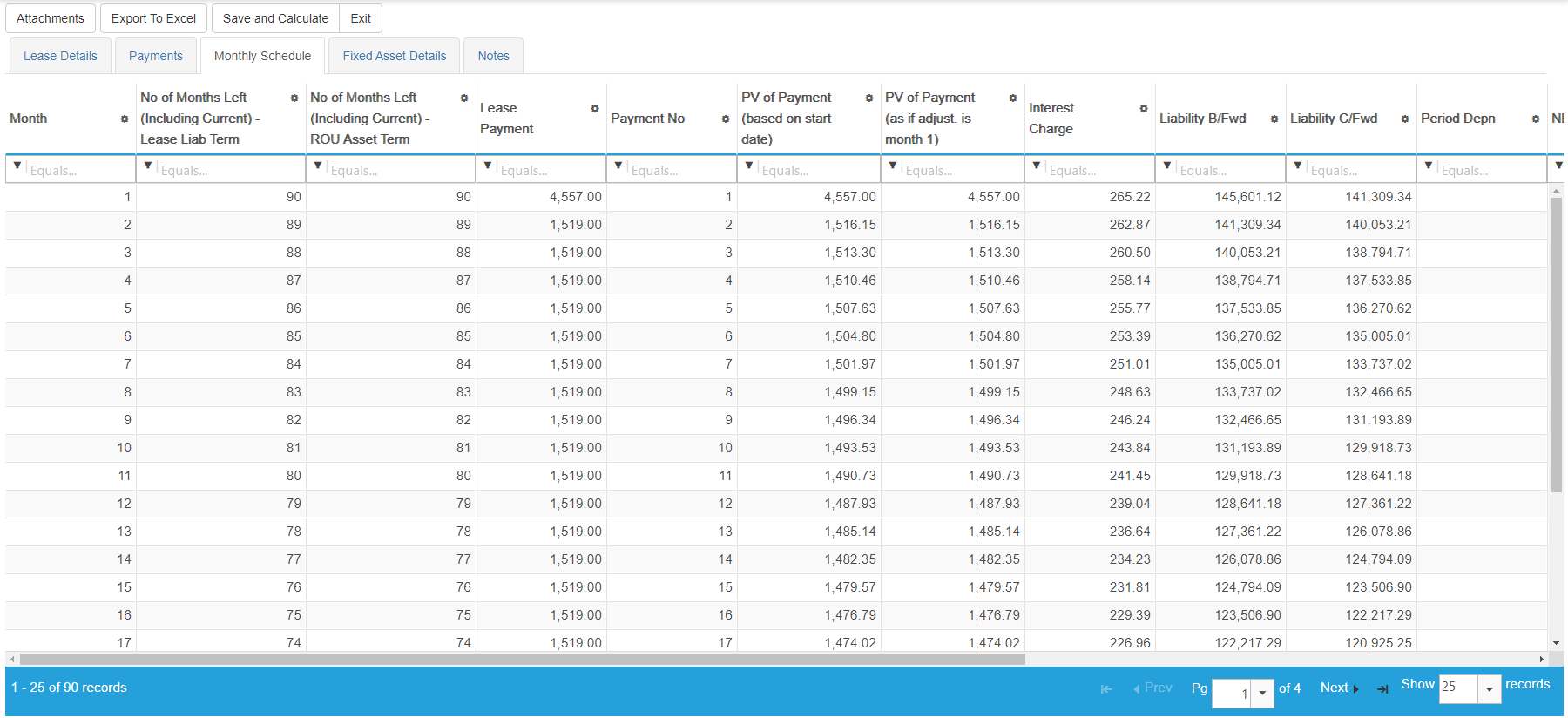
FMIS Monthly Schedule illustrating the payment, interest and lease liability movements used when checking an IFRS 16 schedule. Demonstration data, separate from the worked example below. Open screenshot full size (new tab)

Worked example: rent-free period and incentive

A business takes a five-year office lease on 1 January 2027. The office is available immediately. Year one is rent-free; £24,000 is payable at each year-end in years two to five. The business receives an unconditional £3,000 lease incentive at commencement and pays £1,000 of qualifying incremental initial direct costs.

Assume a 5% effective annual incremental borrowing rate, no service component, no options, no restoration provision, no impairment and no ownership transfer. The office’s useful life exceeds the lease term. The lease is not exempt. Ignore VAT and tax for this illustration. Use straight-line depreciation over five years.

Opening liability: £24,000 ÷ 1.05² + £24,000 ÷ 1.05³ + £24,000 ÷ 1.05⁴ + £24,000 ÷ 1.05⁵ = £81,050.30.

Opening right-of-use asset: £81,050.30 − £3,000 + £1,000 = £79,050.30. The cash incentive is already received, so it reduces the asset; do not deduct it again from future unpaid rentals. Annual depreciation is £15,810.06, with a final rounding adjustment.

Swipe or scroll across the table to see all columns.

Five-year liability schedule (£)
Year Opening Interest Payment Closing
Year 1 £81,050.30 £4,052.52 £0.00 £85,102.82
Year 2 £85,102.82 £4,255.14 £24,000.00 £65,357.96
Year 3 £65,357.96 £3,267.90 £24,000.00 £44,625.86
Year 4 £44,625.86 £2,231.29 £24,000.00 £22,857.15
Year 5 £22,857.15 £1,142.85 £24,000.00 £0.00

Amounts are rounded to pennies at each step. Year-five interest includes the final rounding adjustment so the liability closes at zero. Total contractual payments are £96,000; total schedule interest is £14,949.70.

In year one, the liability increases to £85,102.82 even though rent is £0. The asset falls to £63,240.24. Interest of £4,052.52 and depreciation of £15,810.06 produce total expense of £19,862.58 under these assumptions.

Swipe or scroll across the table to see all columns.

Opening and first-year journals
Entry Debit Credit
Recognise lease at commencement ROU asset £81,050.30 Lease liability £81,050.30
Receive incentive Bank £3,000.00 ROU asset £3,000.00
Pay qualifying direct costs ROU asset £1,000.00 Bank £1,000.00
Year-one interest Interest expense £4,052.52 Lease liability £4,052.52
Year-one depreciation Depreciation expense £15,810.06 Accumulated depreciation £15,810.06

No rent-payment journal arises in year one. In subsequent years, debit the liability and credit bank for each £24,000 rental after recognising interest. Actual systems may route payments through creditors; reconcile that clearing account to prevent duplicate rental expense.

This example demonstrates commencement accounting, rather than transition or ASC 842 operating lease accounting. Its assumptions deliberately isolate the rent-free period and incentive. The main guide’s simpler example explains the basic payment, interest and depreciation relationship.

Reassessments, modifications and terminations

Identify the event before recalculating. A reassessment under existing terms differs from a negotiated change in scope or consideration outside the original agreement. A scheduled fixed uplift already included in the opening calculation does not require a fresh measurement simply because the invoice increases. [8] [11]

Swipe or scroll across the table to see all columns.

Change events and discount-rate treatment
Event Liability response Rate
Index-linked rent changes Remeasure when the contractual cash flows change. Original rate, unless payments change because of floating interest rates.
Floating-interest-linked payments change Remeasure for changed cash flows. Revise to reflect the interest-rate change.
Lease term or purchase-option assessment changes Remeasure the revised payments. Revised rate at reassessment.
Expected residual guarantee payment changes Remeasure the revised expected payment. Original rate.
Modification adds an asset at a commensurate stand-alone price Account for the addition as a separate lease. New lease rate; existing lease remains separate.
Other modification Remeasure at the effective date; assess any reduction in scope. Revised rate at modification.

Remeasurement normally adjusts the right-of-use asset. If a reduction exceeds its carrying amount, recognise the excess in profit or loss. A modification reducing scope requires a proportionate asset reduction and a termination gain or loss before the remaining remeasurement adjustment. See IFRS 16.39–46. [10] [11] [12]

Index-linked example: immediately after a payment, three annual payments of £12,000 remain. At 5%, their present value is £32,678.98. A contractual index reset increases each remaining payment to £12,600. With no other change, the revised liability is £34,312.93 using the original 5% rate. Debit the right-of-use asset and credit the liability by £1,633.95, then update future depreciation. This is an independent illustration, not a continuation of the property example. [8]

Partial termination: surrendering part of an office under a negotiated amendment is not just a lower payment. Identify the rights surrendered and apply the decrease-in-scope treatment before measuring the remaining lease. [11]

Retain the signed amendment, event date, classification rationale and approved rate. Preserve the old schedule, post the adjustment and reconcile the revised version. A future change agreed by both parties can have an accounting effective date before the new cash payments begin.

Presentation, disclosure and reconciliation

Present right-of-use assets and lease liabilities separately or identify the relevant line items in the notes, subject to the investment-property provisions. Present interest separately from depreciation. Classify principal cash repayments as financing; interest follows applicable IAS 7 requirements. Short-term, low-value and variable payments excluded from the liability are operating cash flows. Check the presentation requirements effective for your period, including IFRS 18 where applicable. [12]

IFRS 16 disclosures include asset depreciation and carrying amounts by class, liability interest, exemption and excluded-variable-payment expenses, total lease cash outflow, asset additions, sublease income and sale-and-leaseback gains or losses. A separate maturity analysis addresses undiscounted contractual cash flows, rather than merely reproducing the discounted liability. See IFRS 16.47–60. [10] [13]

Explain relevant leasing activities, option judgements and exposure to cash flows not captured in the liability. Tailor disclosure to material circumstances; a generic checklist alone does not satisfy the disclosure objective. [13]

For reconciliation, distinguish opening liability, interest, cash payments, new leases, remeasurements, terminations and other movements. Reconcile asset cost and accumulated depreciation separately. Tie the liability to the general ledger, then trace payments to cash or creditor records.

Common trap: the maturity table, ledger liability and total cash outflow answer different questions. Record the basis of each output and explain differences instead of forcing all three totals to match. Check current and non-current presentation against the contractual schedule and applicable presentation requirements.

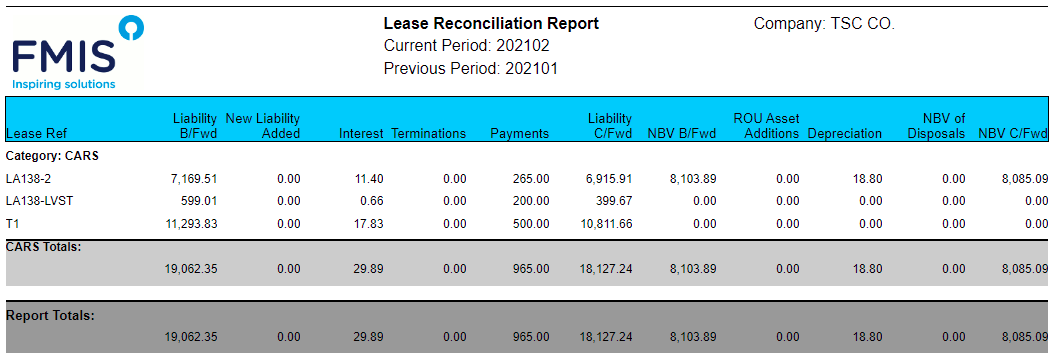
FMIS reconciliation report illustrating opening and closing lease liability and right-of-use asset net book values, with interest, payments and depreciation. Software illustration, separate from this guide’s worked example. Source: Lease Accounting v12.47 manual. Open screenshot full size (new tab)

Subleases, sale and leaseback, and transition

An intermediate lessor assesses a sublease by reference to the right-of-use asset from the head lease, generally rather than the underlying physical asset. An exempt short-term head lease produces an operating sublease classification. The head-lease obligation does not simply disappear because another party pays rent. See IFRS 16.B58. [15]

For sale and leaseback, first assess whether the transfer qualifies as a sale under IFRS 15. A sale does not permit recognition of the entire apparent gain where rights are retained through the leaseback. The subsequent-measurement amendment applies for annual periods beginning on or after 1 January 2024, with earlier application permitted. It prevents recognition of gains or losses relating to retained use rights, without excluding genuine termination effects. See IFRS 16.99–103 and 102A. [14] [16]

These arrangements need transaction-specific analysis. Keep the head lease, sublease or sale-and-leaseback agreements together and identify which party is reporting which rights and obligations. Foreign-currency leases, impairment and public-sector adaptations also need the relevant additional requirements.

Original IFRS 16 transition options addressed adoption from IAS 17. An entity adopting IFRS for the first time must consider IFRS 1 and its relevant lease provisions. Keep transition choices separate from the accounting for a new lease and from migrating an existing schedule into software.

IFRS 16 period-end checklist

Use a repeatable review that connects contract changes to accounting records. Allocate each task to an owner and retain evidence of completion.

  1. Check completeness: compare the register with property, procurement, operating and payment records. Investigate new contracts and assets used under service agreements.
  2. Confirm commencement: retain evidence of when assets became available, including rent-free arrangements.
  3. Review judgements: record events affecting options, the enforceable period, guarantees and other assumptions. Do not change a rate merely because market borrowing costs moved.
  4. Capture changes: obtain amendments and rent-review notices. Separate scheduled payments, reassessments and modifications before calculating adjustments.
  5. Check calculation inputs: verify dates, payment timing, frequency, incentives, component allocation and the rate basis.
  6. Reconcile balances: tie liability and asset schedules to the ledger and investigate differences in payments or clearing accounts.
  7. Review the asset: consider impairment indicators, useful-life assumptions and the applicable measurement model.
  8. Prepare disclosure evidence: reconcile quantitative outputs and retain explanations of material judgements and commitments.

Keep the contract, judgement record, calculation version, posting evidence and reconciliation accessible together. A reviewer should be able to follow a changed balance back to the event and approved treatment, rather than reconstructing it from overwritten spreadsheets.

Common IFRS 16 questions

No. Recognition begins when the underlying asset is available for use. A rent-free period affects the payment schedule, rather than automatically postponing commencement. The property example shows interest and depreciation in the first year without a rental payment.

No. A movement in general borrowing rates is not itself a remeasurement trigger. Apply the event-specific requirements in the change table. Retain the original rate where required, and use a revised rate for the specified reassessments or modifications.

It should remain within a controlled record. Finance still needs the agreement, election basis, expense calculation and relevant disclosure inputs. A renewal or change may require a fresh assessment. Exemption from asset and liability recognition is not exemption from financial control.

Finance must assess and approve the accounting judgement. Software can calculate a schedule from the agreed inputs, but it does not establish the commercial evidence or reporting policy. Keep the approval alongside the lease record.

FMIS support for IFRS 16

FMIS Lease Accounting supports lease liability and right-of-use asset schedules and period postings. Finance approves the lease term, payment treatment and discount rate; the resulting schedules support the calculation and reporting process.

For the wider product scope, see FMIS Lease Accounting. For the general accounting process, return to the main lease accounting guide.

Sources and further reading

The references below support the explanations and point to further detail. Paragraph references identify IFRS 16 requirements. Earlier application publications are used alongside current supporting material and the 2026 overview.