Asset Management Software for Central Government Departments

FMIS provides fixed asset accounting, lease accounting, asset tracking, equipment maintenance and purchasing software for central government departments. Explore how finance, estates and operational teams use these tools across sites, with practical workflows and public-sector examples.

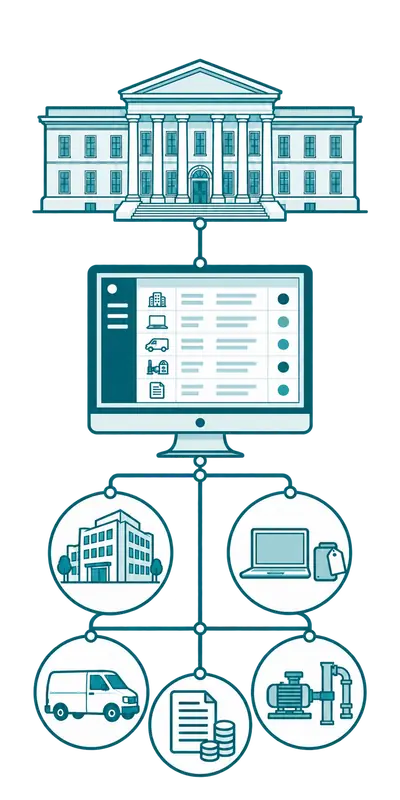
Central government building connected through asset management software to estates, IT equipment, vehicles, financial records and maintained equipment.

Managing Assets Across Government Departments

Central government departments can be responsible for a varied portfolio of property, infrastructure, vehicles, IT equipment and specialist operational assets. Financial information may be held by central finance teams, while estates, IT and operational teams manage the assets themselves across multiple offices and sites.

FMIS provides a structured environment for managing the financial and operational information associated with these assets. Departments can configure asset classes, locations, reporting structures and accounting periods around their requirements, while maintaining a clear history of changes throughout the asset lifecycle.

In the UK, this includes supporting the underlying asset accounting processes used to prepare departmental reports under HM Treasury’s Government Financial Reporting Manual. National government departments and ministries in other countries can configure FMIS around their own accounting framework and organisational structure.

Supporting Teams Across Central Government

FMIS can connect financial asset information with the teams responsible for managing, locating and maintaining assets in practice.

Finance and accounting icon

Finance and Capital Accounting

Maintain asset registers, calculate depreciation, manage asset events and produce information for reconciliation, forecasting, audit and financial reporting.

IT and operations icon

IT and Operations

Record asset locations, custodians, status and movement history. Equipment can be assigned to users or departments and verified through barcode or QR code audits.

Estates Management and Facilities Icon

Estates and Asset Management

Organise property, equipment and other assets by department, site, location and asset type, with supporting records and a clear history of changes.

Consistent Asset Information Across Departments and Sites

Departments often need to bring together asset information held by different teams without replacing every existing finance, procurement or operational system. The priority is to maintain clear records, controlled processes and reliable information for each team that uses the data.

  • Maintain consistent asset classifications across departments, locations and reporting groups.
  • Connect capital expenditure, assets under construction and completed assets with the financial asset register.
  • Reconcile physical assets with accounting records and investigate missing, transferred or retired items.
  • Record depreciation, indexation, revaluations, impairments, transfers and disposals through controlled processes.
  • Manage leased property and equipment alongside owned assets where appropriate.
  • Provide finance, estates, IT and operational teams with relevant views of the same underlying records.
Central government departments linked to an asset register supporting reporting, cross-site oversight, asset tracking, lease records and maintenance.

How FMIS Supports Central Government Asset Management

These workflows show how finance, estates, IT and operational teams can use FMIS to keep asset information current and manage work across departments and sites.

Fixed Asset Accounting and Assets Under Construction

FMIS Fixed Assets supports additions, transfers, cost adjustments, revaluations, impairments and full or partial disposals. Departments can record assets under construction, maintain multiple books and entities, and calculate and forecast depreciation across their reporting structures. Percentage-based indexation, bulk index loading and configurable indexation profiles help finance teams apply the appropriate indices to different asset categories.

Lease Accounting

Departments may manage property and equipment leases across multiple sites, while finance needs consistent information for accounting and reporting. FMIS brings lease terms, payments and changes into a central record. It calculates right-of-use assets and lease liabilities, supports modifications and terminations, and produces schedules and ledger postings for review under the department’s accounting policies.

Asset Tracking and Physical Verification

Equipment may move between departments, sites and users without the financial asset record being updated at the same time. FMIS records each item’s location, status, custodian and movement history, alongside relevant documents. Teams can use barcode or QR code scanning to verify assets on site and investigate differences between physical and financial records.

Estates and Equipment Maintenance

Estates and operational teams need to plan servicing and respond to faults across offices and operational sites. FMIS supports maintenance schedules and work orders, records completed activity and keeps a service history against each item. Teams can then review work that is due, in progress or completed for property-related equipment, vehicles and other assets.

Purchasing and Asset Acquisition

Where departments need more control over purchasing, FMIS supports requisitions, approvals, purchase orders and goods receipt. Purchases can be assigned to departments, projects, budgets and cost centres, with a record of approvals and changes.

FMIS Solutions for Central Government Departments

Fixed asset management depreciation icon

Fixed Assets

Asset classifications, component relationships, depreciation and financial changes.

Signed lease document icon

Lease Accounting

Lease data, calculations, changes and reporting for relevant agreements.

Mobile location tracker icon

Asset Tracking

Location, custodian and movement records, with tools for physical asset checks.

Maintenance management software icon

Equipment Maintenance

Planned tasks, work orders and service history for equipment in scope.

Purchase order icon

Purchasing

Purchasing approvals and management of requisitions, approvals and purchase orders.

client talking with FMIS support icon

More Solutions

Requirements differ between departments. View the full range of FMIS solutions.

Who we work with in the Public Sector

“Excellent summary and detailed reports with a user-friendly system.”

FMIS offers the most comprehensive fixed asset management and leasing software we’ve seen for healthcare.

“FMIS allows us to use barcode labels to properly track our counter-pollution equipment and oil spill dispersant effectively.”

“I find it easy to use and most of all – I like the way you can pull reports by different criteria”

“The fixed asset system will greatly help us due to only having used manual spreadsheets for a number of years.”

Public Sector Experience and Procurement

FMIS has experience supporting asset management requirements across central government and the wider UK public sector. The modular structure allows departments to select the financial and operational functions relevant to their requirement rather than adopting an unnecessarily broad system.

FMIS Fixed Asset Management, Asset Tracking, Equipment Maintenance and Lease Accounting are available as cloud services through G-Cloud 15. Buyers should assess the individual service descriptions, pricing and terms against their statement of requirements and departmental procurement policies.

Read about FMIS and G-Cloud 15

Asset Accounting in UK Central Government

UK central government departments prepare their financial statements using HM Treasury’s Government Financial Reporting Manual, commonly known as the FReM. The manual applies international accounting standards within the UK public-sector context and includes specific requirements and guidance for non-current assets, valuation and lease accounting.

FMIS does not replace departmental accounting policies or professional judgement. It supports the underlying records, calculations and controlled processes used by finance teams, including depreciation, indexation, revaluation, impairment, asset movements, lease calculations and general ledger postings.

Terminology and reporting requirements vary between jurisdictions. Departments and ministries outside the UK can configure FMIS around their applicable accounting standards, reporting structure and financial periods.

Security, Hosting and Departmental Assurance

FMIS can be delivered through FMIS Cloud or installed within the department’s own environment. FMIS Cloud uses UK-based hosting, while local installation remains available where departmental policy or existing infrastructure requires it.

FMIS is certified to ISO 27001 and ISO 9001 and holds Cyber Essentials Plus certification. The system supports role-based permissions, multi-factor authentication and encryption in transit and at rest. Relevant FMIS personnel can also be vetted to Security Check level where required, subject to the scope and staffing of the project.

Detailed information covering hosting, data protection, secure development, vulnerability management, testing, business continuity and accessibility is available through the FMIS Trust Centre.

Review the FMIS Trust Centre

Further reading and procurement

G-Cloud 15 - Government Commercial Agency Supplier logo

FMIS Asset Management Software on G-Cloud 15

Review the FMIS services available through the current UK public-sector cloud procurement framework.

Read the G-Cloud 15 update

UK public-sector indexation

Indexation in UK Public Sector Fixed Asset Accounting

An introduction to the changing valuation context and the practical considerations for public-sector finance teams.

Read about public-sector indexation

Non-Current Assets vs Fixed Assets In the UK public-sector

From Fixed Assets to Non-current Assets

Why UK public-sector reporting increasingly uses the term non-current assets and what this means in practice.
Read the article

Frequently Asked Questions

Yes. FMIS supports configurable company, department, location and asset structures. Departments can maintain central reporting while allowing users to work with the records relevant to their responsibilities and permitted access.

FMIS supports the underlying asset records, calculations and processes used by finance teams preparing reports under the FReM. This can include depreciation, indexation, revaluations, impairments, transfers, disposals, lease calculations, reconciliation information and general ledger postings. The department remains responsible for its accounting policies, judgements and final financial statements.

Yes. FMIS can exchange asset, accounting and operational information with finance and ERP systems through configured integrations, imports, exports and APIs. The appropriate approach depends on the systems involved, the required data and the department’s technical and security requirements.

Yes. FMIS can be delivered through FMIS Cloud using UK-based hosting or installed within the department’s own environment. The most appropriate deployment model will depend on security policy, infrastructure, access requirements and the scope of the implementation.

The current FMIS G-Cloud 15 services cover Fixed Asset Management, Asset Tracking, Equipment Maintenance and Lease Accounting. Buyers should review the applicable service descriptions and framework guidance before selecting a procurement route. Other FMIS modules may require a separate procurement arrangement.

No. FMIS is modular. A department can implement the functions relevant to its immediate requirement and consider additional modules where there is a practical need to connect financial and operational asset processes.

Discuss Your Central Government Requirements

Government departments vary considerably in the assets they manage, their existing systems and the controls they need to maintain. Speak to the FMIS team about your financial, operational, technical and procurement requirements.

G-Cloud 15 - Government Commercial Agency Supplier logo

FMIS awarded G-Cloud 15 supplier status

FMIS Asset Management Software awarded G-Cloud 15 Supplier Status for Fixed Asset Management, Lease Accounting, Asset Tracking & Equipment Maintenance software.
UK public-sector indexation

Indexation in UK Public Sector Fixed Asset Accounting

Understanding how indexation fits alongside revaluation is now essential for finance teams managing non-current assets in the public sector.
Non-Current Assets vs Fixed Assets In the UK public-sector

Why the UK Public Sector Is Moving from Fixed Assets to Non Current Assets

Why is the UK public sector shifting to non-current assets, and how does FMIS software enhance control and compliance?
Local Authority Fixed Asset Accounting Case Study

North London Waste Authority: A Local Authority Fixed Asset Accounting Case Study

FMIS Fixed Asset Management Case Study - How FMIS helped North London Waste Authority effectively track and managed fixed assets