Types of assets in accounting
An asset accounting guide to the different types of assets and how to track them
Written by: Vicky Stanley • Published: April 5, 2022 • Updated: March 10, 2026

Expert Insight
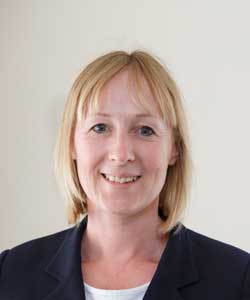 Vicky Stanley is an experienced Fixed Assets Accountant with over 20 years of experience in helping companies to manage their fixed assets more effectively.
To speak to one of our consultants please contact us here.
Fixed assets are long-term assets that a company has purchased and is using for the production of its goods and services. They are sometimes referred to as non-current assets, as opposed to current assets, which include things like stock. Assets can also be classed as physical or intangible and operating or non-operating. Correctly identifying and classifying asset types is essential to fixed asset accounting and more broadly to comply with all major accounting standards.
The International Financial Reporting Standards (IFRS) defines a fixed asset as: “a resource controlled by the enterprise as a result of past events and from which future economic benefits are expected to flow to the enterprise.”
The balance sheet of any organisation must show a correct accounting differentiation between:
Although the income statement may be the primary indicator of performance over a single period for management, the balance sheet may be a better indicator of the overall health of the business. The accounting treatment of assets on the balance sheet is a key indicator of liquidity and in turn solvency. Correct bookkeeping requires a company to track the different types of assets, their fair market values, asset turnover and useful life over the whole asset lifecycle. For tangible fixed assets, this data is needed to calculate depreciation. For intangible assets, it is required for amortization. Ghost assets can be defined as any asset that is lost, stolen, or unusable, affecting the accuracy of these calculations.
This is true of most modern companies regardless of whether they are capital-intensive or not.
The classification of an asset will depend on one of three main criteria:
Depending on the answer to the questions above, you can classify the assets as shown below.
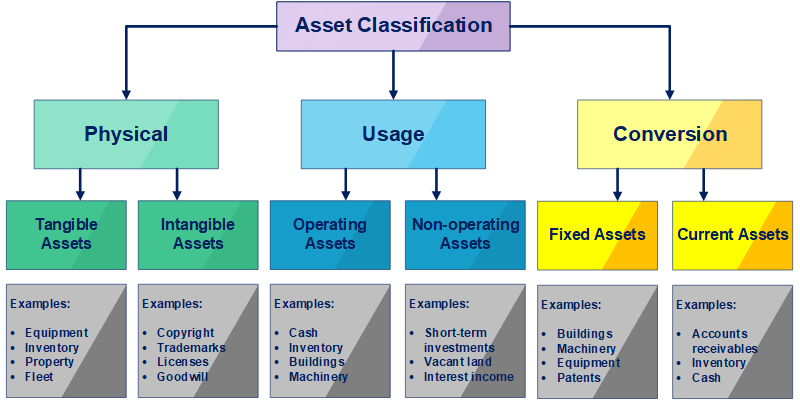
The first distinction is between tangible assets and intangible assets. Tangible assets are physical and may be current or fixed assets. They could include cash, inventory, fleet, machinery and buildings. Intangible assets are non-physical assets and include things like accounts receivable, goodwill, patents or trademarks.
The usage of assets will determine whether an asset is classed as an operating asset or a non-operating asset. Operating assets are used on a day-to-day basis in the normal operation of the company. Examples would include cash, non-cash equivalents, buildings and stock or inventory. Non-operating assets are not essential to the ongoing business operations and could include vacant property or interest income. Non-operating assets may generate income or provide a return on investment (ROI).
The final criterion is the ease with which an asset can be converted to cash. Fixed assets are harder to convert into cash such as property, plant and equipment (PPE). Current assets or liquid assets will be much easier to convert and may include accounts receivable, stock or cash equivalents. The ratio of fixed to current assets will impact business cash flow.
Fixed assets are long term investments and asset turnover will be lower than for current assets. They will accumulate a depreciation expense each financial year and so will have a useful life of longer than 12 months. Companies will also set a capitalisation threshold based on acquisition cost or fair market value, below which they do not class an item as a fixed asset or depreciate the item.
A clear coding structure for different fixed asset types is essential to maintain consistency and accuracy when capitalising non-current assets in any accounting period. The coding structure will often reflect the factors like cost centres, locations or business units. It is important to consider what category and sub-category levels you need when setting the default useful life. Asset lives will vary dramatically between categories, particularly if you own capital assets such as building assets with a long useful life as well as IT equipment, machinery and furniture with a higher asset turnover rate.
Each individual asset should have a unique identifier. For some companies, this may simply be a sequential, system-generated number such as 000001, but for other asset registers, the asset id may have some meaning built into it, such as different numbering sequences for different asset classifications.

A company’s fixed assets are reported in the section described as property, plant and equipment within the non-current (or long-term) asset section of the balance sheet. Current assets are reported separately under the current assets section. Non-current assets will normally contain three separate line items:
All the property, plant, and equipment are classified as fixed assets other than the following except if they are being held for sale, or if they are classified as mineral or biological assets under IFRS 41. Neither is categorised as a fixed asset for balance sheet reporting.
Some organisations will require accounting categories or codes to support work in progress (WIP) or asset under construction (AUC) policies within the fixed assets register. From a fixed asset accounting perspective, we are primarily concerned with capital work in progress (CWIP) rather than stock in progress (SIP). CWIP needs to be shown separately on the balance sheet, as part of fixed assets under right-of-use (ROU) assets.
The way the long-term assets were financed within accounting may also affect their categorisation between purchased, leased, donated or grant-funded assets. New lease accounting standards such as IFRS 16 and ASC 842, have resulted in a significant shift in reporting of leases on balance sheets. The bulk of operating leases are now treated as finance leases, and as such need to be treated as non-current assets. Similarly, software can be classified as a fixed asset, depending on its usage and value to the organization.
For more information on how FMIS can help you effectively track and manage your company’s asset register, please get in touch with an FMIS consultant or call us on +44 (0) 1227 773003.
 https://www.fmis.co.uk/wp-content/uploads/2024/03/SoftwareSuggest-Awards-2024-495x400-1.webp
400
495
John de Robeck
https://www.fmis.co.uk/wp-content/uploads/2026/04/FMISNavyTeal-1-150x80-1.webp
John de Robeck2024-03-26 10:29:322026-03-10 10:57:34SoftwareSuggest Awards – FMIS recognised for easy implementation
https://www.fmis.co.uk/wp-content/uploads/2024/03/SoftwareSuggest-Awards-2024-495x400-1.webp
400
495
John de Robeck
https://www.fmis.co.uk/wp-content/uploads/2026/04/FMISNavyTeal-1-150x80-1.webp
John de Robeck2024-03-26 10:29:322026-03-10 10:57:34SoftwareSuggest Awards – FMIS recognised for easy implementation https://www.fmis.co.uk/wp-content/uploads/2023/10/Asset-Valuation-Methods-495x400-1.jpg
400
495
John de Robeck
https://www.fmis.co.uk/wp-content/uploads/2026/04/FMISNavyTeal-1-150x80-1.webp
John de Robeck2023-10-26 13:16:202026-07-01 10:14:59Asset Valuation Methods
https://www.fmis.co.uk/wp-content/uploads/2023/10/Asset-Valuation-Methods-495x400-1.jpg
400
495
John de Robeck
https://www.fmis.co.uk/wp-content/uploads/2026/04/FMISNavyTeal-1-150x80-1.webp
John de Robeck2023-10-26 13:16:202026-07-01 10:14:59Asset Valuation Methods https://www.fmis.co.uk/wp-content/uploads/2019/06/Feature-image-495x400.jpg
400
495
John de Robeck
https://www.fmis.co.uk/wp-content/uploads/2026/04/FMISNavyTeal-1-150x80-1.webp
John de Robeck2019-12-18 11:23:412026-03-10 11:09:42FMIS announces new NHS partnership
https://www.fmis.co.uk/wp-content/uploads/2019/06/Feature-image-495x400.jpg
400
495
John de Robeck
https://www.fmis.co.uk/wp-content/uploads/2026/04/FMISNavyTeal-1-150x80-1.webp
John de Robeck2019-12-18 11:23:412026-03-10 11:09:42FMIS announces new NHS partnership https://www.fmis.co.uk/wp-content/uploads/2019/11/Govmoney2019-495x400.jpg
400
495
John de Robeck
https://www.fmis.co.uk/wp-content/uploads/2026/04/FMISNavyTeal-1-150x80-1.webp
John de Robeck2019-12-02 17:25:102026-03-10 11:09:51FMIS to sponsor GovMoney 2019
https://www.fmis.co.uk/wp-content/uploads/2019/11/Govmoney2019-495x400.jpg
400
495
John de Robeck
https://www.fmis.co.uk/wp-content/uploads/2026/04/FMISNavyTeal-1-150x80-1.webp
John de Robeck2019-12-02 17:25:102026-03-10 11:09:51FMIS to sponsor GovMoney 2019




 Deltek Vision/Vantagepoint PUG/LFUG Event 2022